
 E-Paper



Terms of Trade | The central political economy contradiction in 2023
Whether 2023 brings more strength to the Congress or the BJP will depend on how the former handles its political challenge and the latter its economic challenge

 Prefer HTon Google


Ironical as it may sound, the government and the Opposition will face a similar kind of challenge, albeit on different fronts, in 2023. In just one line, the challenge is, will doing the essential be enough?
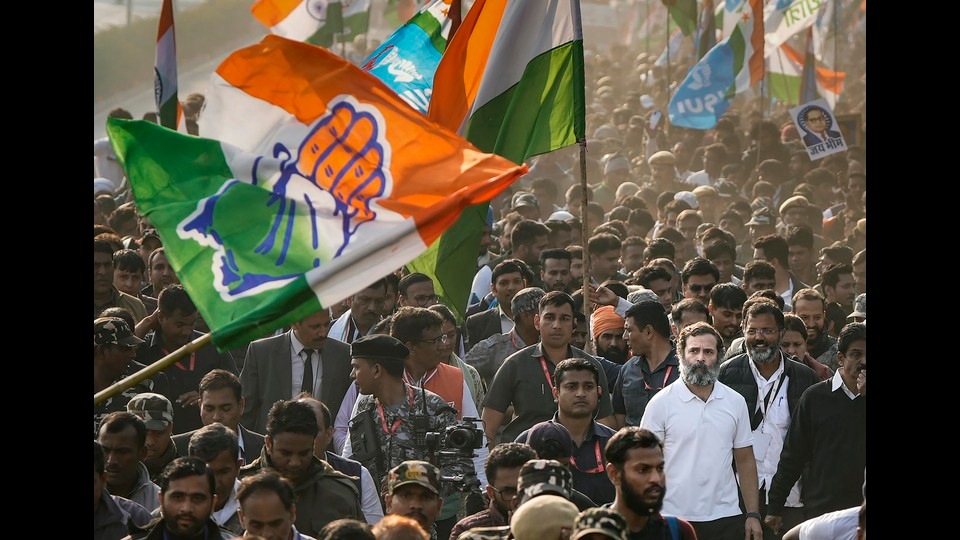
The challenge facing the government and the Opposition
For the government, the key challenge lies in economic growth. There is a widespread consensus that India’s economic growth is losing momentum. Both global headwinds – export demand is slowing down and monetary tightening in advanced economies has added to volatility in the financial markets – and dissipating pent-up demand – it has been a major factor in driving domestic consumption so far – are playing a role. Frontloaded monetary tightening by the Reserve Bank of India (RBI) is expected to add to the problem. To be sure, India will still be the fastest-growing major economy in the world. However, the question is whether a 6.5%-7% growth rate is the new normal for India. If it is, then one has to live with the fact that per capita income will rise at a much slower pace than what is needed to significantly boost living standards for mass of the people. This also means a greater potential for economic discontent.
For the Opposition, it is regarding the fate of what is still India’s largest opposition party, namely the Congress. While the Congress has managed a face-saving win in the Himachal Pradesh elections, 2022 has been a bad electoral year for India’s grand old party. In Punjab, it lost the second state after Delhi to the Aam Admi Party (AAP). Moreover, it failed to wrest Uttarakhand and Goa from the Bharatiya Janata Party (BJP), and in Gujarat, it recorded its worst-ever performance in the elections, which were held earlier this month.
Had the Aam Aadmi Party (AAP) managed to replace the Congress as the main opposition party in Gujarat, the Congress question would actually have become close to redundant in a way, as the AAP would have gained enough political traction to posit itself as a national alternative that could replace the Congress. As of now, the AAP is not in a position to make this claim. While one can have multiple theories about the national political arithmetic, the simplest explanation is as follows: Whether or not the BJP will achieve a parliamentary majority for the third consecutive time in 2024 will be contingent on whether or not the Congress manages to increase its Lok Sabha tally to triple digits. Therein lies the importance of the Congress for the Opposition at large as far as 2024 is concerned.
Both the government and the Opposition seem to be doing the right things
While the first principle criticism of the government’s economic policy not doing enough to give a big push to aggregate demand stands, one has to agree that the government has not been completely wrong-footed in its economic policy approach in the past one year. It has not tried to achieve an abrupt fiscal consolidation. A large amount of the additional duty on petroleum products imposed during the pandemic has been withdrawn. This has been crucial in managing a full-blown inflationary crisis. The government continued with the additional free foodgrain scheme (even if for political reasons) at significant political cost, which provided a crucial cushion to the poor this year (it has been discontinued from 2023 onwards). It has also retained a focus on a capex-driven public investment approach even as it tries to woo private investment through schemes such as Production Linked Incentive (PLI) scheme. Within the larger ideological framework of the government, these policies are aimed at boosting long-term growth while protecting macroeconomic stability and providing the bare minimum relief to the poor.
The Congress (or Rahul Gandhi) too, through the Bharat Jodo Yatra, seems to be making an earnest effort to rejuvenate the party organisation and take its ideological Opposition to the masses. If there is one thing that the Yatra has changed about Rahul Gandhi’s perception as a politician, it is that he is willing to walk his secularism talk against the BJP. This is a change from his self-righteous approach after the 2019 elections when he claimed that the Congress’s loss resulted from his party not cooperating with him. During the Gujarat campaign, this push even received cautious praise from home minister Amit Shah. “I have always been of the view that politicians need to be hard working and it is good when someone works hard. But in politics only sustained efforts show results. So let’s wait and see,” Shah told PTI in an interview.
Whether or not these strategies will yield results is still unknown
This is the operative part. The Narendra Modi government has prepared an economic road map until 2047, and has been selling the 25 years from India’s 75th to 100th year of independence as the Amrit Kal of the country. However, the political dividends of such rhetoric will not materialise if the economy enters yet another slowdown or a period of sub-par growth (which is what even a 6% growth phase is for the Indian economy). Most of the government’s economic bets; such as infrastructure boost and Free Trade Agreements (FTAs), are focused on unleashing the economy’s long-term growth potential. However, the fact remains that domestic consumption is still the largest driver of Indian economy. This engine cannot fire on all cylinders if the current K-shaped economic recovery is not reversed. On this count, the government does not seem to have a clear strategy so far, and to be fair to it, fiscal and external constraints do not offer any easy solutions, unless of course, the government is willing to increase the tax burden on big business to give a large boost to mass incomes in the economy. This will undermine, if not jeopardise, the Bharatiya Janata Party’s big-business driven political finance model.
Similarly, a more perseverant Rahul Gandhi and a well-attended Bharat Jodo Yatra are no guarantees that the Congress will be able to achieve a political revival at the national level. The experience of five years ago shows that even an excellent electoral showing in the state elections in 2023 cannot be taken as a definite sign of the Congress significantly increasing its seat tally in the 2024 Lok Sabha elections. The Congress formed governments in all four significant states (Karnataka, Rajasthan, Madhya Pradesh and Chhattisgarh), which went to polls in 2018. However, it could win only four out of the 93 Lok Sabha seats in these states in the 2019 general elections. The task, as far as the Congress is concerned, is simple. It needs to reinvent its politics not just to energise the camp of the already converted – they are still a large group in absolute terms – but to win back supporters of the BJP. An initiative like the Bharat Jodo Yatra is more likely to achieve the former objective than the latter. The Congress also needs a shrewd political strategist and an ideological pole (which Rahul Gandhi has established himself as) to break ground on the latter front.
Electoral politics, at the end of it, is a zero sum game
The nature of electoral politics means that there can only be one winner in the ultimate analysis. Whether 2023, and the period beyond it, brings more strength to the Congress or the BJP will depend on how the former handles its political challenge and the latter its economic challenge. The better one is at dealing with its difficulties, the harder it will become for the other to achieve its objective. This ongoing dialectic will be the defining “terms of trade” between now and the 2024 general elections.
Every Friday, HT’s data and political economy editor, Roshan Kishore, combines his commitment to data and passion for qualitative analysis in a column for HT Premium, Terms of Trade. With a focus on one big number and one big issue, he will go behind the headlines to ask a question and address political economy issues and social puzzles facing contemporary India.
The views expressed are personal


