E-Paper



The West cannot go on criticising BRICS
Whether BRICS can become a “threat” to the order defined by the West is a question that the Global South should refuse to engage with.

 Prefer HTon Google


BRICS has come of age, Prime Minister Narendra Modi said in his address at the 18th summit of the grouping, hosted in New Delhi over the weekend. It is indeed time for the 20-year-old multilateral platform to be evaluated in terms of how its aspirations have translated into outcomes, and, at a larger level, what the grouping represents and what it has achieved as a cohort.
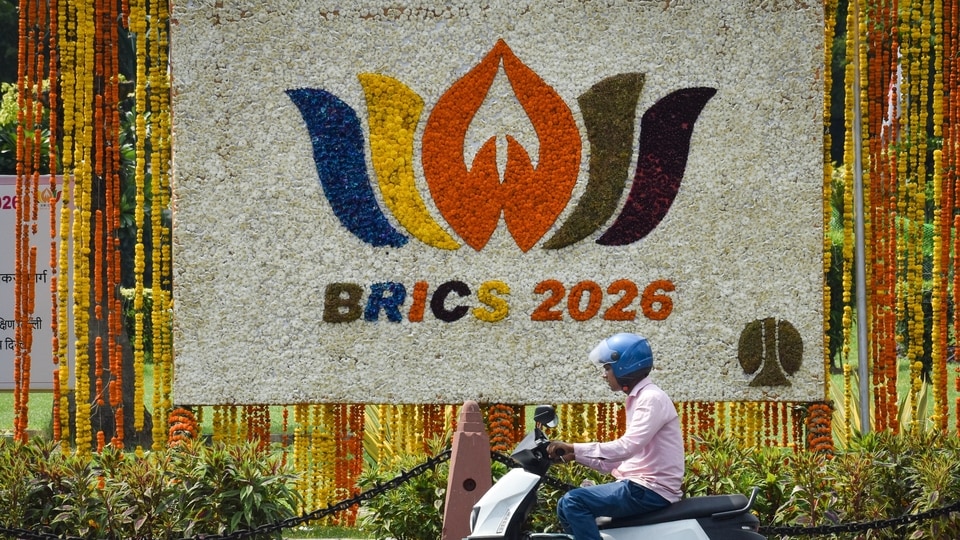
With a grouping as fractured as BRICS, it is naïve to expect a comprehensive consensus on all things, either in letter or in spirit. Then, why have a grouping at all, or bother with summits, goes the argument. The short answer is: In an era of forever wars and interconnectedness of global supply chains, any consensus is better than no consensus, and any summit or meeting is better than no dialogue. The detailed answer must first examine what the present holds for the Global South, represented by BRICS member countries.
Global South long been in back row of decision-making
As Modi observed in his address, the Global South has long been in the back row of decision-making while occupying the front row of consequences. Whether BRICS can change that isn’t as important as the question about the West’s ability to continue to hold the aegis of the global rules-based order. With the ever-growing inconsistency of the US foreign policy, exacerbated by the second Trump presidency’s interventions in Latin America and West Asia, there is a palpable sense of impending doom among the votaries of the 1945 consensus. A diminished United Nations stands as an exhibit of toothless institutional internationalism. What avenue does the Global South, after all, have for its concerns to not only be heard but also mitigated?
It is easy for the West to now undermine globalisation and pivot to more inward-focused domestic and foreign policies, and, consequently, diss multilateralism, once all the gains have been reaped. There is something deeply hypocritical about anti-immigrant rhetoric and policies, speeches on carbon emissions, and even economic sanctions from the West, while the Global South continues to reel under the impact of the former’s actions from just a few decades ago. Nepal continues to get billed, as seen in the recent flash floods, for the global environmental changes. India has controlled its carbon emissions despite growing needs, and its solar generation capacity, at 180 terawatt-hours (TWh), is already more than half of that of the US. China’s solar power generation is at nearly 1,175 TWh, double the generation in all the G7 countries taken together. The West, in short, must see the limits of its pontifications on peace, sustainability, and development.
Bigger, more ambitious agendas for Global South
BRICS, on the other hand, ought to persist in setting bigger and more ambitious agendas for the Global South. The main summit and the parallel sessions have been allowing space to the member-nations to align their common goals. Beyond the big ticket bilateral meets, it is these negotiations between the public and the private players that confer substance to a grouping such as BRICS. During the 2026 summit, for example, Russia’s State-run nuclear energy corporation Rosatom offered Indian firms cutting edge nuclear solutions, bolstering the Russia-India nuclear energy agreement dating back to 1988. This is how cooperation manifests itself materially in summits. While the 1988 agreement resulted in the Kudankulam project, a continued partnership allows it to be sustained meaningfully for both countries.
Conflicts within BRICS member countries
It now has become fashionable to dismiss BRICS owing to the C-word (conflict). It is true that some member-nations such as India-China and Iran-UAE have engaged in military conflict along international borders. Is conflict resolution served better by a common table where disagreements have at least a chance to be discussed, or by condemning the very table as not being architecturally perfect? Today, NATO has wider internal fault lines than ever, and the dismissiveness of the US, the chief contributor, has reversed the disarmament trend in Europe. The NATO example has two important lessons for BRICS. First, any one member’s untrammelled dominance is bound to result in regional complications in the long run. Second, the confidence with which even a fractured NATO operates is something BRICS ought to emulate. In the last decade, BRICS was seen as a security challenge to the EU on account of its improving coherence and institutionalisation. The setting up of the New Development Bank and the Contingent Reserve Arrangement in 2015 showed how military blocs are not the only way to exert geopolitical influence. The BRICS membership should encourage countries to strive towards achieving common goals and overcome differences. The series of high-level meetings between India and China to resolve their boundary differences in the run-up to this year’s summit are clearly not coincidental.
Internal differences may or may not get resolved, but the jointness of BRICS certainly allows member-States to flag issues that can be collectively worked upon. For example, Modi proposed the need for seafarers’ emergency support network as one of the key elements in the BRICS road map in the presence of a powerful group of maritime actors sitting astride crucial global trade chokepoints. As observed during the ongoing West Asia conflict, Indian seafarers are disproportionately impacted, primarily owing to their great numbers, and mechanisms ought to be in place to maximise their safety.
It is essential to analyse BRICS pragmatically, but a West-influenced lens cannot do that job either effectively or honestly. As long as the Global South continues to define “order” and “rules” using a Western vocabulary, no grouping is likely to be deemed satisfactory even within the region.
At the same time, whether a more consolidated and cohesive BRICS can become an effective “threat” or “alternative” to the order defined by the West is a question that the Global South should refuse to engage with on the grounds of the continuing condescension of the West.
The views expressed are personal