
 E-Paper



Bajrang Punia - Looking ahead with new technique, new resolve
Bajrang believes he is ready with a plan to make that happen; the Asian Championship will be a testing ground for the new moves he has picked up, and the weaknesses he has tried to iron out since his breakthrough run last year.


Sitting on a charpai in the courtyard of his house in Sonipat, Balwan Punia is busy watching wrestling videos on his smart phone.
“This is a good thing to have,” he says. “I can now keep a track of my son’s performance, watch how he is preparing for the Olympics.”
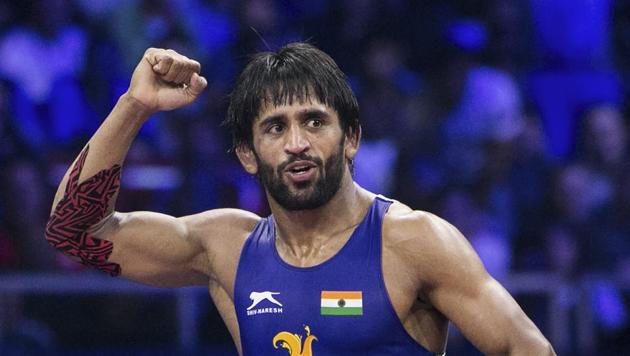
Balwan is talking about Bajrang Punia, the world’s no.1 wrestler in the 65kg category, the 2018 Commonwealth and Asian Games champion, and world championship silver medallist. On Tuesday, Bajrang will kick off 2019 with his first major tournament of the year at the Asian Wrestling Championships in China.
As Balwan opens a video of one of his son’s fights in Germany reccently, Bajrang walks out to the courtyard in a t-shirt and tracks, and says, “I got him that phone six months ago, he had an old-fashioned phone before that.”
Balwan points to his son and says, “He is world No.1 now, I hope he stays that way at the 2020 Olympics.”
Bajrang believes he is ready with a plan to make that happen; the Asian Championship will be a testing ground for the new moves he has picked up, and the weaknesses he has tried to iron out since his breakthrough run last year.
“There, I will know what more I need to do for the World Championship in September, which will be a first qualifying event for the Olympics,” Bajrang says.
One of the things he is keen to test out is his improved leg defence. At the 2018 Asian Championships, Bajrang had lost to Japan’s Takatani Daichi to settle for a bronze. Though he avenged that defeat by beating the same opponent for his Asian Games gold later that year, another Japanese—19-year-old Takuto Otoguro—beat him in the final of the 2018 World Championship.
The Japanese have studied him, and shoot consistently for his legs.
“My attack was good but defence let me down,” Bajrang says, “so I’ve been working on a lot of drills to get down quicker on the mat when someone comes for the legs.”
Under his Georgian coach Shako Bentinidis, Bajrang has made some big changes to his training program. Weight training and machine-aided workouts are out, bodyweight drills for power and speed are in.
“Everything we do, we do on the mat,” Bajrang says.
Maintaining his body weight, is another area he has been focusing on since last year. A constant body weight, ranging from 68kg to 65kg, keeps him injury free.
On the tactical front, Bajrang says he has been working on adding variety to his mat game.
“I want to surprise my opponents, catch them off-guard,” says the 25-year-old. “Use different patterns of attack and defence. I had a chance to use them in some international competitions in February and March and it was successful.”
Some things don’t change—like his fondness for home made food, milk that’s heated in earthen pots, and food that’s cooked over an earthen oven. He believes it’s more nutritious, and helps him recover faster.
Post the Asian Championships, Bajrang plans to train and compete in a variety of different countries—Russia, USA, Turkey—“to help me adapt to different styles of play, and be ready for the world championship…the earlier I get the Olympic quota, the better.”
The Arjuna Awardee was recently ranked world number one but that does not excite him much.
“That’s for academic interest, it doesn’t carry much weight,” he says. “What is important for me is to deliver the goods at the right time.”
He better. His father says he has finalised his plans to visit Japan next year to see his son in action.


