
 E-Paper



Photos: German lab creates see-through human organs
A German laboratory at the Ludwig Maximilians University in Munich led by Dr. Ali Ertuerk has developed DISCO transparency technology which is used by scientists from diverse biomedical research fields to generate high resolution views of intact rodent organs and bodies, a milestone on the way to generate 3D-bioprinted human organs. Until now 3D-printed organs lacked detailed cellular structures because they were based on images from computer tomography or MRI machines.
Updated on: Apr 26, 2019 11:14 AM IST


Share via


Copy link

1/8

 View Photos in a new improved layout
Updated on Apr 26, 2019 11:14 AM
Dr. Ali Ertuerk, Group Leader at the Institute for Stroke and Dementia Research (ISD) at the Ludwig Maximillian’s University, looks at a transparent human brain at his laboratory in Munich, Germany. (Michael Dalder / REUTERS)
2/8
 View Photos in a new improved layout
Updated on Apr 26, 2019 11:14 AM
Dr. Ertuerk examines a transparent mouse. Scientists led by Ali Erturk at Ludwig Maximilians University in Munich have developed a technique that uses a solvent to make organs such as the brain and kidneys transparent. (Michael Dalder / REUTERS)
3/8
 View Photos in a new improved layout
Updated on Apr 26, 2019 11:14 AM
An employee checks the 3D printing of a scaffold for a kidney at Dr. Ali Ertuerk’s laboratory. Once turned transparent, the organ is then scanned by lasers in a microscope that allows researchers to capture the entire structure, including the blood vessels and every single cell in its specific location. (Michael Dalder / REUTERS)
4/8
 View Photos in a new improved layout
Updated on Apr 26, 2019 11:14 AM
Dr. Ali Ertuerk, checks the 3D printing of a scaffold for a kidney. Using this blueprint, researchers print out the scaffold of the organ. They then load the 3D printer with stem cells which act as “ink” and are injected into the correct position making the organ functional. (Michael Dalder / REUTERS)
5/8
 View Photos in a new improved layout
Updated on Apr 26, 2019 11:14 AM
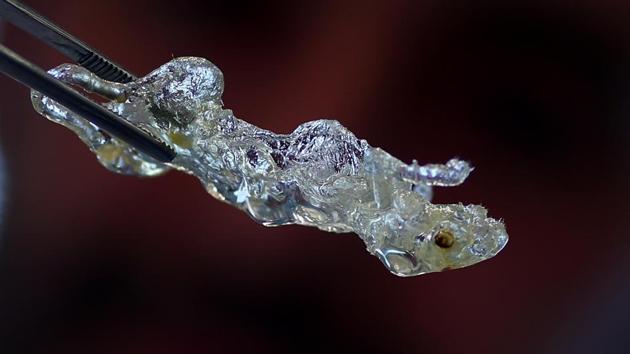
“We can see where every single cell is located in transparent human organs. And then we can actually replicate exactly the same, using 3D bioprinting technology to make a real functional organ,” Ertuerk said. “Therefore, I believe we are much closer to a real human organ for the first time now.” (Michael Dalder / REUTERS)
6/8
 View Photos in a new improved layout
Updated on Apr 26, 2019 11:14 AM
An employee works with stem cells at Dr. Ali Ertuerk's laboratory. While 3D printing is already used widely to produce spare parts for industry, Erturk said the development marks a step forward for 3D printing in the medical field. (Michael Dalder / REUTERS)
7/8
 View Photos in a new improved layout
Updated on Apr 26, 2019 11:14 AM
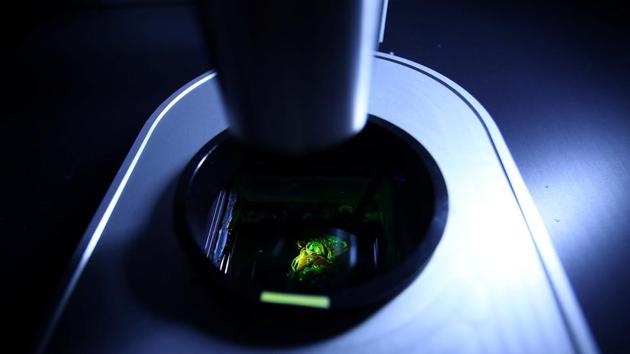
Dr. Ali Ertuerk works at a laser microscope. Until now 3D-printed organs lacked detailed cellular structures because they were based on images from computer tomography or MRI machines, he said. (Michael Dalder / REUTERS)
8/8
 View Photos in a new improved layout
Updated on Apr 26, 2019 11:14 AM


