

 E-Paper


Electing the pope
1 / 13

 View Photos in a new improved layout
Updated on Mar 12, 2013 09:49 pm IST
This handout picture released by the Press office shows the Room of Tears, a small room next to the Sistine Chapel (back-R), with the vestments of the next Pope displayed in three different sizes, before the start of the conclave at the Vatican. Each cardinal places his hand on a book of the Gospels and pledges "with the greatest fidelity" never to reveal the details of the conclave. The master of liturgical celebrations then cries "Extra omnes," Latin for "all out." Everyone except the cardinals leaves and the voting can begin. AFP PHOTO/Osservatore Romano
2 / 13
 View Photos in a new improved layout
Updated on Mar 12, 2013 09:49 pm IST
This handout picture released by Osservatore Romano shows the Sistine Chapel before the arrival of cardinals and the start of the conclave at the Vatican. The conclave's first day begins with the mass for the election of a pope. In the afternoon, 115 cardinal electors gather in the Pauline Chapel of the Apostolic Palace and file into the Sistine Chapel chanting the Litany of Saints and the Latin hymn "Veni Creator," imploring saints and the Holy Spirit to help them pick a pope. AFP/Osservatore Romano
3 / 13
 View Photos in a new improved layout
Updated on Mar 12, 2013 09:49 pm IST
This handout picture released by the press office shows the urns where votes will be placed by Roman Catholic cardinals in the Sistine Chapel at the Vatican before the conclave. Each cardinal writes his choice on a paper inscribed with the words "Eligo in summen pontificem," or "I elect as Supreme Pontiff." They approach the altar one by one and say: "I call as my witness, Christ the Lord who will be my judge, that my vote is given to the one who, before God, I think should be elected." AFP/Osservatore Romano
4 / 13
 View Photos in a new improved layout
Updated on Mar 12, 2013 09:49 pm IST
From left, US Cardinals Justin Francis Rigali, Donald Wuerl, Timothy Dolan, Francis George and Roger Mahony leave the North American College to go to the Vatican's Domus Sanctae Martae, the Vatican hotel where the cardinals stay during the conclave, in Rome. The folded ballot is placed on a round plate and slid into an oval silver and gold urn. AP/Alessandra Tarantino
5 / 13
 View Photos in a new improved layout
Updated on Mar 12, 2013 09:49 pm IST
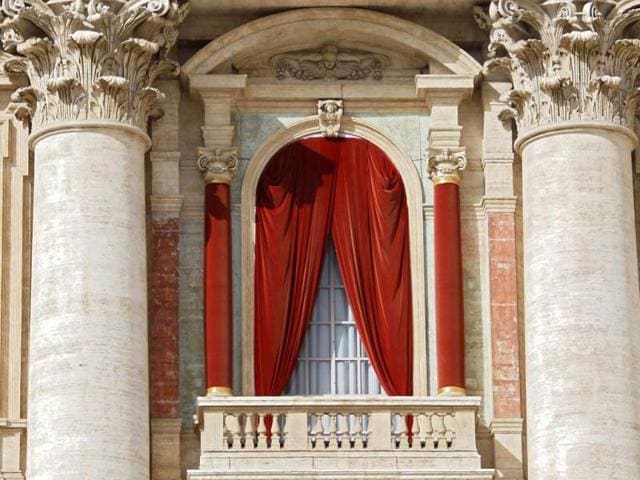
The red curtain on the central balcony, called the Loggia of the Blessings of Saint Peter's Basilica, where the new pope will appear after being elected in the conclave is seen at the Vatican. Once cast, the ballots are opened one by one by three different "scrutineers," who note the names down and read them aloud. Cardinals can keep their own tally on a sheet of paper provided but must turn their notes in to be burned at the end of voting. Reuters/Eric Gaillard
6 / 13
 View Photos in a new improved layout
Updated on Mar 12, 2013 09:49 pm IST
Cardinals attend a mass at the St Peter's Basilica before the start of the conclave at the Vatican. The scrutineers then add up the results of each round of balloting and write the results down on a separate sheet of paper which is preserved in the papal archives. AFP/Gabriel Bouys
7 / 13
 View Photos in a new improved layout
Updated on Mar 12, 2013 09:49 pm IST
Visitors watch a mass at St Peter's Basilica shown on a video monitor in Vatican Square attended by cardinals. As the scrutineer reads out each name, he pierces each ballot with a needle through the word "Eligo" and binds the ballots with thread and ties a knot. The ballots are then put aside and burned in the chapel stove along with a chemical to produce either black or white smoke. AP/Michael Sohn
8 / 13
 View Photos in a new improved layout
Updated on Mar 12, 2013 09:49 pm IST
Italian cardinal Angelo Scola walks in procession for a grand mass in St Peter's Basilica ahead of a papal election conclave in St Peter's basilica at the Vatican. Up to four rounds of voting are allowed each day after the first day, and a two-thirds majority - 77 votes - is needed. If no one is elected after three days - by Friday afternoon - voting pauses for up to one day. AFP/Gabriel Bouys
9 / 13
 View Photos in a new improved layout
Updated on Mar 12, 2013 09:49 pm IST
US cardinal James Michael Harvey attends a mass at the St Peter's basilica before the conclave at the Vatican. Voting resumes and if no pope is elected after another seven ballots, there is another pause, and so on until about 12 days of balloting have passed. AFP/Gabriel Bouys
10 / 13
 View Photos in a new improved layout
Updated on Mar 12, 2013 09:49 pm IST
Cardinal Peter Turkson of Ghana attends a mass in St Peter's Basilica at the Vatican. Under norms introduced by Benedict XVI just before he resigned, the cardinals then go to a runoff of the top two vote-getters. A two-thirds majority is required; neither of the two top candidates casts a ballot in the runoff. Reuters/Stefano Rellandini
11 / 13
 View Photos in a new improved layout
Updated on Mar 12, 2013 09:49 pm IST
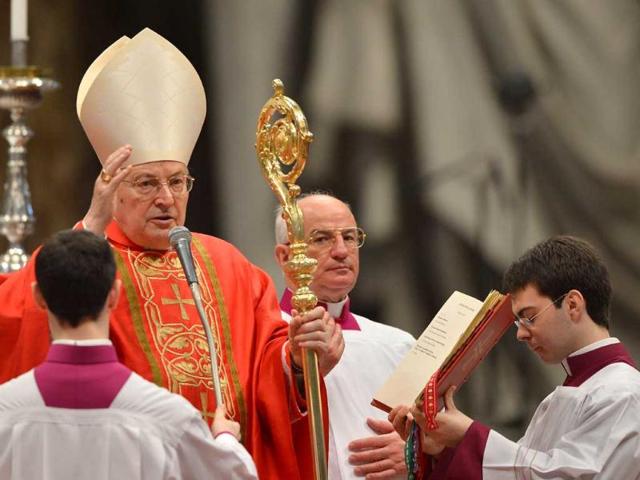
Dean of the College of Cardinals Angelo Sodano leads a mass at the St Peter's basilica at the Vatican. Once a cardinal has been elected pope, the master of liturgical ceremonies enters the Sistine Chapel and the senior cardinal asks "Do you accept your canonical election as Supreme Pontiff?" Assuming the cardinal says "I accept," the senior cardinal then asks: "By what name do you wish to be called?" The master of liturgical ceremonies, Monsignor Guido Marini, then enters the information on a formal document. AFP/Gabriel Bouys
12 / 13
 View Photos in a new improved layout
Updated on Mar 12, 2013 09:49 pm IST
Journalists wait under rain on St Peter's square on ne first day of the conclave at the Vatican. At this point, white smoke pours out of the Sistine Chapel chimney and bells of St Peters toll. The new pope then changes into his papal white cassock, and one-by-one the cardinals approach him to swear their obedience. AFP/Vincenzo Pinto
13 / 13
 View Photos in a new improved layout
Updated on Mar 12, 2013 09:49 pm IST