E-Paper



6-year-old discovers rare 200-million-year-old fossil of a jellyfish-like marine animal in Nebraska, US
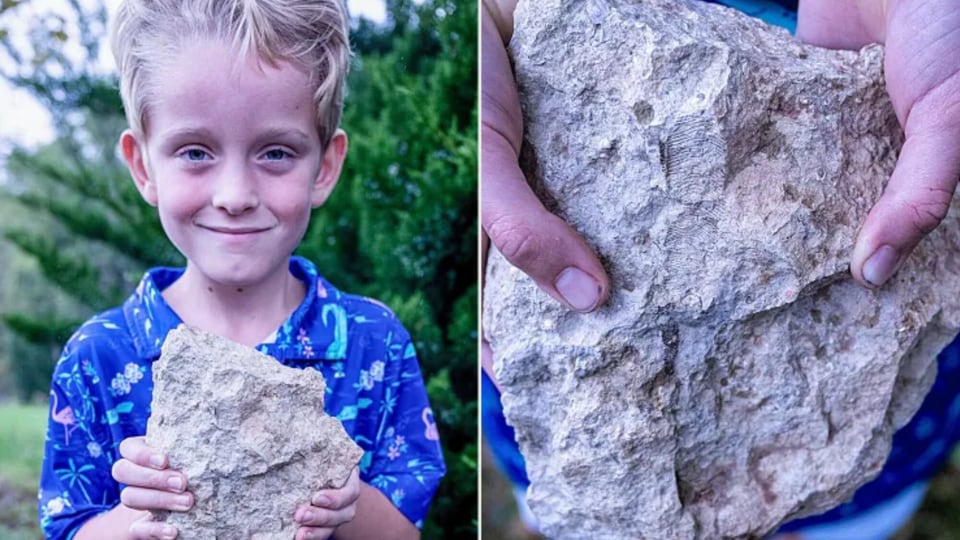
A pattern resembling snake scales caught six-year-old Leo Youngdahl’s eye during a fossil hunt in Nebraska.

 Prefer HTon Google


A six-year-old boy searching for fossils at a Nebraska park stumbled upon something far rarer than he had expected. Leo Youngdahl noticed an unusual imprint on a rock, prompting experts to take a closer look. The discovery has drawn attention because a similar fossil had not been recorded in the US state for more than 55 years.
How a 6-year-old found the rare fossil
Leo, who lives in Eagle, Nebraska, was attending a late-summer Rafting and Rocks event at Schramm Park State Recreation Area near Gretna when he came across a large rock. According to Outdoor Nebraska, a publication of the Nebraska Game and Parks Commission, he turned it over in the hope of finding his favourite fossils of crinoids, marine animals that often resemble plants.
Instead, he noticed an unusual pattern on the underside of the rock that reminded him of the scales on a garter snake's belly.
(Also Read: What changes when a place becomes a UNESCO World Heritage Site?)
Leo showed the rock to Kelly Ekue, an outdoor education specialist at the nearby Schramm Education Center. Having led educational programmes at the site for more than seven years, Ekue was familiar with the fossils commonly found there. However, this specimen looked different.
“I’ve been leading programs at the outcrop for over seven years, and there are six main types of fossils we find,” Ekue told Outdoor Nebraska. “This fossil didn’t look anything like any of the species we see.”
What experts discovered about the fossil
Unsure about the find, Ekue sent a photograph to a geologist, who shared it with other specialists, including paleontologist Shane Tucker of the University of Nebraska State Museum and geologist Bob Diffendal.
The experts identified the 2.75-inch specimen as a conulariid, an ancient marine animal with a jellyfish-like body shaped like an upside-down pyramid.
Conulariids lived between approximately 200 million and 500 million years ago. Their fossils are uncommon because their soft bodies and thin skeletons often broke apart before they could be preserved. Leo's specimen was identified through its distinctive herringbone-shaped pattern, which had left an imprint in the limestone.
According to Outdoor Nebraska, the only other known conulariid fossils discovered in Nebraska were found in Louisville and Weeping Water more than 55 years ago.
Ekue said it was remarkable that Leo had picked up the rock, recognised the imprint as a fossil and asked for help identifying it.
Why the discovery matters
For Leo, the find was especially exciting because he had never discovered a complete fossil before. He was also told that his discovery was “rarer to find than a mammoth bone”.
Although he will not be taking the fossil home, it will remain at Schramm Park, where staff plan to use it in educational programmes.
(Also Read: Aman Gupta-backed Cinnamon Kitchen admits to mislabelling fat and sugar content on ₹199 cookie packs)
Leo is already looking forward to his next discovery. Ekue hopes his discovery will inspire others to explore nature and notice interesting things around them, whether it is a rare fossil, an unusual insect or a strange pattern on a rock.