
 E-Paper





Bhavya Sukheja is a Senior Content Producer at Hindustan Times with over 6 years of experience in digital journalism. She specialises in covering stories that reflect everyday human experiences, with a focus on viral videos, social media trends, and human-interest features that inform readers while sparking meaningful conversations. She loves chasing page views and finding stories that tug at readers’ heartstrings. Before joining Hindustan Times, Bhavya worked with Republic World and NDTV, where she developed her skills in real-time reporting and digital storytelling. Working in fast-paced newsrooms helped her build an editorial approach that prioritises accuracy, clarity, and audience engagement. Bhavya is driven by a curiosity about how people communicate and connect in the digital age. She is particularly interested in stories that highlight cultural shifts, shared emotions, and the evolving nature of online conversations. When she is not tracking trends, Bhavya enjoys unplugging and spending time with her cat.
Eagles hunt baboons weighing up to 26 kg in the Sahara, raising questions about whether they preyed on ancient humans
The findings have raised questions about whether eagles could also have hunted some of the smaller-bodied human ancestors millions of years ago.


Eagles may be capable of hunting and killing prey weighing as much as 26 kg, including large baboons, a new study has found. The findings have raised questions about whether the birds could also have hunted some of the smaller-bodied human ancestors millions of years ago.
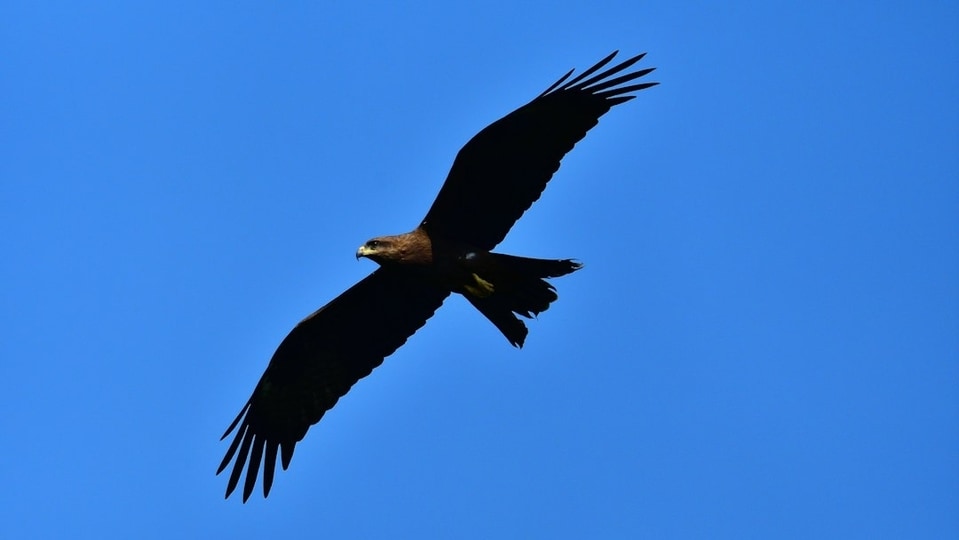
According to a report by LiveScience, scientists made the discovery while studying animal remains in the Sahara Desert in Chad, where they found the remains of at least 9 adult baboons believed to have been killed recently by Verreaux’s eagles. The baboons had an estimated average weight of 22.2 kg, while the largest weighed around 26 kg.
Until now, researchers believed that eagles could not lift nonhuman primates weighing more than 13 kg. However, the newly discovered remains suggest that these birds may be capable of targeting considerably larger prey.
The researchers found deep talon marks on the baboons’ bones, suggesting that eagles had hunted the primates and carried parts of their bodies back to their nests. The findings were published on November 18 in the American Journal of Biological Anthropology.
The study noted that 8 of the 9 baboons were male, a pattern the researchers described as “puzzling”. They suggested that the remains were more consistent with hunting than scavenging, as scavenged carcasses would not necessarily show such a bias towards one sex.
The discovery has also raised questions about the vulnerability of early human ancestors, some of whom were similar in size to the baboons.
The largest baboon in the study weighed approximately 26 kg, close to the estimated weight of Lucy, a famous Australopithecus afarensis fossil discovered in what is now Ethiopia. Lucy, who lived around 3.2 million years ago, is estimated to have weighed about 28 kg, as per LiveScience.
(Also Read: Mild electric shocks to the brain may temporarily remove bias linked to objectification of women, study finds)
What did researchers say?
Catherine Hobaiter, a professor at the University of St Andrews in the UK and the study’s first author, told Live Science that several australopithecine species that lived between 1 million and 3 million years ago would have fallen within the same weight range as the adult male baboons in the study.
She pointed to the Taung Child, an infant Australopithecus whose remains provide the only confirmed example of a hominin killed by an eagle. The child, who weighed around 10 kg, is believed to have been taken by a large eagle approximately 2.8 million years ago.
Hobaiter said modern primates vulnerable to eagle attacks often travel in mixed-species groups to improve their protection against predators. Early human ancestors may have adopted similar strategies, potentially travelling alongside other hominin species to reduce the risk of attacks.
Other researchers also noted that early hominins may have relied on group living, warning calls and choosing habitats that offered protection from predators such as eagles, hyenas and crocodiles.
However, not all experts agree that the baboons were necessarily killed by eagles. Jesús Bautista-Rodríguez, coordinator of the Desert Golden Eagles Project, cautioned that some or all of the animals could have been dead, dying or severely weakened before the birds fed on them. He said the punctures and scratches found on the skulls and shoulder blades were consistent with eagle talons and feeding activity, but did not conclusively establish that the birds had killed the baboons.
Robert Simmons, a researcher at the FitzPatrick Institute of African Ornithology at the University of Cape Town, described the findings as fascinating. He said eagles were opportunistic hunters and could target isolated baboons, particularly in desert environments where a lack of vegetation leaves animals exposed.
W Scott McGraw, an anthropology professor at The Ohio State University, also noted that early hominins may have been attractive targets for large birds of prey because of their relatively small body size, particularly infants and juveniles.


