
 E-Paper



China will struggle to make money from humanoid robots
It is ahead of rivals and training up thousands, but profits are a long way off


 Prefer HTon Google


China’s humanoid robots are sprinting ahead of their rivals—quite literally. On August 17th one of their number, called Superman, clocked up a running speed of 12.66 metres per second, beating the previous record set by Usain Bolt, before crashing into a wall. The triumph only added to the buzz over Unitree, Superman’s maker, which debuted its shares in Shanghai two days later. Their price leapt by 460%.
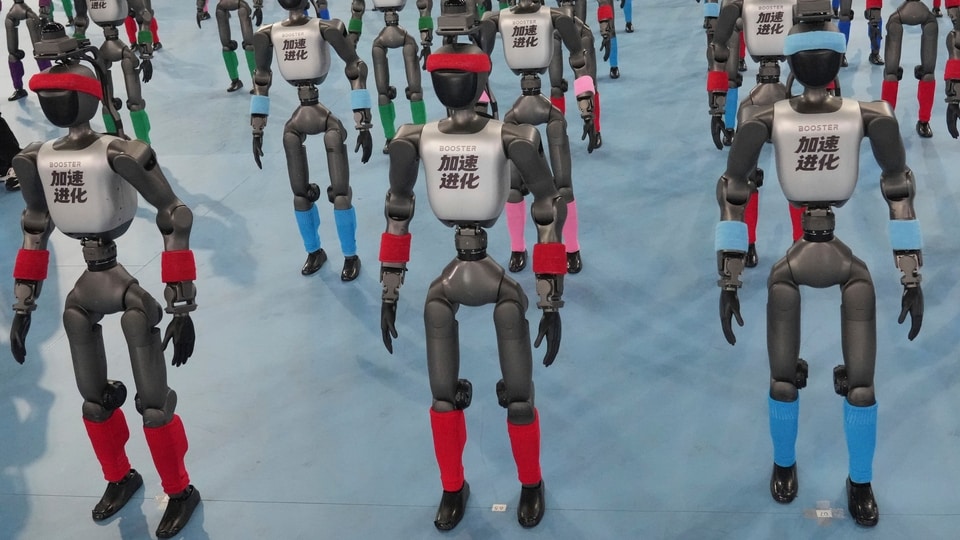
More impressive displays are expected over the coming days as the Humanoid Robot Games take place in Beijing. Yet as the ignominious end of Superman’s running feat demonstrates, the technology still has a long way to go. Chinese companies are expected to sell 50,000 humanoids this year, more than triple last year’s figure. They have largely mastered the hardware behind the machines. The software, however, is another matter.
In order to create the foundation models that will allow robots to seamlessly carry out a multitude of useful tasks, enormous amounts of data must now be collected. The models powering the current generation of humanoids possess a few billion “parameters”; to replicate the functioning of the human body, they will need hundreds of billions.
That would put them at a similar size to the large language models powering chatbots. The difference is that chatbots can be trained on the reams of digital text available on the internet. Gathering the data necessary to teach a robot to identify a glass, pick it up and fill it with coffee is much harder. It must understand everything from its spatial position to the brittleness of the glass and the viscosity of its contents. That information must be mined from experiences in the real world, or detailed recreations of those experiences.
Humanoids are currently fed a hotchpotch of data, often from low-quality simulations. Data collected from the real world are far more useful—and now highly sought after. The best form of these is “real machine” data, which are generated by the actions of a robot, either when it is controlled remotely or when it is carrying out tasks by itself. Another important source comes from recording humans as they complete tasks. Known as “egocentric” data, this information is gathered by equipping a human with a headset and haptic-sensor gloves that record a person’s movements.
China is quickly becoming the frontrunner in the quest for real machine data, thanks to training centres such as the Hubei Humanoid Innovation Centre. At the sprawling facility in the central Chinese city of Wuhan, up to 100 robots spend hours each day observing and mimicking humans. At one of the dozens of work stations in the centre, a young man behind a counter is moving his hand, gloved in digital sensors, in a circular motion as if he were pouring hot water over coffee. Next to him stands a robot that is mimicking his motion but spouting real water from a kettle over a funnel of coffee. The manner in which the bot’s wrist and fingers move are creepily human. A few steps from the makeshift café is what looks like a pharmacy, where another human-robot duo are stocking shelves. Next is a convenience store, then a factory line followed by various other scenes from working life. (Until now foreign journalists have not been allowed to visit these centres.)
The centre in Wuhan is one of 53 facilities in China built especially for gleaning the secrets of human movement, according to data from Interact Analysis, a consulting firm. Most were created in the past two years. Another 34 are under construction or planned. One being constructed in Shanghai will have space for 1,000 humanoids. A small city in coastal Zhejiang province already has six training centres.
Training centres require a large amount of space and many people to run them, as well as a legion of cutting-edge humanoids, which can run to 100,000 ($15,000) yuan apiece. This form of training costs 500-700 yuan per hour, reckons Corey Chan of HSBC, a bank. For every eight hours of coffee-pouring, the droid at the café station produces just three hours of useful data. The rest is spoiled, mostly by errors that engineers do not want the robots to learn. According to one estimate, 100m training hours will be required to develop a robot that can perform a wide variety of daily tasks.
Fortunately for Chinese businesses like Unitree, the government has been picking up much of the tab for the centres. Around four-fifths are state-backed. Many are collaborations between private enterprises and local governments, which buy humanoids and sell the data produced back to the companies. Estimates vary but in the first half of 2026 up to 70% of the humanoids made in China may have gone to these training centres, adding up to around 13,000 machines. By building one, local officials can shore up demand for robots that are being manufactured in their area.
At the same time Chinese robot-makers are finding ways of collecting egocentric data from the country’s large manufacturing workforce—as well as its many unemployed youngsters. A cottage industry has emerged of vendors making wearable gear for that purpose. Some hope young people will wear the kit while at home as a part-time job. JD.com, an e-commerce company, said earlier this year that it has launched a project to pay 100,000 of its staff and 500,000 others to track their own movements. At a facility in Jiangsu, another coastal province, which has reportedly received state funding, the company pays people to slowly carry out tasks in fake grocery stores and other environments. Over the next two years it intends to gather 10m hours of data capturing real-world human scenarios.
Egocentric data generated by humans are far less useful than real machine data, owing to the differences in how human limbs and robotic ones move in the real world. And even the bits that are useful must be labelled, requiring a human to tag each movement manually so that a bot knows to which limb or action it applies. Still, China gained an early edge in image-recognition technology by employing large groups of people to tag pictures. It could do the same again, says an engineer who works for a robotics company.
How to train your droid
China’s humanoid industry is unlike most other manufacturing businesses that have thrived in the country. Over the next few years it is set to produce and sell hundreds of thousands of costly but mostly useless machines in the hope that it can make cheaper and useful ones in the future. American competitors have been relying on less expensive training methods. Tesla, America’s biggest producer of humanoids, is said to be training robots in its own warehouses, which saves constructing standalone training facilities. Various companies have been using videos of human movement to train their humanoids. And since these days America has few factory workers who can be handed gear for egocentric collection, a number of firms are reportedly paying workers in poor countries, where wages are lower than in China, to don headsets and haptic gloves as they work.
Still, as with computer vision, China seems almost certain to maintain the lead in data collection. But at what cost? Given the current state of the technology, and the time that will be required to improve it, a commercial market for humanoids is unlikely to emerge this decade. Morgan Stanley, a bank, reckons that China could be producing about 450,000 of them a year by 2030. Many will remain dim-witted—and continue charging into walls.


