
 E-Paper



Israeli president urges post-election compromise, expresses ‘great respect’ for Arabs
The election campaign saw Netanyahu accuse Arab-majority lists of electoral irregularities.

 Prefer HTon Google


Israeli President Isaac Herzog on Wednesday condemned what he called racist remarks targeting the country's Arab minority amid Prime Minister Benjamin Netanyahu's allegations of fraud against Arab-majority parties, and called on political leaders to reach a compromise to form the next government.
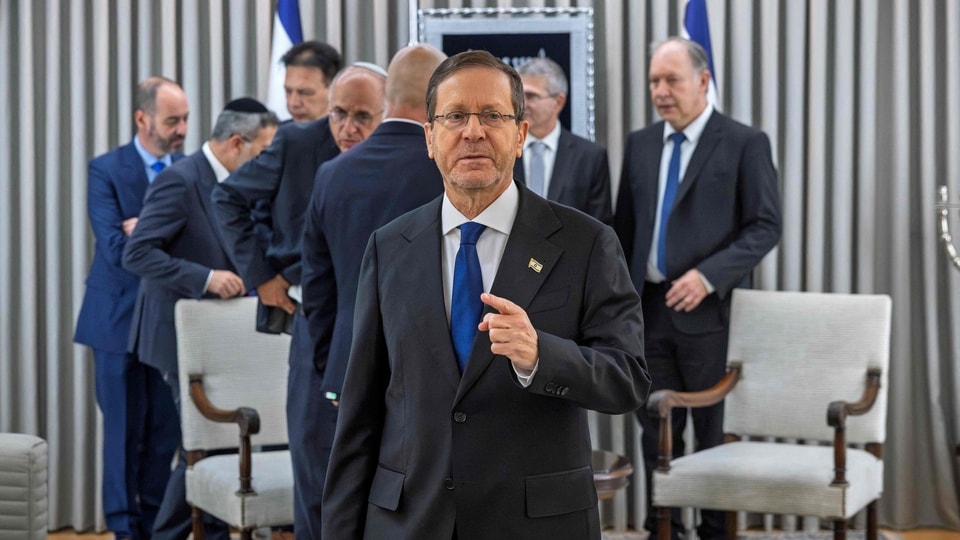
"I hold Arab society in Israel in great respect. I value its contribution to the country in every area of life, and its desire to integrate. This is something to be welcomed. I condemn the coarseness and racist expressions that we have heard recently," Herzog said while receiving the official election results, Reuters reported.
His remarks came amid heightened political tensions following Israel's October 27 election, which left neither of the two main political blocs with a majority in the 120-member parliament.
With no alliance securing the 61 seats needed for a majority, Herzog has assumed a crucial role in government formation. After consulting representatives of parliamentary factions, he must decide which Knesset member is best placed to form a government and secure the legislature's confidence.
The vote, the country's first since the October 7, 2023 Hamas attacks, also saw increased support for Arab-majority political lists.
Also read: Israel opposition backs Gadi Eisenkot for PM, vows to replace Netanyahu's ‘October 7 government’
Herzog calls for compromise
With no clear winner emerging from the election, Herzog urged political leaders to find common ground and avoid another round of voting.
He began consultations with party leaders to decide whether Prime Minister Benjamin Netanyahu or his rival Gadi Eisenkot should get the first opportunity to form a government, AFP reported.
"In the current reality, in which there is no clear winner after the elections, I ask for originality and creativity, courage and goodwill, so that the State of Israel emerges the winner," Herzog said.
He also cautioned that political leaders would have to make compromises, saying "not every commitment and promise can be fulfilled".
Netanyahu targets Arab-majority lists
The election campaign saw Netanyahu accuse Arab-majority lists of electoral irregularities, pointing to the arrests of several people found with envelopes of cash on polling day. Authorities described these as localised incidents. He also accused Arab party leaders of accepting money from Qatar, an allegation that has also been levelled against the prime minister's aides.
However, the Central Elections Committee said an audit of 9,069 polling stations following complaints found no evidence that called the integrity of the results into question.
Justice Noam Sohlberg, who heads the committee, said investigations into allegations would continue but were unlikely to fundamentally change the outcome. He also stressed that the results, once lawfully determined, were binding on all.
Ultranationalist National Security Minister Itamar Ben Gvir said his party did not accept the results and called for the arrest of Arab-Israeli party leaders.
Opposition rejects unity government proposal
Eisenkot, a former military chief seeking to unite centrist and centre-right forces, has accused Netanyahu's Likud party of attempting a "pogrom against democracy".
Netanyahu, who has served as Israel's prime minister for nearly two decades across multiple terms, has called for a broad national unity government under his leadership. He is also facing corruption charges that could lead to imprisonment if he leaves office.
However, Eisenkot and his allies have ruled out joining a unity government.
Herzog is expected to hold two days of initial consultations before giving a contender 28 days to form a government, with a possible 14-day extension.
(With inputs from AFP and Reuters)


