E-Paper



Threats won’t stop future defence deals with India: Russia on US sanctions
India could get deal on frigates and Kalashnikov assault rifles, says ambassador Nikolay Kudashev.


Russia won’t be pressured by the threat of US sanctions while finalising big-ticket military hardware deals with India, including contracts for four frigates and production of Kalashnikov assault rifles, said Russian ambassador Nikolay Kudashev on Thursday.
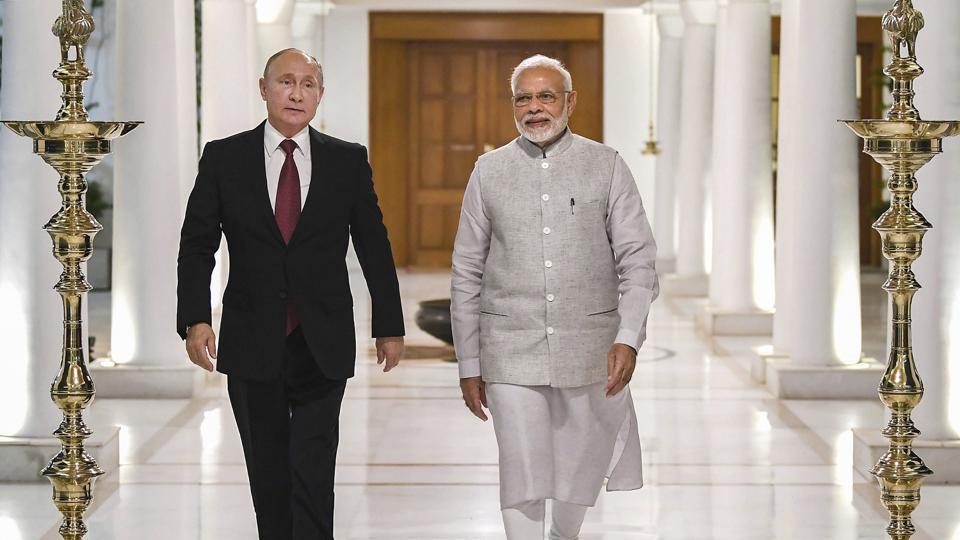
A day after President Donald Trump remarked New Delhi will find out “sooner than you think” about Washington’s response to the $5.4 billion deal for Russian S-400 air defence systems that comes under the purview of Countering America’s Adversaries Through Sanctions Act (CAATSA), Kudashev said India is “too big and too large to depend on or be afraid of somebody”.
Kudashev described the S-400 deal as the “largest contract” in the history of military-technical cooperation with India, and also “one of the speediest contracts”. Implementation of the deal, signed during President Vladimir Putin’s annual summit with Prime Minister Narendra Modi on October 5, will start in 2020 and be completed in five years, he said.
“In the coming months, you could expect more deals, talks are on, this is a normal process and I hope that within two to three months…we could soon have a deal on frigates and…on the Kalashnikov assault rifles. There could be other deals also,” Kudashev told a group of journalists.
Asked whether it would be right to state that India and Russia wouldn’t be deterred by the threat of sanctions under CAATSA, Kudashev replied: “Yes. It was specifically mentioned by defence minister Nirmala Sitharaman and foreign minister Sushma Swaraj that India will not acknowledge sanctions other than those adopted by the UN Security Council.”
He added, “CAATSA is bad, it is not the way to do things…It is an instrument of political pressure, an instrument of unfair competition.”
India plans to acquire four more Krivak/Talwar-class frigates from Russia and begin licenced production of Kalashnikov assault rifles to fully utilise the capacity of ordinance factories and boost its “Make in India” programme.
Kudashev said Russia is expecting India to decide “as soon as possible” on the site for a new nuclear power project with six reactors, even as work continues on the Koodankulam nuclear project. The construction of the third and fourth reactors at Koodankulam has started and both sides are “ready to start” work on the fifth and sixth reactors, he said.
Referring to the new nuclear power project, he said, “the Indian government feels it needs to have some more consultations with local communities (for selecting a site) and there is no clarity as yet.”
The two sides are also making progress on the Rooppur nuclear power project in Bangladesh and looking at the possibility of taking up similar joint projects in other countries, he said.
Kudashev also said Russia could consider signing pacts similar to the Logistics Exchange Memorandum of Agreement (LEMOA) and Communications Compatibility and Security Agreement (COMCASA) inked by New Delhi and Washington to give legal basis to ongoing military-technical cooperation.
The Russian envoy was critical of the US strategy in Afghanistan, saying it had “failed” as there had been a deterioration of the security situation and a spike in violence. India and Russia, he said, could take up joint projects for capacity building and training in Afghanistan.