
 E-Paper


How American universities get around the DEI backlash
Schools are relabelling offices faster than they are cutting them


 Prefer HTon Google


UNIVERSITY STUDENTS have long delighted in fashionable slang. Now their administrators are joining in. Amid a growing backlash against “woke” programmes for minority students, campus leaders are finding new names for their diversity, equity and inclusion (DEI) offices—ditching words such as “diversity” and “equity” in favour of ones like “well-being” and “community”. In May George Washington University replaced its Office for Diversity, Equity and Community Engagement with an Office of Community, Culture and Inclusion. Earlier in the year the University of Illinois Urbana-Champaign renamed its Office for Diversity, Equity and Inclusion to the Office for Access, Civil Rights and Community.

Behind this linguistic makeover lies a Republican-led crackdown on DEI at public universities. Since 2023 state lawmakers have introduced more than 150 bills targeting campus diversity programmes, according to the Chronicle of Higher Education. President Donald Trump, who has called DEI “radical”, “wasteful” and “un-American”, has added to the pressure by issuing orders dismantling DEI programmes in the federal government and threatening to withdraw funding from universities that embrace them. The campaign has yielded legislative results: 34 bills in 19 states have become law. But an analysis of university staffing data by The Economist suggests that, for all the political noise, the crackdown’s impact so far has been limited.
DEI offices typically help universities comply with civil-rights laws and oversee programmes to recruit and support under-represented students and staff. They may also run training on topics such as unconscious bias and inclusive teaching. Supporters say such offices ensure broad access to higher education and foster more inclusive campuses. Conservatives argue that they have grown into ideological bureaucracies that promote racial preferences and progressive politics.
Universities have generally responded to the legal and political pressure in one of three ways. A handful have resisted outright calls to dismantle their DEI programmes. Harvard is the best-known example: it rejected White House demands to abandon DEI, among other conditions, in return for continued federal funding. Others have publicly reaffirmed their support for DEI. Last year the chancellor of the State University of New York system told legislators that it had “no intention of backing away” from its commitment to diversity and inclusion. The president of the University of Minnesota made a similar pledge.
The second approach is compliance. After Texas passed Senate Bill 17 in 2023, banning DEI offices at public universities in the state, the University of Texas at Austin said it laid off 49 employees (the American Association of University Professors, a trade union, counted 62). Jay Hartzell, then the university’s president, said DEI funding would be “redeployed to support teaching and research”.
Most universities, though, have opted for a third approach: renaming and reorganising their DEI offices, rather than eliminating them. This is not surprising. Dropping politically charged terms from office and job titles allows universities to retain staff and pursue the same goals while appearing compliant and attracting less scrutiny from conservatives. “A number of institutions have changed titles, changed names of departments,” says Jerry Cirino, sponsor of Senate Bill 1, which banned DEI programmes at public colleges and universities in Ohio. Mr Cirino says he’s broadly pleased with compliance, but that “the practice is still going on, they’re just calling it something different.” Even DEI advocates acknowledge this. “Some people have changed the language they use publicly, but the underlying work is very similar,” says Emelyn A. dela Peña, president of the National Association of Diversity Officers in Higher Education, a trade group.
The Economist obtained payroll records from several large state-university systems to measure the effect of the crackdown on staffing and salaries. The data show that spending on DEI staff is falling, not just in many Republican states but in several Democratic ones too. Yet the decline was modest—even at institutions that swiftly eliminated their DEI offices.
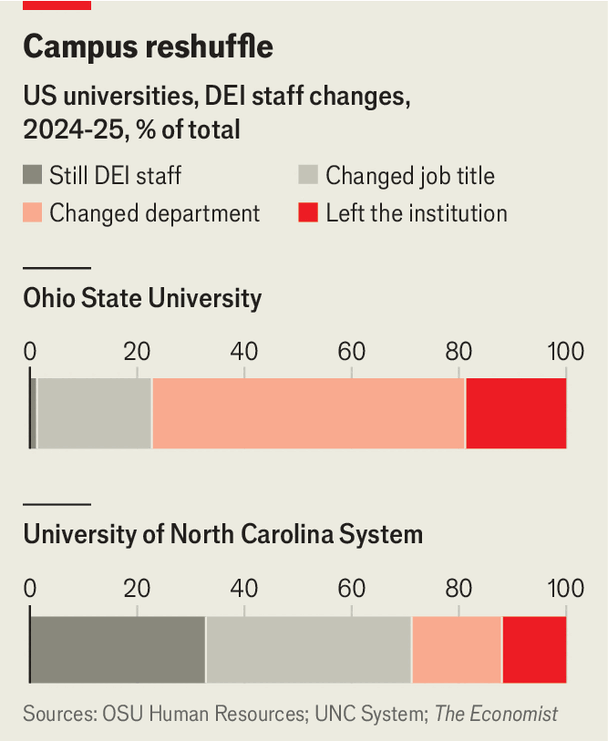
Take Ohio State University. Before Senate Bill 1 took effect in 2025 the university employed more than 150 diversity-related staff at an annual cost of some $11.2m. Afterwards, DEI-related job titles and departments virtually disappeared. Yet nearly four in five employees remained on the payroll with new titles or in new departments (see chart). As a result, staffing costs for this group fell by just 14%.
The University of North Carolina system offers another example. Although North Carolina did not formally restrict DEI offices until 2026, the system’s board of governors anticipated the crackdown, revising its policy in May 2024 to reaffirm “nondiscrimination” and renounce “administrative activism”. Universities across the system responded by altering the job titles or department names of some 69 DEI employees. But headcount barely budged and salaries fell by just 5%. In many cases, vague titles became vaguer still. One well-paid associate dean moved from “inclusive excellence” to “well-being”; a vice-provost swapped “equity and inclusion” for “student health, well-being and thriving”.
This kind of DEI musical chairs is not what legislators intended. Ohio’s ban expressly bars institutions from renaming offices, departments or positions that continue to “serve the same or similar purposes”. Yet such cosmetic changes are easy to make. “I can take an ‘Office of Community and Engagement’ and do the same thing I was doing under DEI,” Archie Ervin, a DEI consultant, recently told Prism Reports, a non-profit news site.
Legislators are stepping up enforcement. Texas has created an ombudsman who can investigate violations and recommend withholding funds. In February Ohio legislators proposed requiring universities to prove that reassigned DEI staff are doing substantially different work or risk losing state funding. A Tennessee bill introduced in 2024 would have prohibited any university department from performing the functions of a DEI office, “regardless of name or designation”.
For all this, what conservatives call the “DEI bureaucracy” will be difficult to dismantle. Having spent more than a decade building diversity offices and hiring staff, universities are reluctant to reverse course. Yet DEI advocates warn that cosmetic changes will not shield them from conservative attacks. “The mistake is thinking that they can change a few words here and move some stuff around there, and that that’s going to be fine,” says Isaac Kamola of the American Association of University Professors. For many conservatives, attacking DEI has become a useful weapon in the culture war—one they have little reason to abandon.


