E-Paper


In 2014, South Carolina sent 36 retired armored carriers to reefs off Beaufort and Hilton Head; they joined sites built with surplus military gear
South Carolina deployed 36 retired armored carriers in 2014 to expand artificial reefs and support marine life, fishing and diving.

 Prefer HTon Google


On September 4, 2014, 36 ex-military armored carriers were sunk into the ocean floor off South Carolina. These were sunk into the Atlantic Ocean off Beaufort for the purpose of creating more artificial reefs, providing hard surfaces for marine life to attach to. The operation was carried out in cooperation with the South Carolina Army National Guard and the South Carolina Department of Natural Resources, as reported in a National Guard report on September 10, 2014.

Before being lowered, the vehicles were stripped of their military gear and cleaned for their new use. This process also gave Guard members practical experience in preparing and moving the heavy vehicles, a task relevant to their military responsibilities. The operation repurposed obsolete equipment for the state's artificial reef program.
How retired vehicles could be used for creating underwater habitats
Artificial reefs introduce hard surfaces into areas of the ocean floor that have insufficient amounts of naturally occurring hard-bottom material. A soft sand bottom provides less surface area for sponges, soft corals, and barnacles to adhere to compared to rocky areas or other kinds of hard surfaces. Once placed underwater, the material can provide surfaces for marine life to settle on.
Deep Dive

The National Guard’s report quoted Robert Martore of the South Carolina Department of Natural Resources, who estimated that the vehicles could remain productive as artificial reef material for up to 150 years. That was an estimate of their potential usefulness, not a confirmed lifespan for every vehicle. Martore also described how the structures could become covered with marine growth and be used by fish for food and protection.
The project also had a recreational purpose. Artificial reefs give anglers additional fishing locations and offer scuba divers places to explore. In the National Guard’s account, 1st Lt. Jason Dunnagan, the state's Innovative Readiness Training Program coordinator, estimated that the wider project generated $83 million annually for South Carolina through tourism-related activities, including hotel stays and deep-sea recreation.
The structures can attract marine life, but their ecological effects depend on factors such as location, materials, and the species present. Their presence alone does not mean they will develop the same characteristics as natural reefs.
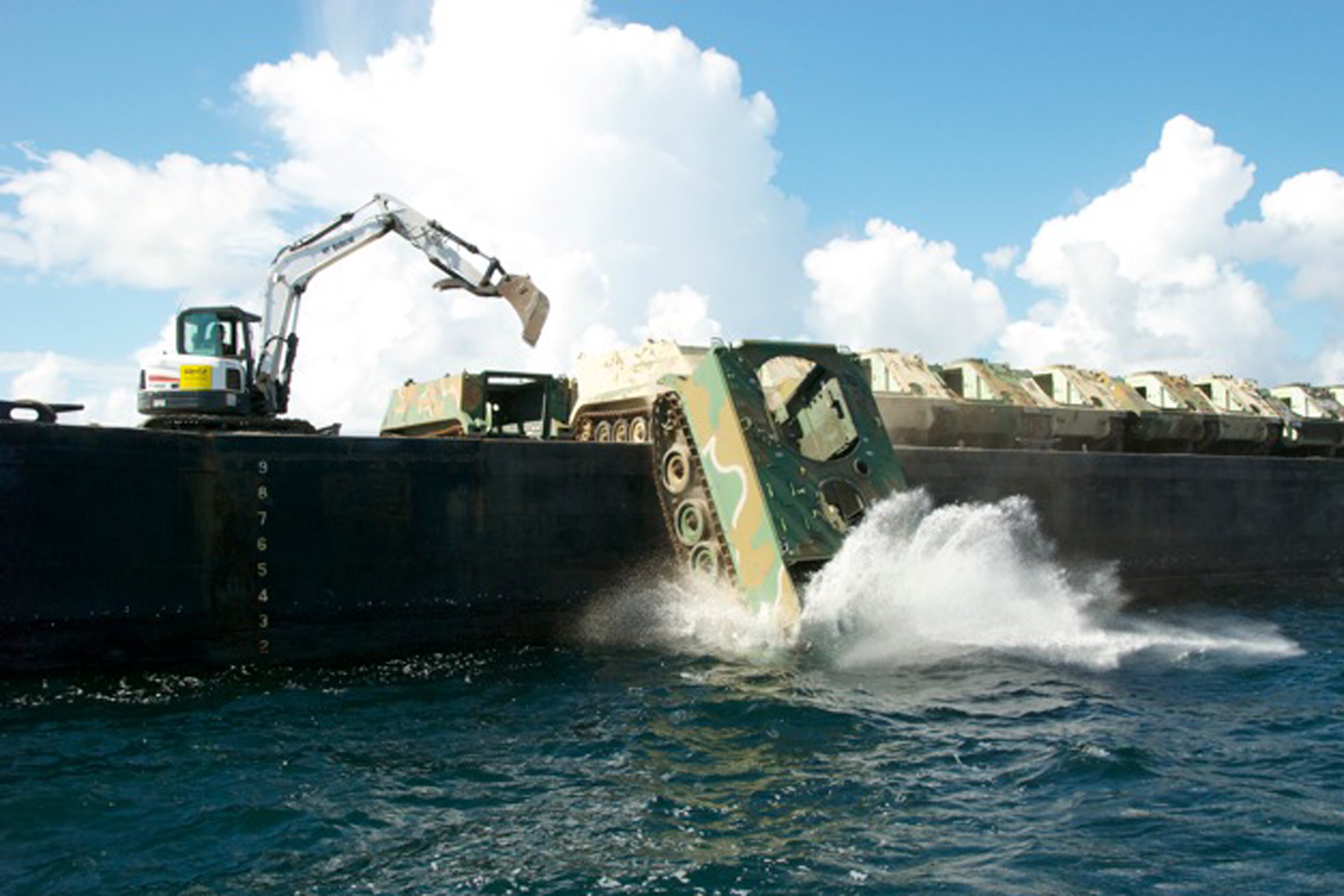
An alliance based on excess military equipment
An article by the Defense Visual Information Distribution Service on Sept. 8, 2014, notes that the Guard and the Department of Natural Resources had been cooperating for 17 years to create marine habitats off South Carolina. The partnership used surplus military equipment to support the state's artificial reef program.
The 36 vehicles joined hundreds of others already deployed through the partnership. According to the Defense Visual Information Distribution Service report, 587 armored vehicles had been deployed for the project between its 1997 start and September 2014, helping create more than 1.12 million cubic feet of new reef habitat since the project began in 1997. The report also noted that about a dozen reef sites were located off Beaufort County, with the state continuing to add materials as they became available.