
 E-Paper


‘It was a mistake, but…': Tulsi Gabbard as Trump officials grilled over leaked US military plan on Signal
Signal chat leak: Tulsi Gabbard told a House intelligence panel that no classified information was shared, prompting Democrats to demand accountability.

 Prefer HTon Google


Signal chat leak: US director of National Intelligence Tulsi Gabbard on Wednesday admitted that it was a “mistake" that the editor of The Atlantic, Jeffrey Goldberg, was added to a Signal messaging chat discussing sensitive war plans.
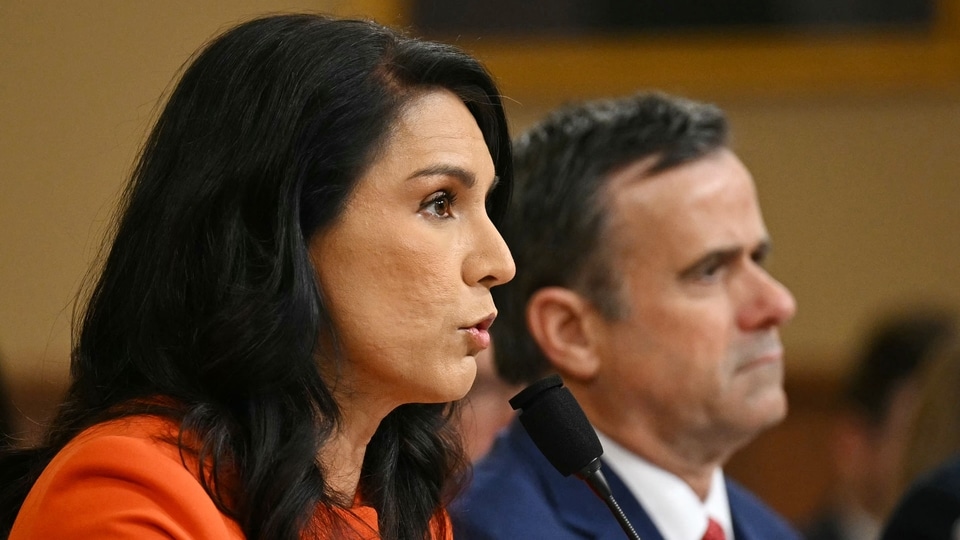
Speaking before the House Intelligence Committee, Tulsi Gabbard said the conversation included “candid and sensitive” information about military strikes against Houthi rebels in Yemen. She, however, told the senators during testimony that she said the texts did not contain any classified information.
“The conversation was candid and sensitive, but as the president and national security advisor stated, no classified information was shared,” Tulsi Gabbard said. “There were no sources, methods, locations or war plans that were shared,” she added.
Wednesday's hearing was called to discuss an updated report on national security threats facing the US. Instead, much of the focus was on the text chain, which included Gabbard, CIA director John Ratcliffe, secretary of defence Pete Hegseth, Vice President JD Vance and other top officials.
The grilling of Gabbard and Ratcliffe comes even as Jeffrey Goldberg's publication released more details from the chats, showing the level of detail they offered about the strikes.
While Democrats have demanded an investigation into the sloppy communication, the National Security Council has said it will investigate the matter, which Donald Trump on Tuesday downplayed as a “glitch.”
Goldberg said he received the Signal invitation from Mike Waltz, Trump’s national security adviser, who was in the group chat and has taken responsibility for the lapse.
Even though the texts contained detailed information on military actions, Gabbard, Ratcliffe and the White House have all said none of the information was classified — an assertion Democrats flatly rejected on Wednesday.
“You all know that's a lie,” representative Joaquin Castro, D-Texas, told Ratcliffe and Gabbard, who said that any decisions to classify or declassify military information falls to the secretary of defence.
Demand of Pete Hegseth's resignation
Several Democrats on the panel said Hegseth should resign because of the leak.
“This is classified information. It’s a weapon system, as well as a sequence of strikes, as well as details of the operations,” said representative Raja Krishnamoorthi, a Democrat from Illinois. “He needs to resign immediately.”
Ratcliffe defended his use of Signal as “appropriate” and said questions over the Signal leak have overshadowed the military operation targeting the Houthis.
“What is most important is that the mission was a remarkable success,” he told lawmakers. “That’s what did happen, not what possibly could have happened.”
The discussion at times grew heated as Ratcliffe and Democratic lawmakers spoke over one another. At one point, representative Jimmy Gomez, an Illinois Democrat, asked whether he knew whether Hegseth was drinking alcohol when he participated in the chat.
“I think that’s an offensive line of questioning,” Ratcliffe angrily replied. “The answer is no.”
Ratcliffe and Gomez then began shouting over each other as Gomez sought to ask a follow-up question. “We want to know if his performance is compromised,” Gomez said.
The Atlantic releases the transcript
On Wednesday, The Atlantic released the transcript of the group chat between top US officials on the Signal messaging app that inadvertently included its chief editor, revealing how Pete Hegseth shared details of timing and weapons systems to be used in attacks against militants in Yemen.
Gabbard appeared to suggest that because Hegseth chose to share the attack plans in a non-secure chat, they were by definition no longer classified.
“Ultimately the secretary of defense holds the authority to classify or declassify,” Gabbard said.
(With inputs from Reuters, AP, Bloomberg)


