
 E-Paper



A taste of Japan plated with a side of books
Sahil Bhutani's experience at a vegetarian wedding highlights India's growing fascination with Japanese cuisine, reflected in literature and culinary trends.

 Prefer HTon Google


When 33-year-old Sahil Bhutani agreed to accompany his friend to a Marwari wedding in Kolkata, he was not expecting a sushi spread on the menu. “I was bemused to see Japanese food items, which are traditionally prepared with fish and other seafood, at a pure-vegetarian wedding. It was all-vegetarian sushi, of course, consisting of cucumber, carrot, avocado, and it was fascinating to see everyone’s plates lined with rows of it alongside dal makhani, rajma and mint chutney.”
Taking a cue from the Kolkata crowd, he incorporated the idea at his own wedding earlier this year. While his very north Indian wedding ceremony progressed, guests, including this writer, stuffed our faces with lavish prawn tempura and salmon sushi with Awadhi preparations.

I came home that night mulling over the current obsession with ‘everything Japanese’ among Indian diners and, in fact, among Indian readers too. A lot of very successful recent Japanese fiction in translation has food as the central theme. From the bestselling Butter (Asako Yuzuki, trans. Polly Barton) to The Kamogawa Food Detectives (Hisashi Kashiwai, trans. Jesse Kirkwood), and Sweet Bean Paste (Durian Sukegawa, trans. Alison Watts) to The Chibineko Kitchen (Yuta Takahashi, trans. Cat Anderson), all these books have Japanese cuisine in different forms and preparations at their core.
Naturally, this gave birth to the idea of hosting a Japanese Literary Lunch – a menu inspired by the dishes featured in these books. I have been running the Dokusha Book Club, an online community of readers of Japanese literature in translation for almost three years now, and this initiative was right up my culinary-literary street.
Restaurateur AD Singh whose standalone Japanese restaurant in Lodi Colony — Guppy, named after a tropical fish — came on board for this lunch collaboration believes Indian diners have reasonably developed palates. “They’re very comfortable with the authentic flavours of Japanese food and as people grow more comfortable with the kinds of Japanese restaurants currently in the market, I believe we’ll see the emergence of more specialised places like dedicated sushi bars, ramen noodle cafés, izakayas, and more. It’s a delicious and healthy cuisine, and I expect it to grow rapidly as more people become familiar with it,” he says.
For the lunch, fish had to be part of the menu because it monopolises traditional Japanese cuisine – think sashimi (raw sliced fish), shioyaki (grilled salted fish), nitsuke (simmered fish), and more.
But there are those who cater to vegetarians too. Like Bento B, Amit and Supriya Gupta’s Japanese diner with branches in Ahmedabad and Vadodara. “We have several vegetarian and Jain options (tofu, edamame, avocado) on our menu. In fact, for every non-vegetarian dish, we have a vegetarian offering. Ahmedabad has been very receptive to Japanese cuisine. Most of our ingredients are sourced from Japan and, thanks to our travels across the world, we too understand the cuisine well enough to incorporate it into our menu,” explains Amit whose second venture in the city, Noboru, that specialises in Japanese and Korean dishes, is named after the cat that goes missing in Haruki Murakami’s The Wind-Up Bird Chronicle.
From Sozo Izakaya’s Prawn Katsu Sando in Mumbai to Megu’s Shira-ae at The Leela Palace, New Delhi, and Kolkata’s Okonomiyaki (savoury Japanese pancakes), the desi Indian touch to preparations from the land of the rising sun keeps getting fancier. There are also the likes of Shokupan (meaning soft, fluffy, sweet Japanese milk bread), the newly-opened sando takeaway in New Delhi’s Vasant Vihar that makes a version of “cloud-bread” Japanese sandwiches.
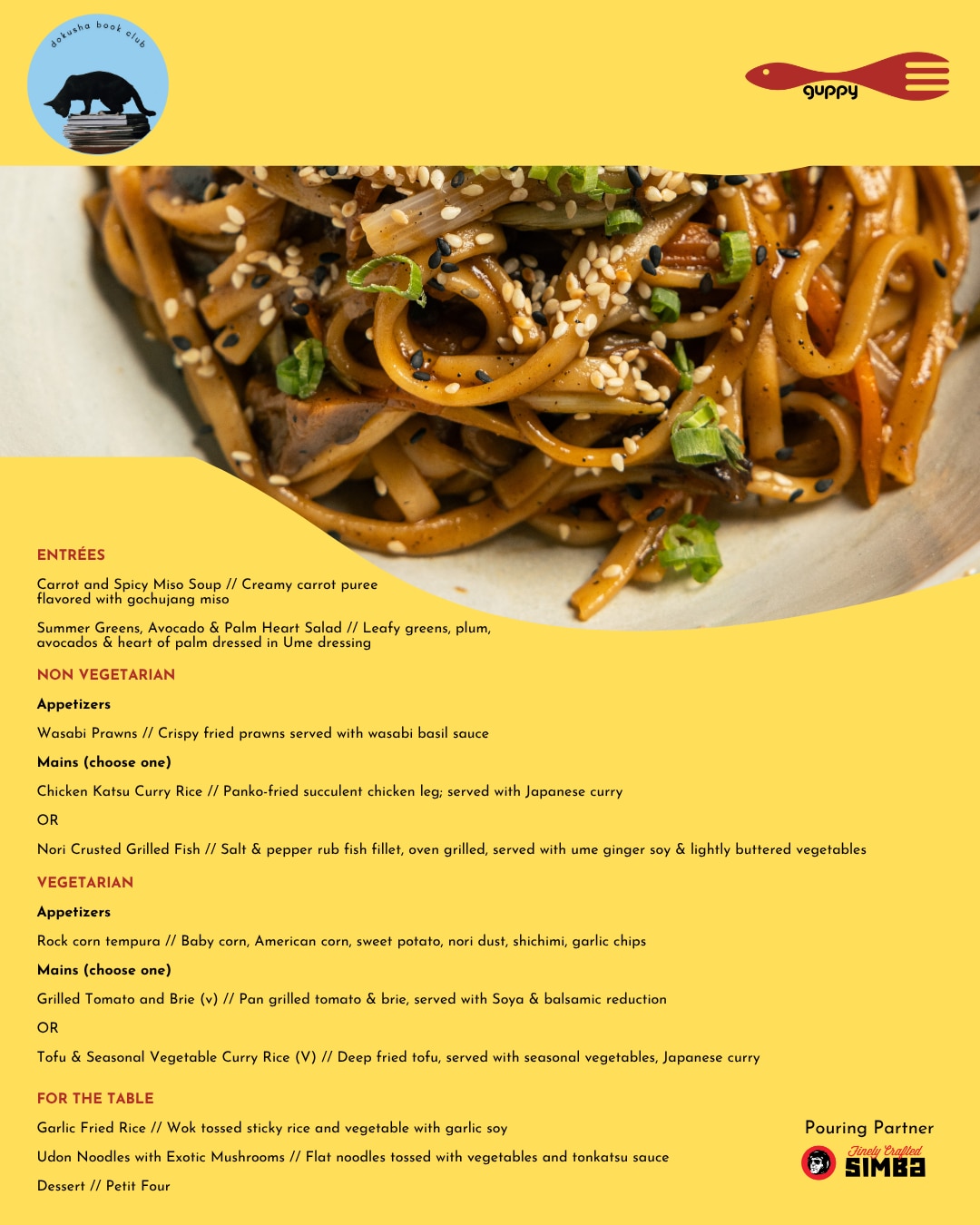
Our Japanese literary lunch had carrot and spicy miso soup, wasabi prawns, chicken katsu curry, nori crusted grilled fish, udon noodles and rock corn tempura, among other sides.
But do regular Japanese folk indulge in such culinary opulence every day? In Seichō Matsumoto’s quiet crime thriller Inspector Imanishi Investigates, the protagonist, after returning home late at night after a full day of chasing murder leads, is seen diving into a bowl full of steamed rice with green tea poured over it. Occasionally, his wife throws in some salted dried fish. A classic example of inexpensive, meat-over-rice dishes, a phenomenon common and accessible in 1960s Japan.
And while food references in Haruki Murakami’s novels are negligible and have always had a Western influence — with spaghetti (or perhaps the ritualistic and meditative act of cooking spaghetti) making a frequent appearance —contemporary works of fiction are introducing readers, if not diners, to a diverse flavour palate that everyone is eager to learn more about.
In Hisashi Kashiwai’s The Kamogawa Food Detectives for example, a father-daughter duo runs a nondescript diner-cum-detective agency in the quiet back alleys of Kyoto where they decode, investigate and recreate dishes that customers come looking for: a widower’s request to recreate his deceased wife’s soul-satisfying Nabeyaki-Udon, the memory of a first and last date over a half-finished beef stew in the winter of 1957, and a dying man’s wish to taste tonkatsu (deep-fried pork cutlet) one last time. All this food packed with Jesse Kirkwood’s tasteful translation lends a necessary dash of flavour to the nostalgic and nuanced gastronomic interpretations. Not to mention the geeky takeaway trivia such as “fugu chef” (a highly trained chef who masters the art of cooking fugu, a poisonous pufferfish, a highly prized ingredient in Japan) and mizugashi (fruit or light desserts that are often served at the end of a meal).
It is also interesting to see how cleverly these novels employ food as a metaphor to highlight the societal and behavioural issues of the country that, to the outsider, seems almost perfect. The very purpose of literature is to prod and probe and some other recently-published contemporary novels do just that.

Durian Sukegawa’s Sweet Bean Paste uses the goodness of dorayaki (soft, pancake-like patties with sweet bean filling) to put the spotlight on themes of ostracism and the importance of kindness and inclusivity (the old woman Tokue’s unmatched skills of making the highest quality of sweet bean paste overshadows her leprosy). Then, there is Rika, the journalist in Asako Yuzuki’s bestselling debut novel Butter, who loves to devour her rice tossed in butter and soy sauce every night, along with indulging in other delicacies; the steady weight she gains over time is noticed by her boyfriend but dismissed by gourmet cook and felon Manako Kajii who claims, “There is nothing in this world so pathetic, so moronic, so meaningless as dieting”, thus refuting conventional societal expectations from women to maintain their figure.
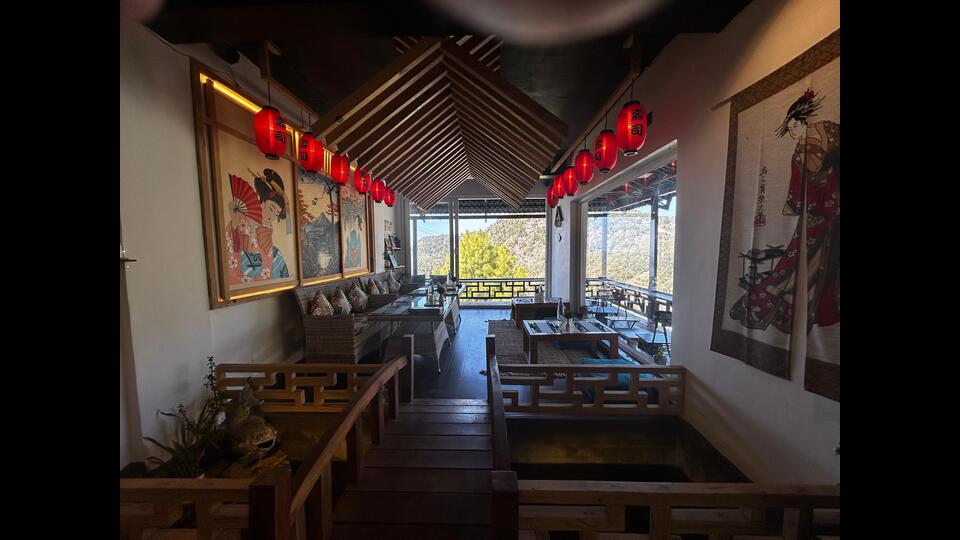
This Indian obsession with everything Japanese is definitely here to stay, and not just in mainstream metropolitan cities like New Delhi, Bangalore and Mumbai, but also in humble hill towns. The Wild Sakura in Mukteshwar, on the Himalayan foothills of Uttarakhand, features Ukiyo-e wall paintings, floor-style seating and lanterns. Owner Karamjeet Singh Arora opened this exquisite little homestay in July 2022 and there’s been no looking back since. The in-house restaurant, Café Mizuki, now serves an absolutely wholesome bowl of ramen.
“I flew to Japan 17 years ago for work and felt an instant connection with the country. When we launched The Wild Sakura, I had no idea about people’s fixation with Japanese trends – décor, food, and drinks, and it’s great that it has worked magnificently in our favour. I keep travelling to Japan four to five times a year and keep bringing back new culinary and décor trends to keep up with the growing demand here,” he says adding that a matcha and dessert café is also in the offing.
Matcha has already taken over the internet and cafés (even though the books don’t really promote matcha except for Kumi Kimura’s Someone To Watch Over You, where it appears as a reference of colour). Perhaps it’s only a matter of time before your local chai ki tapri starts selling a “cutting matcha tea”.
Arunima Mazumdar is an independent writer. She is @sermoninstone on Twitter and @sermonsinstone on Instagram.


