
 E-Paper



Covid cases in Chandigarh hit plateau, but there’s no room for complacency
Growth rate drops to 1% from 5% in September; declining active cases and a recovery rateof 88% also promising signs.

 Prefer HTon Google


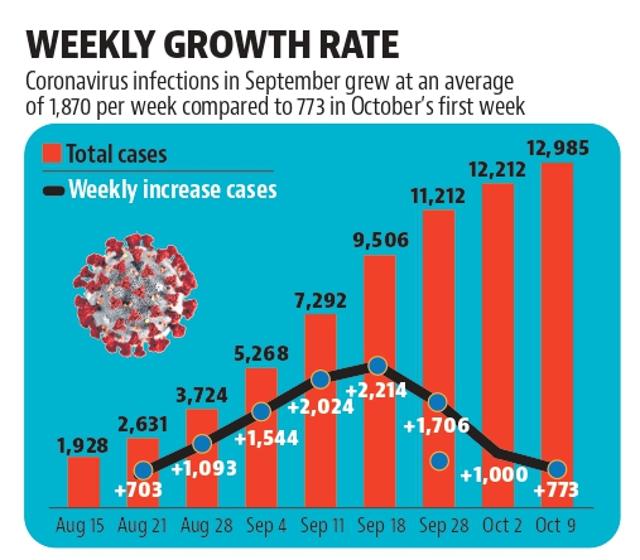
The Covid-19 pandemic in the city has seemingly reached a plateau, with the growth rate of new infections falling from being the country’s highest at 5% in early September to 1% on Friday.
From 12,212 cases on October 2, the tally rose to 12,985 on October 9, a weekly growth rate of 1%. This is in sharp contrast to the cases reported last month, when the infections were swelling at an average of 1,870 per week.
It is also coupled with the downward trend shown in the number of active cases in the past three weeks, even as the recovery rate also stands at a sizeable 88%.
“It is difficult to say how the situation will evolve from here on out, but the trajectory of cases shows that the curve is flattening. While the number of tests has decreased, the ratio of positive results has not shown a major jump. This is a positive sign and our fingers remain crossed,” UT health secretary Arun Kumar Gupta said.
Dr Amandeep Kang, UT’s director, health and family welfare, said the strategy of declaring affected areas as micro-containment zones had returned good results.
“On Friday, 1,020 samples were collected and only 63 people tested positive. This is the second time in the last few days that the daily cases have remained below 100. But, with the festival season ahead, people should continue to exercise caution by maintaining distance, wearing masks and ensuring hand hygiene,” she said.
‘DON’T LOWER YOUR GUARD’
However, experts have cautioned that with more curbs being lifted on commercial activities and schools reopening, chances of the infection growing again remained.
“The pandemic is not over. Lowering out guard can prove risky. The festival season ahead will lead to crowding of public as well as indoor spaces, increasing chances of spread of infection. With the health services playing their role, residents also need to exercise precautions,” said Dr Rajesh Kumar, former head of the community medicine department, Post-Graduate Institute of Medical Education and Research.
On health department’s plans to deal with more restrictions being removed, Dr Kang said, “We will focus on information and education activities. There are apprehensions that crowding at public places will increase, but people should not be complacent until we reach a level where negligible cases are detected.”


