
 E-Paper



Chandigarh-Kharar-Ludhiana highway: 200+ streetlights defunct on this 10km NH stretch, one has to grope in dark
The tricity typically starts experiencing winter haze and fog in early to mid-November as the night temperature begins to drop. Reduced visibility makes it harder for motorists to judge the position and speed of other vehicles, spot pedestrians and identify road hazards

 Prefer HTon Google


This winter, if you plan to drive along the Chandigarh-Kharar-Ludhiana highway (National Highway 5) at night, do it at your own risk. At least 211 streetlights along the first 10 kilometres of the highway, starting from Verka Chowk, are non-functional, which essentially means that commuters will be left to their own devices to navigate this stretch, especially on foggy nights.
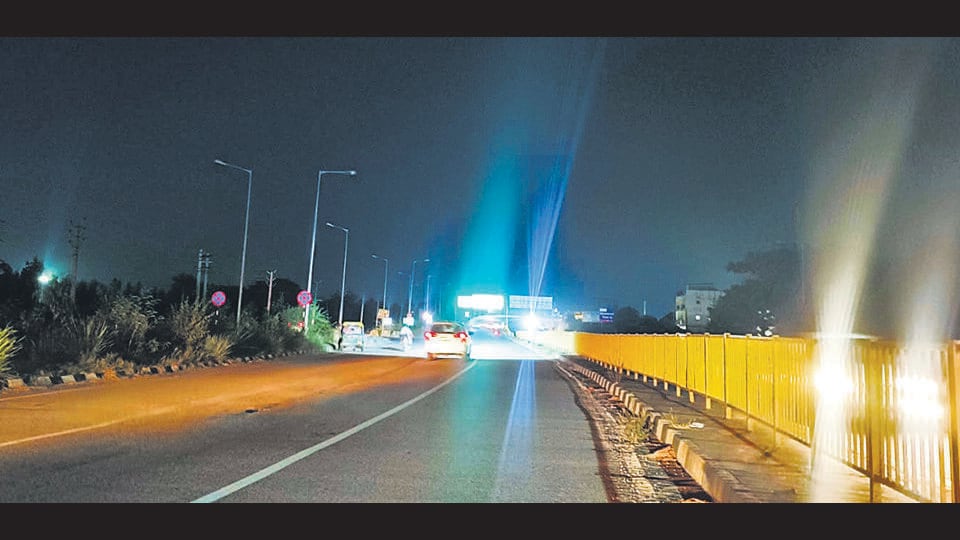
The tricity typically starts experiencing winter haze and fog in early to mid-November as the night temperature begins to drop. Reduced visibility makes it harder for motorists to judge the position and speed of other vehicles, spot pedestrians and identify road hazards. These risks are only compounded on highways.
A ground survey by this reporter revealed that 125 lights on central poles and another 86 along both sides of the highway are non-functional even as the National Highways Authority of India (NHAI) claims that it regularly checks road infrastructure under its jurisdiction.
The six-lane road has three lanes on each carriageway, with around 400 central lighting poles on the stretch.
One of the worst-affected sections lies between the Shivjot cut and the area near Omega. At one point from Khanpur to Modern Valley, lights on both sides of a roughly 200-metre stretch are lying defunct. Reflectors are also missing from the central road marking, reducing visibility at the curve. The highway also has high-mast lighting towers at key locations, but even those are not working.
Eight black spots along the stretch
The lack of functional streetlights is particularly concerning as the stretch has at least eight identified accident black spots. According to the Ministry of Road Transport and Highways, a black spot is a 500-metre stretch where either five road accidents involving grievous injuries or fatalities have occurred over three consecutive years, or 10 fatalities have been recorded over three years.
One major black spot is near Gopal Sweets, while another is near the Khanpur turn, which is surrounded by residential societies, including Darpan City, Modern Valley and Omega City. Residents use these roads daily to commute to Chandigarh, Kharar and other parts of the tricity.
Several students also live in housing societies around Khanpur, making the stretch a regular route for those travelling to educational institutions and other parts of the region.
A rough estimate suggests that at least 3,000 motorists use the stretch daily.
Road-safety expert Harpreet Singh says proper lighting is crucial around black spots and locations where road users need to identify hazards in time. “High-mast lighting becomes important at black spots because it improves visibility over a wider area. If a pedestrian or any obstruction is present on the road, better lighting can help a driver identify it earlier,” he said.
Fog could worsen visibility
Commuters who regularly use the highway say the absence of functional streetlights leaves them dependent on vehicle headlights while navigating dark stretches, curves and junctions.
Raghav Dhoundial, a student, says, “I often travel on this stretch at night. When the streetlights are not working, the road becomes difficult to judge, especially around the curves and cuts. With so many housing societies and students living here, proper lighting is important for people travelling late.”
Dr Seham Singh, a daily commuter, says poor lighting becomes an even greater concern when visibility drops at night or during fog. “Drivers may take longer to notice pedestrians, two-wheelers or vehicles entering the road. Functional streetlights and reflectors can give motorists more time to react and reduce the risk of crashes,” he said.
When contacted, NHAI executive engineer Rishab Goyal said the lighting system is checked regularly. He added that the issue of non-functional lights identified during the ground inspection had been noted for rectification and will be addressed.


