E-Paper



Paddy sowing season: Landless women labourers extend helping hand to farmers in Haryana
Thousands of women laborers in Haryana are competing with migrant workers in the paddy sowing season, earning equal wages and working more efficiently.

 Prefer HTon Google


: Unfazed by the scorching sun and sludge under their feet, a group of young women with their face covered are busy planting rice saplings in the mud, carefully maintaining a specific distance between each seedling.
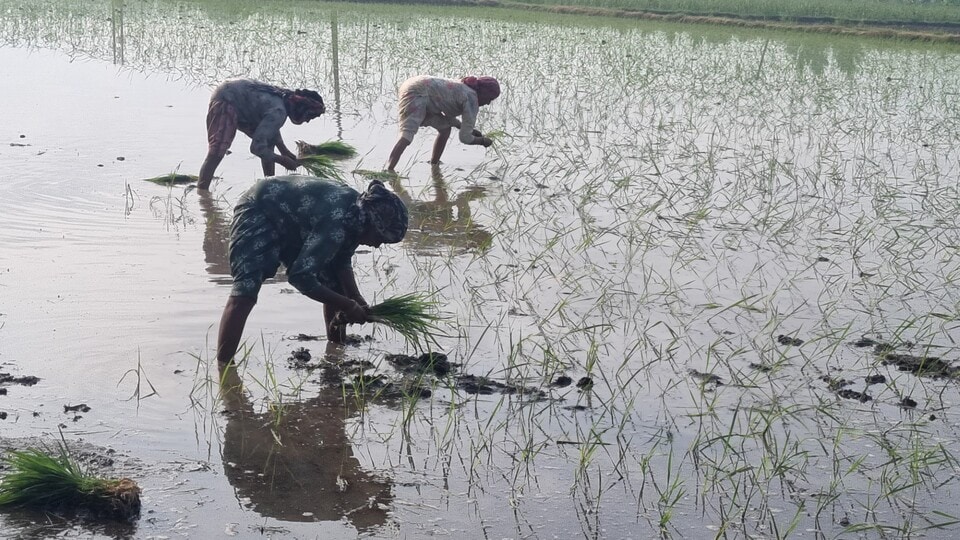
They continue working in the field tirelessly till 7 pm everyday only to stop for a few minutes to take short tea and lunch breaks.
These girls are among the around thousands of women labourers in Haryana working shoulder to shoulder and giving a tough competition to the migrant labourers in this season of paddy sowing in Indri block of Haryana’s biggest rice producing district of Karnal, which is also known for growing the world’s finest basmati rice. These teams of women are formed every summer and they manage to transplant thousands of acres of paddy every year.
Earn equal to male labourers
Paddy sowing season, which officially begins from June 15, is the best time for landless women labourers to earn as they get an opportunity to earn as much as their male counterparts. The normal wage rates for a women worker are only ₹300 per day, while a male labourer gets ₹400 to ₹450. But for paddy transplantation, they charge ₹3,500 per acre and one labourer earns around ₹750 per day.
“Our earning depend on weather as someday we transplant around two and half acres and sometimes if the weather is hot, we could complete only two acres. But as per instructions of our group leader, we have to complete two acres a day to ensure that we could get at least ₹600 per day,” said another young girl Rajneesh.
Women work better than men
Many farmers prefer transplantation by local women labourers as, according to them, the migrant labourers do not come every year.
“We used to depute migrant labourers for transplantation but we noticed that they increased their charges, but for the past few years, we have changed this practice and given the task to the local women labourers as they not only take ₹500 less that the migrant labourers, but they also work more efficiently and plant saplings more densely than the male migrant workers.” said Banarsi Das, a farmer of Indri.
Left school to support family
There are several school dropouts who have chosen to help their families instead of continuing with their study after Class 8 or 10.
“I have left school after matriculation. Being the eldest child of my family of five members, it’s my responsibility to help my labourer father so that my younger brothers could continue their studies,” says Simran, standing knee-deep in water, holding a bunch of paddy plants in a field in Ramba village on Karnal-Yamunanagar highway.
Similar is the story of 18-year-old Radha (name changed) who could not continue here study after class 10 three years ago as her family needed money to pay back their debts they took to build a two-room house. “Now I have got an identity of a woman labourer and will live with it my entire life like my mother,” she said.
Water gets hotter than sun
“Sometimes the water becomes hotter than the sun as working in the scorching heat does not cause as much trouble as it does in hot water,” said a labourer Khushi.
“we can cover our faces to protect our skin from the scorching sun, but there is no protection from the hot water,” Khushi said, adding that covering their face has double benefits as it not only protects them from the sun but also helps them to hide their identity so that nobody can recognise them while working in fields.
Extend helping hand to farmers
Paddy transplantation is a labour-intensive exercise and the official figures from Haryana agriculture department reveal that out of the total 35.50 lakh acres under paddy, around 33 lakh acres are transplanted manually and around 4 people are required to complete one acre in a day.
Even as the state government is encouraging the farmers to opt for direct seeding of rice (DSR), a less labour-intensive method, over 99% farmers still follow the traditional method and they depend on the migrant and local labourers to complete the task. The farmers had been dependent on the skilled migrant workers, but after the Covid-19 lockdown, they approached the locals again and the women workers formed teams.
Even as there was a fall in the number of migrant labourers, but the transplantation of paddy has not suffered much as local women have come out in support of farmers.
A group leader of women labourers in Karnal’s Sangohi village said, “We formed the team of 9 women and started transplantation on June 15. There is no dearth of work and even farmers were ready to pay more as they were in desperate need of help, but we decided not to exploit their helplessness and only charge ₹3,500 per acre.”