
 E-Paper



₹99-crore wall along Yamuna stretch among projects cleared by Delhi government
Environmental activists criticized the wall, warning it could constrain the river without addressing the causes of rising flood risks.

 Prefer HTon Google


The Delhi government on Friday approved projects worth ₹622 crore to strengthen the Capital’s flood-control and drainage infrastructure, including a ₹99-crore reinforced concrete wall along a vulnerable stretch of the Yamuna and three biomining projects worth ₹260 crore to scientifically process and dispose of silt removed from drains.
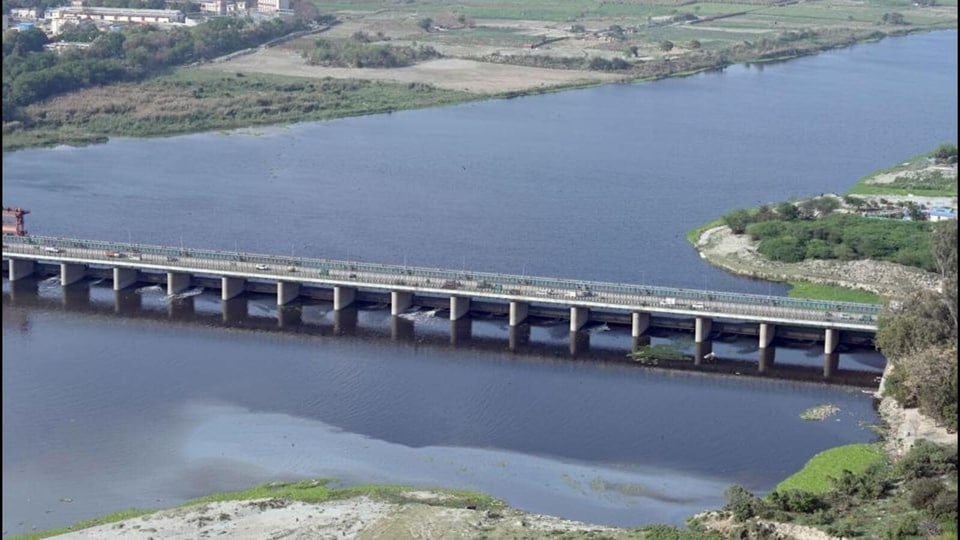
The proposed wall, however, has drawn criticism from environmental activists, who warned that it could restrict the river’s natural flow without addressing the underlying causes of rising flood risks.
The decisions were taken at the 40th meeting of the flood control board, chaired by irrigation and flood control minister Parvesh Singh at the Delhi Secretariat. The board also discussed plans to beautify drain banks across the city, modelled on the Barapullah drain, with walkways, green belts, plantations, lighting and protective fencing.
Also Read | Delhi government readies MoU for Sabarmati-style Yamuna makeover
The 4.7-km reinforced cement concrete wall will run along the Yamuna from the Magazine Road drain to the Old Railway Bridge. It is intended to protect vulnerable, low-lying areas during periods of high water levels.
The board also gave in-principle approval to three biomining projects costing ₹260 crore to process and dispose of desilted material scientifically. The Najafgarh drain and other major drains carrying heavy silt loads are expected to benefit.

Currently, desilted material often remains along drain banks and roadsides, where rainwater can wash it back into drains, undermining desilting efforts, officials said.
The government also proposed turning spaces alongside drains into cleaner, safer public areas to curb neglect and encroachments. Singh directed officials to adhere to project timelines and ensure regular monitoring.
Also Read | Union minister Shah launches 43 projects aimed at Yamuna clean-up
“Desilting means nothing if the silt finds its way back into our drains,” the minister said, adding that biomining would help break the cycle of repeated silt accumulation.
Experts, however, disagreed on the efficacy of the move to construct a wall. Bhim Singh Rawat, a Yamuna activist and member of the South Asia Network on Dams, Rivers and People (SANDRP), described the wall as a “half-baked measure” that failed to address the underlying causes of rising flood risks. He called for construction to be halted until ongoing topographic and bathymetric surveys of the river are completed.
An analysis of the 2022, 2023 and 2025 floods indicated a significant change in the Yamuna’s flooding pattern, Rawat said. Despite peak flood volumes at Hathnikund Barrage being comparatively lower than during the historic 1978 flood, Delhi experienced unexpectedly high water levels, raising concerns about the river’s reduced capacity to carry floodwater, he said.
Rawat attributed the potential reduction in the river’s flood-carrying and absorption capacity to structures such as bridges and barrages, as well as encroachments and construction on the floodplain. Without studying and addressing these factors, a flood comparable to that of 1978 could trigger a major disaster in the Capital, he warned.
Also Read | Toxic froth returns to Yamuna, AAP alleges tender irregularities in anti-froth drive
He said better desilting and silt disposal were routine measures and called for a sustainable silt management policy.
Diwan Singh, convener of Yamuna Satyagraha, echoed the concerns. “They are trying to cage Yamuna which is not in sync with its natural flow,” he said, adding that attempts to control the river through bridges, barrages and walls risked turning it into a canal.


Stay updated with all top Cities including, Bengaluru, Delhi, Mumbai and more across India. Stay informed on the latest happenings in World News along with Delhi Election 2025 and Delhi Election Result 2025 Live, New Delhi Election Result Live, Kalkaji Election Result Live at Hindustan Times.


