
 E-Paper



Delhiwale: A tale of two colours
It is changing again

 Prefer HTon Google


It is changing again. The Sufi shrine of Hazrat Sarmad Shahid and Hazrat Hare Bhare Shah lies in a small chamber at the foot of Old Delhi’s Jama Masjid.
This time, look up.
The ceiling and upper walls of the historic site are being covered with pieces of glass. The work began a week ago and is expected to continue for three more weeks. Bamboo scaffolding stands around the two graves. Parts of the glasswork are already in place, in patterns of blue, yellow and mirror pieces.
This late morning, artisan Sadiq is sitting cross-legged on the marble floor, surrounded by glass and mirror. He holds a pen against a piece before cutting it. Beside his left knee is a pile of red glass pieces, each cut in the shape of a rhombus. A sheet of green glass lies beside his right knee. It too will be cut for the patterns overhead.
Red and green have long divided the shrine between its two saints. Hazrat Sarmad lies under a red chaadar, Hazrat Hare Bhare Shah under a green chaadar. Hazrat Sarmad, the Jewish mystic from Iran who became a naked fakir in Mughal Delhi, was executed under Emperor Aurangzeb. Red came to stand for his blood. Not much is known about Hazrat Hare Bhare Shah, who is identified with hara, or green.
The two colours once ran through the shrine. The passage beside the green saint’s grave was green; the same passage beside the red saint’s grave was red. Jaalis, walls, doors and tiles followed the division. Much of this was erased during the renovations begun in the Covid years. Today, the floor and walls are of white marble. So are the enclosures around both graves. White has replaced most of the red and green.
Yet, the two colours have survived.
Hazrat Sarmad’s grave is covered in a red cloth. Hazrat Hare Bhare Shah’s grave is covered in a green cloth. The trunk of the neem tree standing between the two graves is wrapped in red and green fabrics. Two donation boxes stand together, one red, one green. At the entrance, the signboard is divided between the two colours.
One more element in the shrine stubbornly continues as before: the old well. For generations, men from one extended family drew water from it into goatskin bags called mashaks, and sprinkled it on the dusty ground outside. The work was once done by brothers Jameel, Khaleel, Shakeel and Aqeel. It has passed to a younger generation: Rafeeq, Laheeq, Saeed and Umar.
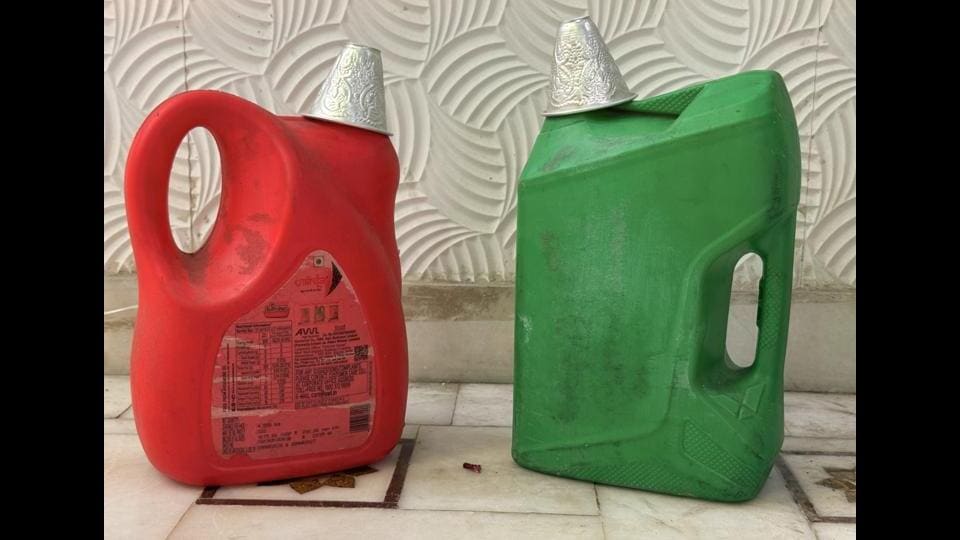
Last, and quite literally least, amid the latest renovation, two plastic water cans stand jointly on the shrine’s floor. One is red, the other green. See photo.


Stay updated with all top Cities including, Bengaluru, Delhi, Mumbai and more across India. Stay informed on the latest happenings in World News along with Delhi Election 2025 and Delhi Election Result 2025 Live, New Delhi Election Result Live, Kalkaji Election Result Live at Hindustan Times.


