
 E-Paper



Nearly 700 red zones in Delhi sealed in 10 days to curb Covid spread
As on December 30, Delhi had 849 micro containment zones, up from 176 on December 20, shows data from Delhi’s district administrations.

 Prefer HTon Google


As Covid-19 cases increase in the national capital, authorities have sealed nearly 700 hot spots between December 20 and 30, showed data from Delhi’s district administrations.
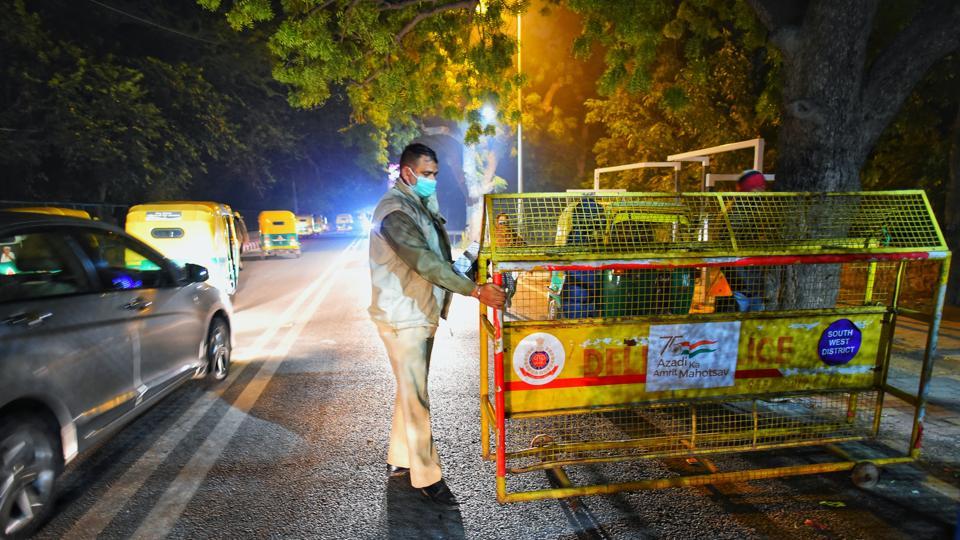
As on December 30, Delhi had 849 micro containment zones, up from 176 on December 20, according to the data.
Also Read | Positivity rate up to 2.44%, city adds 1796 new cases
Containment zones are sealed premises or areas that are essentially under a hard lockdown for a certain period, and are placed under increased surveillance by district teams. Essential goods are delivered to doorsteps, and these areas can be de-notified only if no new cases are added for 14 days.
Delhi’s South district, comprising Saket, Hauz Khas, and Mehrauli, among other areas, has 402 containment zones — the highest among the city’s 11 revenue districts. The West district, comprising Patel Nagar, Punjabi Bagh, Rajouri Garden, and other areas, follows the South district with 108 containment zones. The New Delhi district, comprising Chankyapuri, Vasant Vihar, and Delhi Cantonment areas, has 86 containment zones, and the North district, comprising Narela, Model Town, and Alipur and other areas, has 70 containment zones.
A South district official, requesting anonymity, said the number of containment zones is higher in the district because district authorities are trying to contain as many positive cases as possible to check further spread of the coronavirus. “Many containment zones have only one Covid-19 patient,” said the official.
To be sure, all of the sealed zones in Delhi encompass no more than a few flats, in accordance with the state’s micro containment zone policy, as compared to the early days of the pandemic, when entire areas or lanes were shut.
Densely populated districts have very few containment zones. The North-East district, one of the city’s most densely populated districts comprising Karawal Nagar, Yamuna Vihar, Seelampur, and other areas, had zero containment zones on December 30.
A North-East district official said the district isolated Covid-19 cases, and there was not even a single cluster with three cases (needed to create a containment zone). “But we still created 20 containment zones, and as of December 31, the district has 20 containment zones. The containment zones work as a deterrent against home isolation violations,” said the official, adding that North East has one of the lowest caseloads.
The East district, which has Gandhi Nagar, Mayur Vihar, Preet Vihar and other areas under it, has 11 containment zones and Shahdara has 32 containment zones. The Central district, which is also densely populated, has only 18 containment zones.
A North district administration official said containment zones are created by sealing a particular area such as a flat, house, or floor after a patient tests positive for Covid-19 and is found fit enough to stay in home isolation. “The assessment is done by district health officials. In many cases, containment zones have been created even where only one person tested positive. Containment zones are created on a micro-scale to ensure that there is minimum inconvenience to those living nearby,” said the official, seeking anonymity.
“Civil defence volunteers are deployed to check on violations in the sealed area. The district health teams get in touch with the patient and trace and test his/her contacts. In some cases, we have traced and tested up to 40 contacts. Most patients in containment zones right now are asymptomatic and are recovering in home isolation,” a health department official said on condition of anonymity.
According to experts, during the first wave that swept through the Capital in March-April 2020, the first containment zones were created in Delhi’s overpopulated districts, but during the pandemic’s later waves, these areas reported fewer cases as well as a comparatively lower number of containment zones.
Delhi’s first containment zone was carved out in Shahdara on March 26, 2020.
Dr Sanjay Rai, professor, community medicine department at All India Institute of Medical Sciences, said the districts reporting a low number of Covid-19 cases right now had reported a high number during the first wave. “The first containment zone in Delhi was created in Shahdara, followed by the East district. These are densely populated areas where infection spread quickly, and people developed antibodies against coronavirus. Evidence has emerged that people who recover from mild Covid-19 develop antibodies which may last a lifetime,” Dr Rai told HT.
Dr Rai added that a large number of people were infected with the coronavirus and recovered without even realising they were infected, and that ultimately shielded them against Covid-19. He said this was the reason behind these districts reporting a lower number of cases even during the second wave.


