
 E-Paper



The many lives of Purana Qila
Emperor Humayun’s court chronicler, Khwandamir, provides the earliest eyewitness account of the fort’s founding


Emperor Humayun’s court chronicler, Khwandamir, provides the earliest eyewitness account of the fort’s founding. He records that in Muharram 940 AH (July–August 1533), Humayun selected a strategic mound on the banks of the Yamuna near ancient Indrapat to build a grand fortified Capital called Dinpanah (“asylum of the faith”). Khwandamir details the astrological hour chosen for the foundation ceremony, the emperor personally laying the first stone, and the rapid construction of the ramparts, bastions and gates within 10 months.
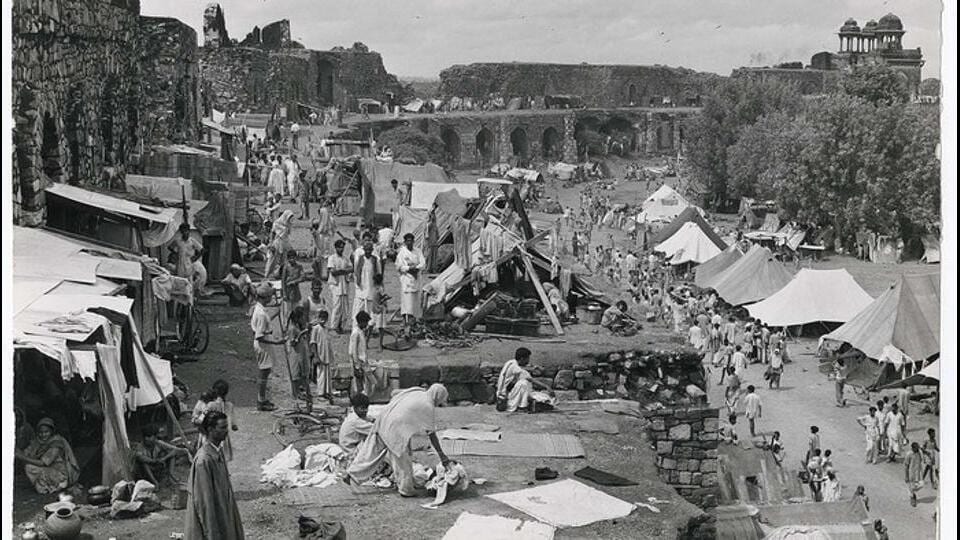
People lived in the Purana Qila then and even after Humayun was long gone. Up till the early 1910s there were houses with paperwork to prove their landholding. Much later a camp for refugees was set up in Purana Qila; soon those people spilled out to make neighbourhoods like Jangpura, Lajpat Nagar, South Extension, etc.
Margaret Bourke-White’s photographs of Purana Qila in 1947 are among the most enduring visual records of Partition. A vast settlement of tents, makeshift shelters and displaced families. The fort’s monumental walls stand behind a landscape of temporary homes. Looking at these images, one sees the extraordinary capacity of a city to absorb people in moments of crisis. But one also begins to see another history: that of the houses which had occupied this very ground before the refugees arrived.
Purana Qila has always been more than the 16th-century fort we encounter today. Its history is stratified, not only in the archaeological deposits beneath its surface, but in the successive communities that have made homes within its walls. The excavated remains of a Kushan-period house complex, alongside evidence of habitation extending through the Gupta, Rajput, Sultanate and Mughal periods, reveal a landscape of domestic occupation far older and more complex—a less remembered common fact for why kings built where people already lived. People built rooms, made courtyards, cooked, worked and raised families here centuries before the present fort acquired its familiar form. When you enter the fort it is on an incline, an ancient mound of the old city Mahabharata spoke of. Is this the site? That I’d leave for archaeologists who have worked and tested the site.
The old city traditionally associated with Indraprastha eventually became a living settlement known as Indrapat. By the early 20th century, a village still stood inside the fortifications. It was not an archaeological remnant but a functioning neighbourhood, with permanent houses and residents, some of whom held official property documents. In 1913, when the colonial administration undertook the archaeological clearance of the site, the village was dismantled. Around 1,900 people were displaced and more than a hundred houses were demolished. The Archaeological Survey of India (ASI) photographed the process. Today, these images survive in the British Library’s Northern Circle collection, recording the removal of houses from a landscape that was about to be remade as a monument.
The desire to recover the monument required the removal of the village. The history of preservation, in this instance, began with an act of displacement. A predicament of colonial origins.
Three decades later, in 1947, Purana Qila became a refuge for people displaced by Partition. Muslims fleeing violence in Delhi gathered here before many left for Pakistan. Subsequently, Hindu and Sikh refugees arriving from across the new border also found shelter within the fort. The monument became a city of tents and improvised dwellings. Bourke-White’s photographs capture this moment with extraordinary intimacy: people sitting on the ramparts, shelters spreading across the grounds, and domestic life taking shape against the monumental architecture. The temporary settlement would remain for years. Small tenements, kitchens and shared facilities gradually transformed the camp into a neighbourhood. By the early 1960s, its remaining residents were evicted once again.
Delhi’s history is often told through its ruins. But ruins are rarely empty. They contain several histories, and sometimes the people who inhabit them eventually establish themselves outside them. The refugees who left Purana Qila became part of the making of post-Partition Delhi, in neighbourhoods such as Lajpat Nagar, Rajendra Nagar and Patel Nagar, each with its own distinct history of rehabilitation. Their houses, shops, extensions and neighbourhood institutions became part of the city’s modern domestic landscape.
This December, Purana Qila will acquire yet another contemporary life. From December 4, the India Biennale will bring art, architecture and design into the fort, opening a new portal into the historicity of the site. Among its presentations is Anant: A Rare 18th Century Mahabharata Scroll, presented by DAG. The long, previously unseen scroll will bring the epic imagination of Indraprastha into dialogue with the physical landscape traditionally associated with it. The biennale offers an opportunity to encounter the fort’s past through a contemporary cultural lens.
Yet there is another history that remains harder to see. The Mahabharata scroll will draw attention to the ancient city and its epic associations, but the village of Indrapat, whose houses were removed in the early twentieth century, is not so readily visible in the monument’s public story. Nor are the domestic lives that occupied this ground across its archaeological layers, or the refugee homes that briefly returned it to the condition of a lived settlement.
Perhaps this is what the houses of Purana Qila ask us to ponder. The monument standing before us is only one layer of a much longer history. Beneath it are archaeological dwellings; in its archival photographs are demolished homes; in Bourke-White’s images are the makeshift houses of a displaced population. Those houses are the domestic history of Delhi.
The story of Purana Qila is ultimately the story of a city continually being made and unmade. Its houses may have disappeared, but their histories did not. They travelled into the neighbourhoods of modern Delhi, into the memories of families and into the architecture of homes built elsewhere.
Anica Mann works on archaeology and contemporary art in Delhi. The views expressed are personal

Stay updated with all top Cities including, Bengaluru, Delhi, Mumbai and more across India. Stay informed on the latest happenings in World News along with Delhi Election 2025 and Delhi Election Result 2025 Live, New Delhi Election Result Live, Kalkaji Election Result Live at Hindustan Times.


