
 E-Paper



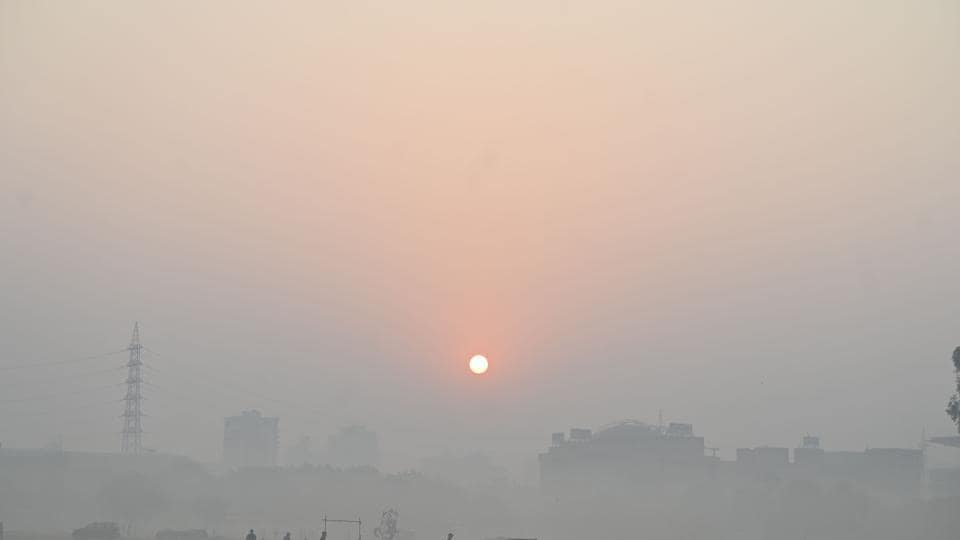
Gurugram wakes up to very poor air, dense smog after festivities
The sharpest spikes in PM2.5 concentrations were recorded overnight. Between 11pm on Sunday and 5am on Monday, concentrations crossed 500 micrograms per cubic metre (µg/m³) at all four monitoring stations

 Prefer HTon Google


Gurugram’s air quality deteriorated sharply following Diwali celebrations on Sunday, with the air quality index (AQI) rising from 288 to 345 on Monday, according to the Central Pollution Control Board’s (CPCB) 4pm bulletins.
The city’s air quality slipped from the ‘poor’ to the ‘very poor’ category as firecracker emissions added to existing pollution levels across the National Capital Region (NCR).
Data from the CPCB, analysed by the Hindustan Times pollution dashboard, showed that Teri Gram was the worst-affected monitoring station in Gurugram, recording an AQI of 398 at 4pm on Monday. Gwal Pahari followed at 356, Sector 51 at 344 and Vikas Sadan at 262. PM2.5 was the dominant pollutant at all four stations.
The sharpest spikes in PM2.5 concentrations were recorded overnight. Between 11pm on Sunday and 5am on Monday, concentrations crossed 500 micrograms per cubic metre (µg/m³) at all four monitoring stations. Teri Gram recorded the highest concentration of 585 µg/m³ at 3am on Monday.
At Teri Gram, PM2.5 concentrations rose from 176 µg/m³ at 8pm on Sunday to 366 µg/m³ an hour later. Sector 51 recorded an increase from 74 to 150 µg/m³ during the same period. At Gwal Pahari, concentrations rose from 159 to 179 µg/m³, while Vikas Sadan recorded a marginal increase from 159 to 163 µg/m³.
Dr Manoj Kumar, an analyst at the Centre for Research on Energy and Clean Air (CREA), said gaps in monitoring data and differences in measurement methods could lead to discrepancies in reported pollution levels.
“There are some missing points in the CPCB data for pollution, which would affect the overall air quality readings in the city. CPCB and other independent air quality measuring companies have different parameters to calculate AQI. Moreover, CPCB gives a 24-hour average and other organisations consider momentary short-term spikes as well, which can cause discrepancies in the numbers,” he told HT.
The post-Diwali deterioration was also reflected across Haryana, where 11 cities recorded AQI levels above 300 on Monday, according to the CPCB’s 4pm bulletin.
Bahadurgarh in Jhajjar district recorded an AQI of 400, followed by Charkhi Dadri at 389 and Rohtak at 378. Faridabad and Panchgaon recorded 350 each, Kaithal 347, Bhiwani 340, Manesar 333, Ballabhgarh 316 and Narnaul 305. Sirsa and Jind recorded AQI levels of 289 and 235, respectively.
Residents reported reduced visibility in several parts of Gurugram on Monday morning as a thick haze enveloped residential neighbourhoods.
Roshan Sharma, a resident of Sector 85, said, “On Monday, the sky and the open space in front of my house appeared like a white blanket of haze. Hardly anything was visible.”
The sharp increase in particulate pollution followed widespread firecracker bursting on Sunday evening and overnight, adding to the city’s existing pollution burden.


Stay updated with all the Breaking News and Latest News from Mumbai. Click here for comprehensive coverage of top Cities including Bengaluru, Delhi, Hyderabad, and more across India along with Stay informed on the latest happenings in World News.


