E-Paper



Between pages and passing years, a love affair in Lucknow’s Love Lane
Octagenarian Mobin Beg has watched Lucknow’s book culture change, but his bond with books has endured

 Prefer HTon Google


His gentle, light eyes carry hope. His lips always carry the flicker of a smile.
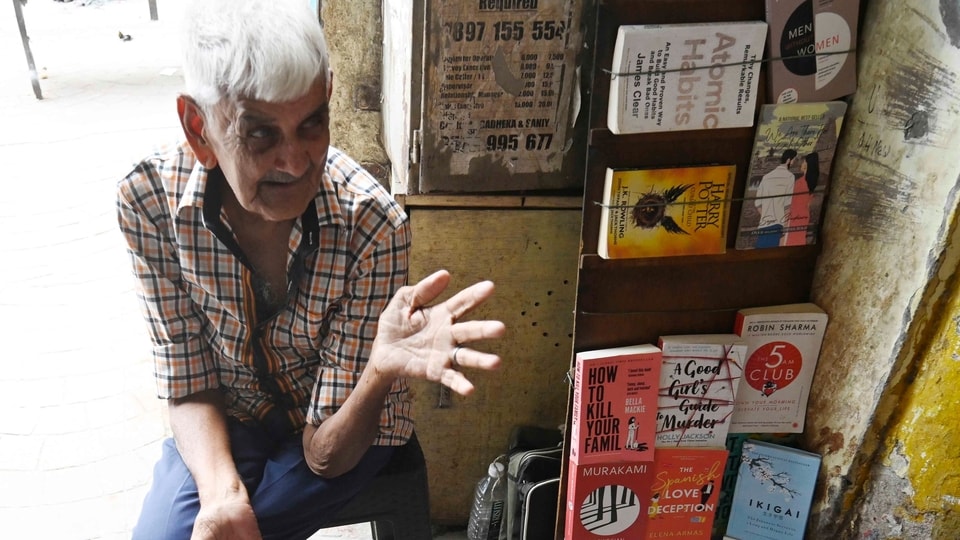
As you stroll through Love Lane in Hazratganj, thumbing through stand after stand of women’s clothes, you may miss seeing him, but he has been witness to the sea of changes in Lucknow - both the subtle ones as well as the not-so-subtle ones - for nearly four decades.
Eighty-year-old Mobin Beg sits quietly on a low stool, beside his display of some 30-odd English paperback titles, waiting for someone to pick up one, even though he knows how reading habits have evolved and paper has given way to screens. But Beg remains a ‘Momin’, a believer in the lasting charm of books.
From Monday to Saturday, between 11 am and 5 pm, Beg can be found at his makeshift setup - a modest display that stands as a quiet act of persistence against the modern tide.
“Accha lagta hai, time bhi kat jata hai (It feels good, and it helps pass the time),” Beg says when asked why he continues to sit on the pavement for six hours a day at his age. It is an unassuming explanation for a journey that began four decades ago out of financial necessity, but over time deepened into routine, habit, and ultimately, an absolute passion, even with failing faculties.
Also read: Lucknow waste-side story: ‘Swachh’ on paper, stench on the ground
From shopfront to sidewalk
Beg’s ties to the Hazratganj book trade go back to the early 80s. Around 20 years ago, he and his brother ran a small bookshop in Love Lane. When the building was demolished, their paths diverged: his brother relocated to a shop in Janpath, while Beg took his trade directly to the streets.
In the 1990s, his roadside business flourished on the popularity of comic books. On good days, he would sell dozens of titles to eager youngsters. Today, the comics are gone, and English paperbacks find few takers: sales have dwindled to just two or three books a day.
“Sab phone mein lage rehte hain (Everyone is absorbed in their phones),” Beg says softly, acknowledging the shift in how people consume stories.
The economics of his trade are as delicate as his setup. A novel carrying an MRP of ₹900 is typically offered at his stall for ₹500, sourced from distributors for around ₹350. His daily profit is minuscule, and his living conditions remain humble.
For those who interacted with Beg when books were lapped up faster than kebabs, the decline is more than a change in sales figures.
Also read: Actor Bhagyashree on her love affair with Lucknow: There’s a distinct softness to this city
Dr Anita Bhatnagar Jain, a 1985 batch former IAS officer and former additional chief secretary, was a frequent customer of Beg in the late 70s.
“That was a time when reading was a hobby for many people. That is also a reason Beg’s books and comics used to sell at that time,” Jain said. Her association with Beg was not limited to buying books. “Mobin Beg has been a great source of books for me. Because of him, I was able to read a lot,” she said.
The change is not limited to Mobin’s stall. Former bureaucrat Wajahat Habibullah believes it reflects a wider transition in Lucknow, a city with a long association with books and reading.
“Lucknowites have always been very fond of reading. However, these days the reading habit is dying.” Habibullah says. But Mobin’s continued business is a sign that the culture has not disappeared altogether, he mused.
“It is characteristic of Lucknow that Beg is able to sell these many books in a day,” he said.
Beg lives in Rajajipuram with his wife, his son Aaweg Beg, who is a tuition teacher and the family’s sole earning member, his daughter-in-law, and two grandchildren. He no longer commutes by bicycle as he did well into his 70s. Five years ago, his son began dropping him off in the morning and picking him up every evening.
The bicycle is gone, but the daily pilgrimage remains unchanged.
Chapter of goodwill in book of life
What Beg lacks in commercial footfall, he has accumulated in goodwill and community respect. Sanjay Arora, owner of the nearby Kalakunj Book Store, has known Beg for 46 years. Beg still stops by Arora’s store daily to purchase three or four titles at a special discounted rate to restock his pavement display.
“He has been around since the time I first came here,” says Arora. “We became friends over the years. He has kept the lamp burning.”
Other local shopkeepers echo the sentiment. Deepu Jaiswal, a clothing vendor who has operated near Beg’s spot for two decades, and Mohd Shakeel, a fellow trader of 25 years, note that while Beg was never financially wealthy, he has earned immense affection. Long-time patrons occasionally pay him more than the asking price of a book simply to support his presence.
Down the road is Universal Book Store, one of Hazratganj’s premier literary hubs. Its owner, Chandra Prakash, views Beg’s presence not as competition, but as an inspiration. “Even at this age, if Beg is selling books, it is something tremendous,” Prakash says. “It shows his sheer passion for the trade.”
But as the world passes by him, flickering screens in hand, his gentle, light eyes carry hope. His lips carry the flicker of a smile.