
 E-Paper



UP CM Yogi announces advanced paediatric centre at SGPGI
CM Yogi Adityanath also inaugurates emergency medicine and kidney transplant centre; dedicates projects worth ₹600 crore at SGPGI, Lucknow

 Prefer HTon Google


Chief minister Yogi Adityanath on Saturday announced that a ₹500 crore advanced paediatric centre will be developed at Sanjay Gandhi Post Graduate institute of Medical Sciences (SGPGIMS), Lucknow.
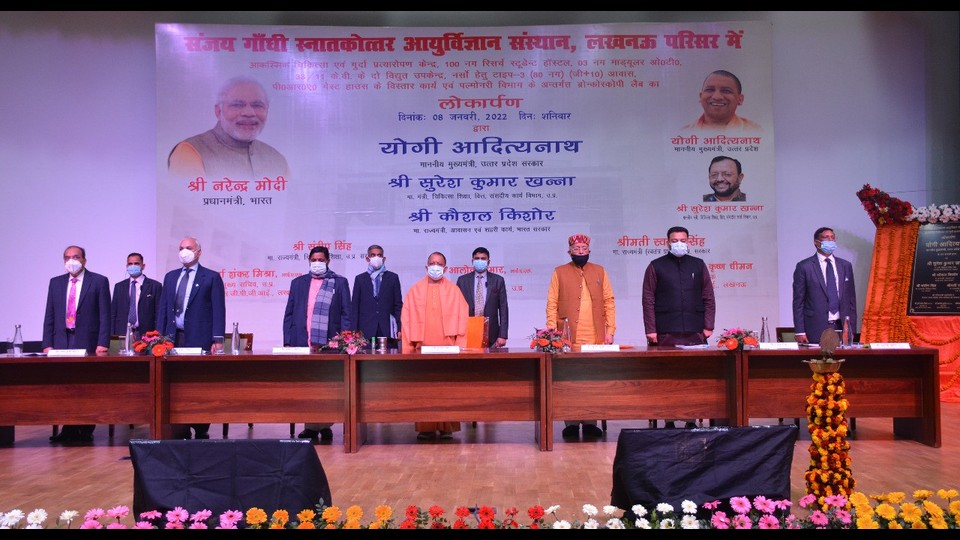
He also said the government will ensure that the project comes up in a time-bound manner. “It will be a centre for children with all the components existing as departments under one roof. It would provide holistic care to children,” said a press release issued by SGPGIMS soon after the CM’s announcement.
Yogi said this while dedicating to people the newly constructed emergency medicine and renal transplant centre at the medical institute. The centre houses a host of advanced facilities under one roof. The inauguration ceremony took place in CV Raman auditorium at the SGPGIMS.
He said kidney patients in Uttar Pradesh will now get best treatment facilities. “The day is not far when SGPGI will become the hub of organ transplant. Not only will the kidney transplant project expand here but liver transplant will also get a boost,” Yogi said.
“When the foundation stone of the emergency medicine and kidney transplant centre was laid three years ago, we were not sure if it could be established on time. But despite Covid, it has been inaugurated today with the help of the central government and that too within time,” the CM said.
Various projects worth more than ₹600 crores have been inaugurated at SGPGI, a CM tweet reads. It says with this people of UP will be able to get better medical facilities. His tweet says, “With a view to providing best facilities to kidney patients in UP, the emergency medicine and kidney transplant centre has been inaugurated at SGPGI today.”
“We will not let any challenges to become a breaker,” Yogi said while lauding the efforts put up by the team of SGPGI for excellent management of Covid 19 pandemic without being affected by the criticism which was also a part of this difficult journey.
Stating that the SGPGI played an important role during the first and second wave of Covid, the CM said in fight against the pandemic, medical institutions like SGPGI worked relentlessly. Yogi also shared his intensive and extensive planning and research work done to eradicate Japanese Encephalitis (JE) from eastern UP, particularly Kushinagar district, which could only be done with the interdepartmental coordination.
“Today, when someone asks me what is the biggest achievement of our government, I say that earlier thousands of children would lose their lives due to encephalitis. But after coming to power in 2017, we have been able to control encephalitis to a great extent. Our government has given a new life to eastern Uttar Pradesh,” the CM said.
The kidney transplant centre will enhance the capacity of dialysis to 110 dialysis stations from the existing 55 stations, clinical beds from 62 to 97, critical care nephrology from 8 to 11 beds and there will be two operation theatres dedicated for intervention nephrology to cater to estimated 50,000 patients of end-stage kidney disease requiring dialysis and kidney transplant in UP.
Referring to the achievements of the government in the medical field, the CM said before 2017 the medical infrastructure in Uttar Pradesh was like a challenge. The state had 12 medical colleges. “Today we are moving towards setting up medical colleges in every district,” he added.
The new emergency medicine centre is built to cater to over one lakh emergency patients per year. This is a seven-fold increase in the number emergency beds from the current 30 to 210 beds. It will have multiple (over 20) emergency care segments, including a dedicated radiology wing with MRI/CT/ultrasound/DSA/x-rays.
Speaking on the occasion, SGPGIMS director prof Radha Krishan Dhiman presented a detailed report of the facilities of the centre. He also expressed his gratitude to the state government for extending its full support in completing the centre within record time.
Union minister of state for housing and urban affairs Kaushal Kishore; UP minister, medical education, Suresh Kumar Khanna; UP minister of state, medical education, Sandeep Kumar Singh; chief secretary, Uttar Pradesh, Durga Shankar Mishra and principal secretary, medical education, UP, Alok Kumar were also present on the occasion.
* The advanced paediatric centre will have under one roof 22 departments and services. They include neonatology (new-born care), paediatric gastroenterology (liver and digestive), paediatric endocrinology (hormones and diabetes), paediatric intensive care and emergency, paediatric genetics, paediatric immunology, paediatric neurology, paediatric cardiology, paediatric nephrology, surgical specialties like paediatric surgery, paediatric urology, paediatric neurosurgery besides new branches like paediatric orthopaedics and rehabilitation, developmental paediatrics and paediatric psychiatry among others.
*The centre will have 18 wards, 13 ICUs and high dependency units (HDUs), 14 operation theatres, a large occupational therapy /physiotherapy and rehabilitation centre, child-friendly areas like play rooms and nursery/infant feeding rooms in addition to outpatients, social services and OPD diagnostics.
* The new departments will develop DM, MCh and PDCC courses and be able to provide trained manpower for Uttar Pradesh and the country. To provide the best care to the children of the country, development of subspecialties of paediatrics is crucial, an official said.
*The capacity building will target not only doctors but also specialised nursing, nutritionists, paediatric occupational and physiotherapists among others.
*Medical and paramedical training focused on child health would attain higher standards with capacity building for the state and the country. Such advanced paediatric centres exist only in 3-4 other states in the country and would be a boon for Uttar Pradesh.


