
 E-Paper



Are Mumbai’s flamingos in the pink of health?
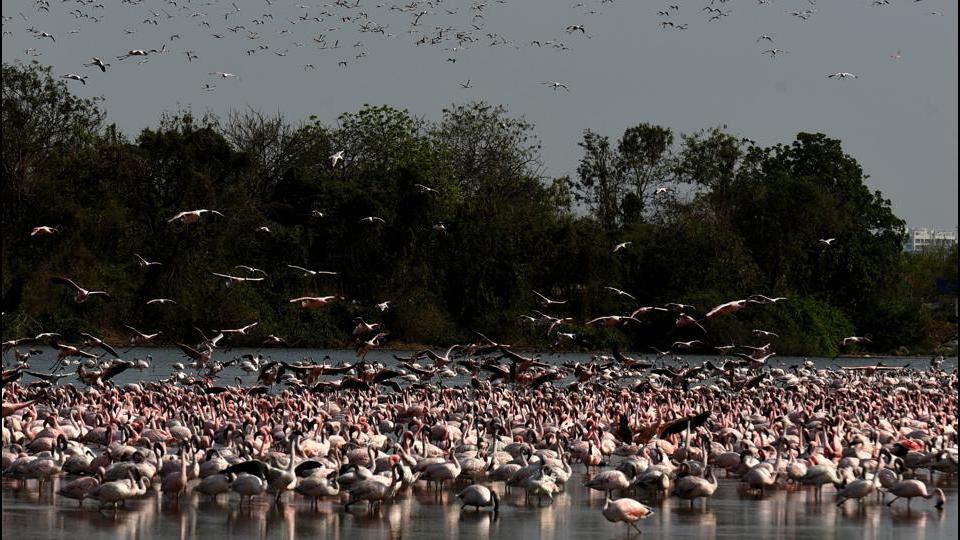
Flamingos have been flocking to Mumbai for close to three decades, and though experts maintain they have probably visited in smaller groups earlier, the first large congregation (about 8,000 birds) was observed only in 1994

 Prefer HTon Google


For the past three years, a group of 20-25 researchers and field staff have been residing at the Bombay Natural History Society’s (BNHS) field station in Airoli, which was set up in 2017 to facilitate scientific studies in and around Thane Creek and Navi Mumbai. On three consecutive days each month — depending on when the tide is most favourable — the researchers set out to survey 46 kilometres of marshes that line the banks of Thane Creek, a coastal inlet off the city’s eastern waterfront separating it from mainland Maharashtra.
Armed with gumboots, lifejackets, binoculars, cameras, and a variety of data sheets, the group breaks off at Airoli jetty into smaller teams. A few team up with local fishermen, who help them wade into the mudflats on long, wooden planks, where the researchers use a tube-like implement called a grab sampler to extract columns of the loose, squishy sediment that makes up the creek’s mudflats. Each excursion lasts between three to five hours. Samples and data collected from the field are then brought back to the BNHS campus for laboratory assessment.
During the months when flamingoes and other migratory shorebirds arrive to feed on the algae, cyanobacteria and small crustaceans that live in the creekbed, the group ventures into deeper water to count, photograph and observe these birds in their habitat. The end goal, researchers explained, is to draw up an evidence-based conservation blueprint for the ecology of Thane Creek, which many say is at risk from pollution and upcoming infrastructure projects.
It’s also part of an ongoing long-term study — the first of its kind — to assess the populations and behaviours of flamingos and other waders in Thane Creek.
Bridging the gap
Flamingos have been flocking to Mumbai for close to three decades, and though experts maintain they have probably visited in smaller groups earlier, the first large congregation (about 8,000 birds) was observed only in 1994. Their numbers have since grown, with hundreds of thousands annually migrating from their breeding grounds in the Rann of Kutch to the landscape in and around Thane Creek, arriving usually in November and staying till early June.
Little else is known about why they visit and what their relationship is to the city’s environment.
The BNHS conducted a preliminary assessment of the area’s avian biodiversity and prepared a report in 2015, when they were commissioned to conduct a 10-year-long study after the Mumbai Trans Harbour Link (MTHL) — a 22-km-long bridge to be built across the mouth of Thane Creek from Sewri in south-east Mumbai to Chirle in Uran, Raigad district — was given the go ahead.
In September 2015, ahead of the then chief minister Devendra Fadnavis’ visit to Japan, to meet with the project’s primary benefactors — the Japan International Cooperation Agency (JICA) — the state accepted a key condition put forth by the Union environment ministry, without which the MTHL would have been denied the mandatory environmental clearance (EC) needed for work to take off.
The condition was that a long-term monitoring study of flamingos and other shorebirds in Thane Creek be outsourced to BNHS, who would track their numbers alongside the construction and operation of the MTHL. The BNHS study (which began in 2017) will conclude in 2027.
Learning about waders
Researchers highlighted four broad aims of their ongoing study. First, they are trying to assess the true extent of the Creek’s flamingo population, with recent estimates putting it between 100,000 to 150,000 annually. The second is to assess the availability and distribution of food in the creek’s intertidal mudflats.
The third goal is to learn more about the flamingos’ migratory paths. Though largely from Gujarat, researchers now believe that some birds may also be flying over from Kazakhstan and Iran.
A total of 39 birds in the creek have been tagged with aluminium rings bearing unique ID numbers, and may be re-sighted in other countries. Two birds tagged in Mumbai have been tracked from Tamil Nadu and Rajasthan in the last two years, and researchers also plan to tag about 10 flamingoes with radio-collars by December 2021.
And finally, the researchers also hope to also understand the relationship of the birds to the creek. They now know that the birds are habituated to feeding sites, and that a group of flamingos will forage in the same spot, day after day. Researchers also know that the largest groups congregate in Sewri, Mahul and Airoli, and that they use satellite wetlands in Bhandup, Navi Mumbai and Uran as roosting grounds during high-tide, when the water level in the creek rises.
“We are also studying the birds’ behavioural responses to disturbances like the MTHL construction, and fishing,” said Mrugank Prabhu, a scientist at BNHS and one of the residents at its Airoli field station. At the moment though, Prabhu added, it is still too early to draw any conclusions from the work his team has done. When asked specifically if the MTHL construction underway had an impact on flamingo numbers in Sewri and Nhava, he emphasized that “the birds have not abandoned the area despite the project.”
“They are keeping a safe distance from the construction site, and are feeding there in good numbers. The disturbance may be temporary, but only long term monitoring will reveal that,” added Rahul Khot, assistant director at BNHS.
““There is a paucity of historical data on the subject of flamingos and the ecology of the creek, which is an incredibly dynamic system. Our long-term ecological monitoring study is a flagship effort toward shaping conservation policies in future. We are finally producing the critical data that is required for this,” said Khot.
The absence of a proper study has been a sticking point for environmentalists. Had such a long-term monitoring study been undertaken prior to the construction of the MTHL, the impact of the project would be easier to gauge and mitigate. “The state has been content to use these flamingos as tourist attractions, but didn’t think of investing in conservation until it absolutely had to,” said Stalin D, director of non-governmental organisation Vanashakti.
Raising concerns
The environmentalists’ main objection to the MTHL has been its direct passage through the Sewri-Mahul mudflats, which provide a habitat for as much as 15% of the near threatened lesser flamingo (Phoeniconaias minor) in South Asia.
In its preliminary assessment, the BNHS recommended that this section be re-routed, but the suggestion was not accepted by the state government.
However, based on environmentalists’ demands and a recommendation by the Union ministry of environment, the state declared 1,690.5 hectares of the creek — in Mulund, Vikhroli, Bhandup, Kanjur and parts of Mandale village — as a Flamingo Sanctuary in 2015. The forest department even prepared a 10-year management plan. With MTHL cutting through a sizeable portion of migratory bird habitat in Sewri and Nhava, the sanctuary, which is north of the MTHL, has delineated a zone in which further development and infrastructure projects would be restricted.
Experts, however, also cautioned that the MTHL isn’t the only thing to watch. Pollution from domestic sewage, effluents from over 4,000 industrial units which line the creek, and hot water discharges from Tata thermal power plant and the BARC nuclear research reactor causes an edge effect: rapid ecological changes between two habitats (such as land and water) which can create a set of specific conditions that allow certain species to thrive. In this case, rapid pollution and siltation in the Thane Creek is leading to a proliferation of food (and feeding) grounds and driving up flamingo numbers.
“It’s somewhat of a paradox that pollution helps the flamingos thrive. The real question is to what degree the creek could sustain these processes before risking their survival?” asked Dr Prasad Karni, a biologist and member of the Paryavaran Dakshata Mandal, a Thane-based environment advocacy group.
Rapid siltation is making the creek shallower and narrower. HT reported on June 14 that a study by the state forest department’s mangrove cell indicated that Thane Creek has lost 30 sq km of its water spread since 1972, with most of this area having been turned into fresh mudflats. These are believed to support flamingos for a time, but soon become overrun with mangroves that take root in the silt.
“Flamingos and migratory waders are benefiting from the shrinking waterways as their population increase is being witnessed in the same trajectory as the expansion of mudflats and mangroves. This in combination with high sewage load that MMR is pumping into the creek as well as warm water from refineries and power plants make it a perfect feeding ground, with nutrient rich flora and fauna,” said Dr Deepak Apte, a marine biologist who helmed the MTHL flamingo monitoring programme as former director of BNHS.
“The way I see it, MTHL is not as much of an issue as these other changes happening inside the creek. Heavy siltation is already promoting growth of mangroves, which if left unchecked will outgrow the available area for birds to forage. This is not good news for flamingos, who prefer shallow mudflats over mangrove forests,” said Apte, calling for the implementation of an ecological restoration plan for Thane Creek.


