
 E-Paper



CM Fadnavis seeks judicial probe into MPSC exam chief’s functioning amid protests
Devendra Fadnavis met a delegation of protesters on September 30 in Mumbai, assuring action, following which MPSC secretary Mahendra Harpalkar was transferred.

 Prefer HTon Google


Prompted by agitations led by civil services aspirants across the state, which entered their fifth day on Monday, chief minister Devendra Fadnavis urged Governor Jishnu Dev Varma to set up a judicial commission to probe the alleged irregularities in the Maharashtra Public Service Commission (MPSC).
The state government requested that the a panel, led by a retired high court judge, be formed to probe the functioning of the current MPSC chairperson Vivek Bhimanwar, his predecessors and members of the commission, people aware of developments said. The government has requested that investigation be completed in three months, following which appropriate action will be taken based on the report.
Student groups and MPSC aspirants have been protesting in various parts of the state such as Nashik, Chhatrapati Sambhajinagar, Mumbai, but primarily concentrated at S M Joshi Bridge, Pune, since Thursday, demanding Bhimanwar’s resignation, following the paper leak in MPSC’s recruitment examinations for the post of Food and Drug Administration (FDA) inspector, in July.
Also Read I 3 student protests at Azad Maidan over school closures, engineering admissions and IIT Bombay suicide
Fadnavis met a delegation of protesters on September 30 in Mumbai, assuring action, following which MPSC secretary Mahendra Harpalkar was transferred, even as Bhimanwar maintained that there have been many paper leaks before he took over as chairperson. He didn’t respond to calls from this paper on Monday.
Political tug-of-war
Conversely, continuous visits by key opposition leaders to the demonstrators have fuelled accusations that the politicians are leveraging the situation to corner the Fadnavis administration.
While the initial agitation was spearheaded by NCP (SP) MLA Rohit Pawar, the protest has since split, with students now agitating at two other locations - LBS Road and Tilak Chowk - in Pune. One of the groups is demanding that the existing descriptive format (of the exams) be continued instead of the objective format, which was discussed with Fadnavis when he interacted with protesters recently.
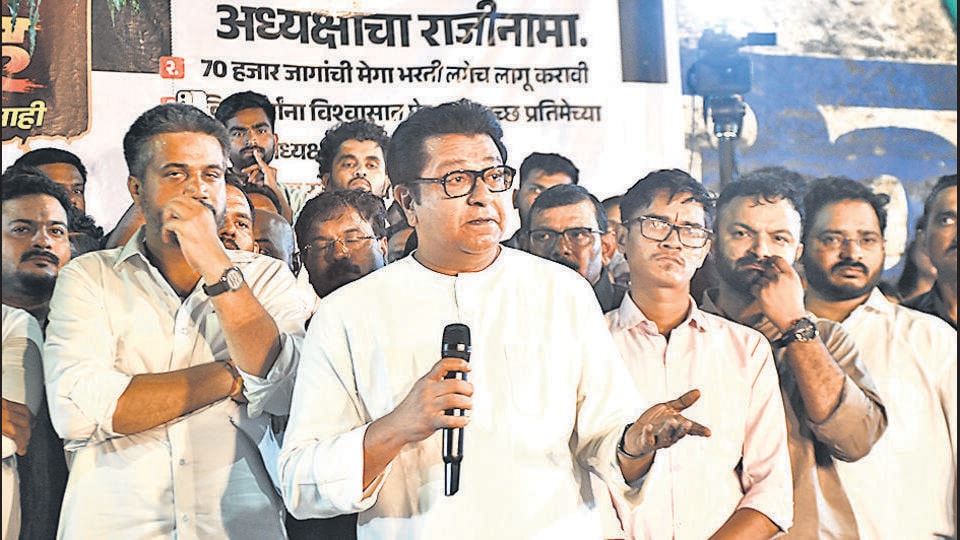
Key political figures are rallying behind the protests. Congress leader Rahul Gandhi is reportedly in contact with Rohit Pawar, while NCP (SP) chief Sharad Pawar previously urged Fadnavis to address the students’ demands immediately. Leaders—including Congress state president Harshavardhan Sapkal, Balasaheb Thorat, MNS chief Raj Thackeray, and CJP founder Abhijit Dipke—have already visited the protest site. Additionally, Shiv Sena (UBT) leader Aaditya Thackeray and Maratha quota activist Manoj Jarange-Patil are expected to visit the demonstrators on Tuesday.
Rohit Pawar said Rahul Gandhi is expected to join the protest on October 7 or 8, warned that if a resolution were not found soon, protesters would march to Mantralaya.
“One lakh students may take to the streets in Pune during Rahul Gandhi’s visit. The students could either call for a Pune shutdown or march towards Mantralaya, Mumbai,” he said.
He called the CM’s latest move “a diversionary tactic to mislead the protesting MPSC aspirants”. “Article 317 has to be invoked to remove Bhimanwar, who is in a constitutional position. However, the authority to do so lies with the governor, which Fadnavis has taken away without cabinet approval,” he said.
Raj Thackeray added, “I have been insisting for the last 22 years that Marathi sons and daughters must be recruited for jobs. If this were followed, there would not have been any need for the job aspirants to stage an agitation.”
Accusing the opposition of politicizing the issue, a BJP leader stated that despite the CM holding two marathon meetings with MPSC aspirants over the past three weeks—assuring them a SIT probe, a high-level committee led by additional chief secretary V Radha, and a judicial inquiry into past and present chairpersons—the students’ planned protest was revived only after outside interference disrupted their agreement to call it off by October 2.
BJP spokesperson Navnath Ban termed the protest in Pune “a politically sponsored agitation by the NCP (SP)”. He claimed that “only 20% of the protesters were MPSC aspirants, while the remaining were political workers associated with Rohit Pawar”.
Pawar refuted the allegations, saying, “Some legislators such as Nitesh Rane were attempting to give the agitation a political colour. Action against Bhimanwar would earn the gratitude of the protesting students. We won’t leave this place until the MPSC chief chairman resigns.”
The anxious aspirants
For thousands of aspirants, preparing for the exams is no longer just a two- or three-year pursuit; for many it stretches between five and eight years, with each exam cycle bringing an additional burden of rent, food, study material and test-series expenses in the cities where they attend coaching classes.
Rushikesh Lungare, 27, who comes from a Nanded-based farming family, has spent nearly five years preparing for the examinations – appearing for the mains three times. “Preparing for the exams with a base in Pune is financially draining. A student needs at least ₹15,000 to ₹30,000 a month to cover all expenses. I take up part-time work whenever there is no examination,” he said. “Learning about the paper leak, and the network that drove it, was deeply shocking and made us question the entire system.”
Shriram Hangargekar, from Dharashiv district where his mother manages the family’s agricultural land, has been preparing for the exams for nearly seven years. “I feel ashamed to depend on my family. I have now taken up a gig worker’s job simply to meet my expenses in Pune,” he said, adding he has taken the mains thrice.
Also Read I Mumbai police clamp down protest by tribal students seeking better school facilities
A retired bureaucrat earlier associated with MPSC, called attention to the social dimension of the protest given the long-standing debate over representation and recruitment within the MPSC. “Over years, the commission has faced allegations regarding the perceived influence of different social groups in government recruitment. There has been a debate over the representation of Marathas and OBCs in the process, particularly since the change in political dispensation. The current controversy has brought these underlying social and political sensitivities to the fore as well.”
(With inputs by Kimaya Boralkar and Ranjan Dasgupta)


Stay updated with all the Breaking News and Latest News from Mumbai. Click here for comprehensive coverage of top Cities including Bengaluru, Delhi, Hyderabad, and more across India along with Stay informed on the latest happenings in World News.


