
 E-Paper



It takes a village: How residents of a Jalna taluka have united to stop a teacher’s transfer
When the school was set up on a small hill in 2004, it had two classrooms, sans doors and windows, with 15 students. Today the fully functional primary school has eight classrooms with 149 students. In the past, villagers who belong to the Banjara tribe, were on the move at all times, leading to frequent dropouts

 Prefer HTon Google


Mumbai: The Zilla Parishad (ZP) in Jalna, approximately 400 kilometers from Mumbai, has received a unique request – the villagers of Sriram Tanda, from Mantha tehsil, Jalna district, have communicated to the ZP office that the routine transfer order of a schoolteacher, Jagdish Kude, be withdrawn. They have written to the state government as well.
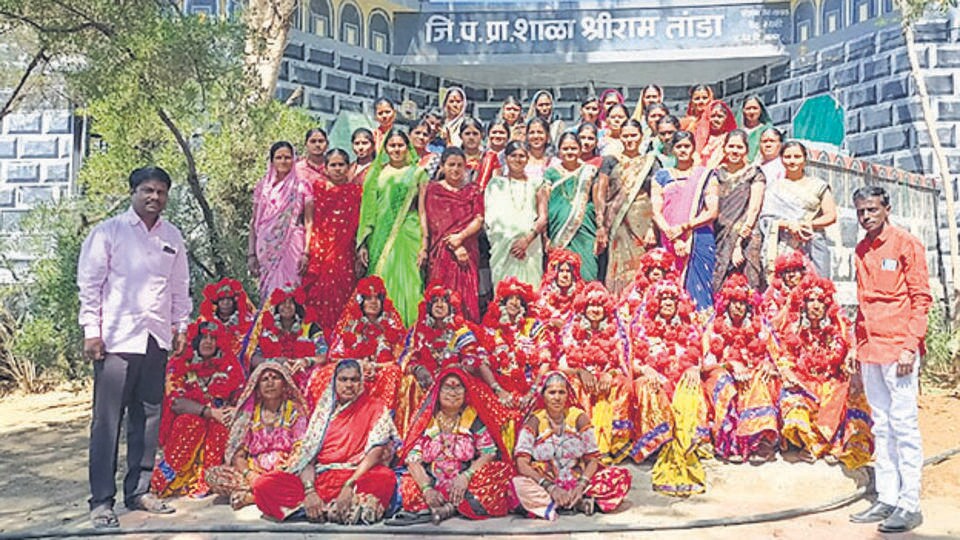
Their pleas are a mark of respect for Kude, who is no less than a social reformer in the village.
When the school was set up on a small hill in 2004, it had two classrooms, sans doors and windows, with 15 students. Today the fully functional primary school has eight classrooms with 149 students. In the past, villagers who belong to the Banjara tribe, were on the move at all times, leading to frequent dropouts. And those that stayed in the village did not make the effort to educate their children.
Kude went door-to-door urging young parents to send their children to school, impressing on them the value of education. He also wrote to the state government to have the school painted and add many facilities.
“He is not only a teacher for us but also a person who brings recognition to our village. Due to him, migration of villagers has stopped, the village became free of alcohol addiction, and the fame of the school spread across the state,” said Sanjay Chavan, a former student and resident of the village, who own a computer institute in a neighbouring town. As word got around, more students started seeking admission to the school, “some even covering a distance of 30 kms”.
Chavan added, “He created an atmosphere for pleasant education in the school and his style of teaching was student-friendly. He taught in a way that every one could understand.”
Kude’s 19 years in the taluka has changed the lives of people – many former students are now white-collar workers, settled in cities.
Laxman Rathod, a senior product manager at an IT firm in Hyderabad, said, “The credit for my achievements rests with Kude sir.” Rathod exited the school when he was in Class II, “bored with education”. He spent the next three years grazing cattle. Things changed in 2004, when the teacher urged him to join the school. “Once in, I became engrossed in education and eventually studied engineering. If not for him, I would have been wandering in the village and become a farm labourer at best,” said Rathod.
In promoting education, Kude is looked upon as a reformer. As Chavan said, “There was no awareness in the village – no one thought about educating girls after Class V. Kude changed this mindset,” he said, emphasising that ‘beti bachao beto padhao’ became an ambition in the hamlet, way before it became a national slogan.
The schoolteacher also conducted de-addiction campaigns: the village, which once had 10 to 12 liquor making centres, is now alchohol free.
“If he is transferred, the pillar of the village will collapse, and then everything will go back to the way it was in 2004. This has emboldened us to prevent the transfer,” said Chavan.
Nand Kumar Rathod, a parent, said, thanks to Kude, today there is a long queue for admission outside the school every year. “My elder daughter attended school till Class V and my younger one is in Class IV in the same school; she travels five kilometres to study every day,” he said. “If sir gets transferred, I will send her to another school.”
Kude is sentimental about the school, as he is a picture of humility. “Transfer is a part of my job. I really thank all my senior officers, villagers and colleagues who helped me in this journey,” said Kude.
Varsha Meena, CEO of the Zilla Parishad, Jalna, said, “I received representation from the villagers requesting to stop the transfer of a teacher, but this transfer was done by senior authorities through an online process. I have forwarded the villagers’ letter to the authorities.”


