
 E-Paper



THE PLAY’S THE THING
Over 54 theatre groups have entered the month-long Maharashtra State Amateur Marathi Drama Competition, which encourages performances from across the state and outside. The competition, which has been running for 62 years, aims to promote and support amateur artists in the face of steep rental prices for privately-owned theatres. The performances are being staged at various venues in Mumbai and tickets have been priced at an affordable ₹10-15. The competition has been a platform for many renowned figures in Marathi theatre, cinema and TV. The state government is considering a hike in the prize money for the winners.


MUMBAI: The preliminary round of Maharashtra State Amateur Marathi Drama Competition, organised by the state government’s Directorate of Cultural Affairs, is underway, keeping alive a 62-year-old tradition. The one-of-its-kind festival in India encourages performances from across the state and outside. This year, over 54 theatre groups have entered the month-long contest, inaugurated by cultural affairs minister Sudhir Mungantiwar, on November 22. The contest has received participants from Baroda, Indore and Gwalior as well.

The performances are being staged at the Ravindra Natya Mandir, in central Mumbai, and the Sahitya Sangh and Y B Chavan auditorium in south Mumbai.
Keeping an old tradition going is not bereft of challenges. At the inaugural function, Mungantiwar threw light on the difficulties of sustaining and promoting amateur artistes in the face of privately-owned theatres with steep rentals. “Only professional, mainstream or big theatre groups that have deep pockets can afford them. But we don’t want Maharashtra’s glorious tradition to be held to ransom over this,” said the minister, promising that the department “will soon build 75 new theatres across the state where rentals will be within reach of the amateur groups”.
The tickets for the performances have been priced at an affordable ₹10-15. “Apart from the legacy, we also need to appreciate how much this competition has contributed to the performing arts in general and theatre in particular. Some of the celebrated theatrical works, actors and playwrights have emerged from this platform, which is nothing short of a movement now,” said head of the Directorate of Cultural Affairs, Bibhishan Chavere. “The tickets have been priced low to draw in the crowds. This will not only encourage new performers but also create new audiences among the youth by honing their tastes.”
The competition was started by Maharashtra’s first chief minister Y B Chavan, a connoisseur of art and culture. Celebrated dramatist, actor, director and narrator Shambu Patil (he has voiced Jananpith awardee Bhalchandra Nemade’s novel ‘Kosala’), reminisced how before the state’s cultural policy was formed, mainstream theatre was the touted preserve of the upper-classes. “The themes were often mythological and peddled supremacist narratives employing heavy, literary language,” he said. “Though they monopolised the institutionalisation, popular folk forms like wahi, gondhal, sattak, batavni, sawal-jawab -- which go back hundreds of years – continued to be patronised by masses since they spoke in their language about issues and concerns close to their hearts.”
Without the state’s patronage, the art would have become extinct, said Patil. “The competition has become the biggest platform for anyone who wants to be an actor, script writer or director,” he said.
And indeed, some of the biggest names in mainstream theatre, cinema and TV have been associated with the state-run competition. Plays like Vijay Tendulkar’s iconic ‘Shantata Court Chalu Aahe’ were performed for the first time here, while playwrights like Ratnakar Matkari and P L Mayekar also showcased their works on this platform. The contest has also birthed directors such as Santosh Pawar and Kumar Sohoni, and actors like Arun Nalawade, Nirmitee Sawant, Shreyas Talpade and Chhaya Kadam. Chief among all is Vijaya Mehta, noted Marathi film and theatre director.
“The arrival of this platform made it easy and gave impetus to many of us to attempt experiments with form and content, which was not easy to achieve in the mainstream format,” said Mehta. “It is a good platform for those cutting their teeth in theatre. One gets to learn so much and grow from the exposure, so when opportunity presents itself to transition to mainstream on stage or the screen it becomes easier.”
Eminent playwright and screenplay writer Mahesh Elkunchwar however had a contrarian view. The octogenarian Sangeet Natak Akademi awardee felt that in “over six decades, it should have gone far beyond”.
“I have had to decline many offers to participate in the platform early on, because of petty politicking,” said Elkunchwar.
Others like Elkunchwar, raised concern over the identity of the jury members being kept in the shadows. “That was not the case before. It used to comprise the who’s who from the world of literature and theatre,” an author who writes with great authority on performing arts, especially theatre, told HT, on condition of anonymity.
Another drawback is the lack of access to sponsorship, promotion and attention that English theatre is known to garner. “Even with current triumphs, the revenue is minimal because, in order to keep tickets affordable for the typical theatregoer, the most expensive ticket in a Marathi play is still only one-fifth the price of a ticket in an English production,” said Kshama Vase, whose Nandurbar group is presenting ‘Nikhare’ (Embers) in this year’s competition.
Ticket price is closely linked to prize money, which continues to be modest – the first prize for in the preliminary round is ₹40,000, the second ₹30,000 and the third ₹20,000.
It is then safe to say that the actual prize is “the recognition and the doors that the win helps open,” said Shambhu Patil. “There was a time when the competition and its inauguration were becoming erratic. Irate, the theatre fraternity boycotted the awards 25 years ago; after that there has been a slow and steady rise in the prize amount,” he said.
Aware of the lacunae, at the inaugural function last week, Mungantiwar said that the government was considering a hike in the prize money, although he did not promise any figures.
The paltry remuneration has meant that writers and actors who exit the stage and make it big in cinema or TV rarely look back. Both actors Shreyas Talpade and Chhaya Kadam expressed how they “would love to do theatre -- maybe an occasional play” but the “math just does not add up.”
A crucial drawback, stakeholders in the fraternity said, is the old tradition of satire and the freedom to take potshots against the ruling regime being compromised. “Though plays entering the competition have to be cleared by the censors, artistes resort to camouflage or subterfuge to pass their message,” a senior official said.
He said, “Unlike earlier when the political leadership took heed and went for mid-course correction in their policies or looked the other way, over the last 25 years, extra-constitutional censorship has become the bigger problem. Occasional vandalism, violence or threats have led to theatre groups indulging in self-censorship. This strikes against the very character and spirit of this platform.”
This year’s entry ‘Gadhvachi Laat Direct Sarkaraat’ (A Donkey’s Kick Can Land You In Power) alludes to the political developments leading to the formation of the current regime. “We have cleared the censor, so there should be no issues,” was all the director of the play, Ankur Wadhwe, said.
Members of the Jalgaon-based theatre group, Flying Bird Film and Theatre Foundation, led by Kirankumar Adakmol, had an odd request. The group is performing the play ‘Chandani’ written by Rohit Pagare. For a few actors, this is their first exposure to the world outside the rural interiors of the state. “I remember one of the actors, Ravikant, reminding me to seek a slot in the night for the performance as many of them had performed only under the glow of lanterns,” said Adakmol.
He said, an urban artiste “may brush this off as silly, but you have to understand that there are people who have never stepped foot inside a pucca theatre and don’t know that you can simulate a night by just putting out the lights”.
“This is a huge learning curve for them. It is tough to quantify such intangible benefits,” he added.
Mumbai’s BEST employees’ theatre group has been performing for 14 years. This year, the group presented an adaptation of William Shakespeare’s ‘Macbeth’.
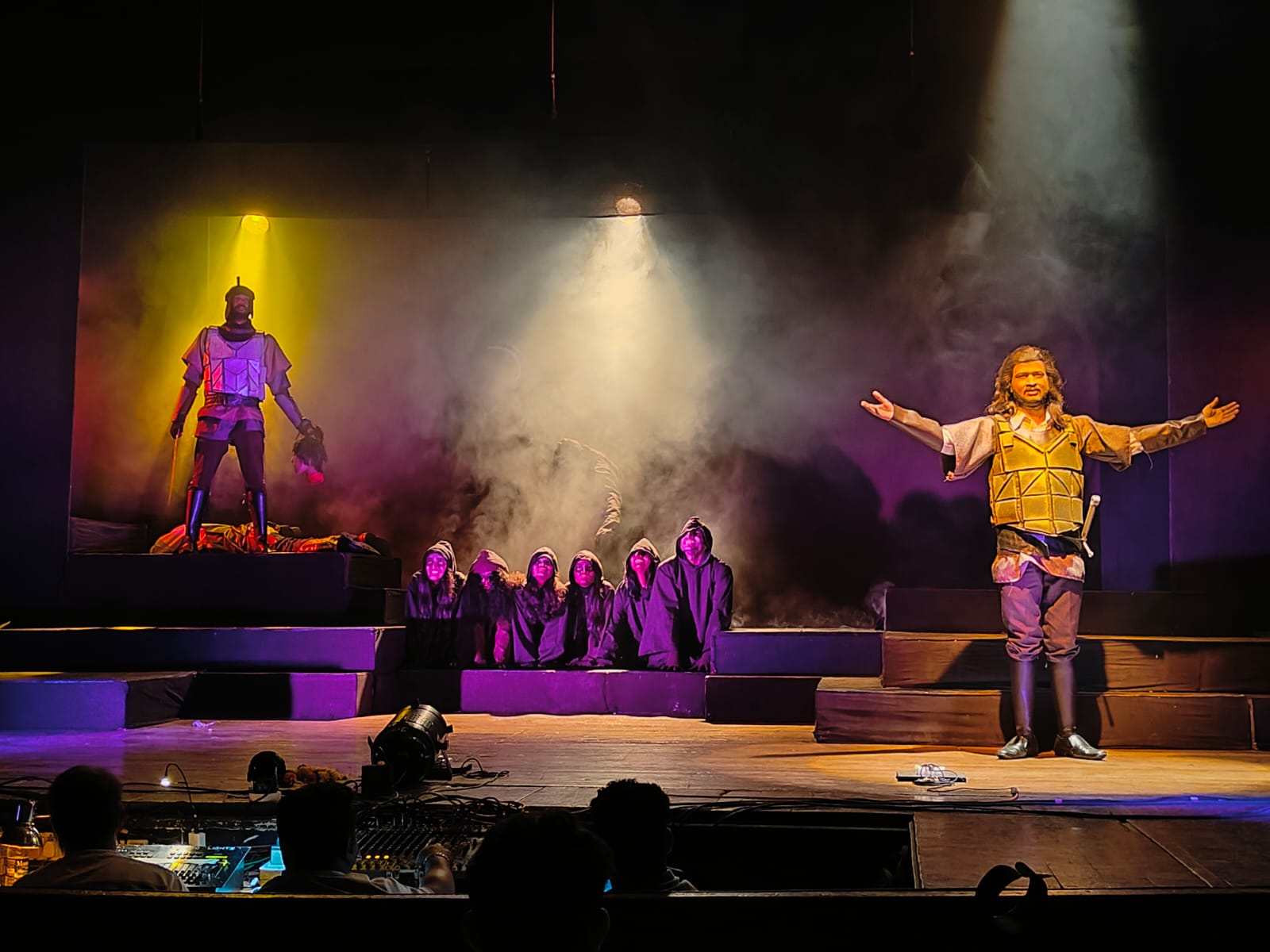
Vijay Suryawanshi, who heads the group, said members routinely engage in readings and rehearsals after finishing their duties. It took them two months to rehearse for the play, as aligning with the workers’ duty schedules was a challenge. “Sometimes Lady Macbeth or one of the witches would go missing,” said Suryawanshi. “We then had to take turns with whoever was free to fill in temporarily.”

Stay updated with all the Breaking News and Latest News from Mumbai. Click here for comprehensive coverage of top Cities including Bengaluru, Delhi, Hyderabad, and more across India along with Stay informed on the latest happenings in World News.


