
 E-Paper



Sutradhara’s tales: Pataleshwar cave temple is rock-cut legacy and monolithic marvel of Rashtrakuta period
This area was once part of the Bhamburda village, which forms an older part of the Shivajinagar suburb today


Did you know one of the oldest monuments in Pune was never built? It was excavated. You may have passed it innumerable times as you moved around Deccan and Shivajinagar gaothan. To truly know this monument you have to literally climb down a historical staircase, to enter a nether-land.
“Mangal Desha, Pavitra Desha” is the famous poem by Ram Ganesh Gadkari describing Maharashtra in his lucid style. He aptly calls Maharashtra, “Dagdanchya desha”, or stone country.
This basalt rock-dominated area provides unique material for raising rock-cut monuments.
Capitalising on this resource, Maharashtra, especially western Maharashtra, sees intense rock cutting activity since the second century BCE, starting at places around Pune such as Bhaje, Karla, Bedse, and Junnar, as part of a Buddhist religious endeavour.
The Vruddheshwar caves on the Fergusson hill and the cave at Hinjewadi mark the Buddhist viharas and water tanks used in the early historic period.
However, the Brahmanical cave excavations begin some centuries later at multiple centres (Konkan, Badami and Central India).
The Punya Vishaya from the Rashtrakuta copper plate inscriptions we discussed last week did not provide us with a material manifestation of what Pune might have been during that period.
This can be seen in the form of the Pataleshwar cave, excavated underground on a huge bedrock of basalt, next to the Jangli Maharaj Math, and on the road by the same name.
This area was once part of the Bhamburda village, which forms an older part of the Shivajinagar suburb today.
The Pataleshwar cave is not an isolated monument, but connects with the larger rock-cut landscape of the Deccan.
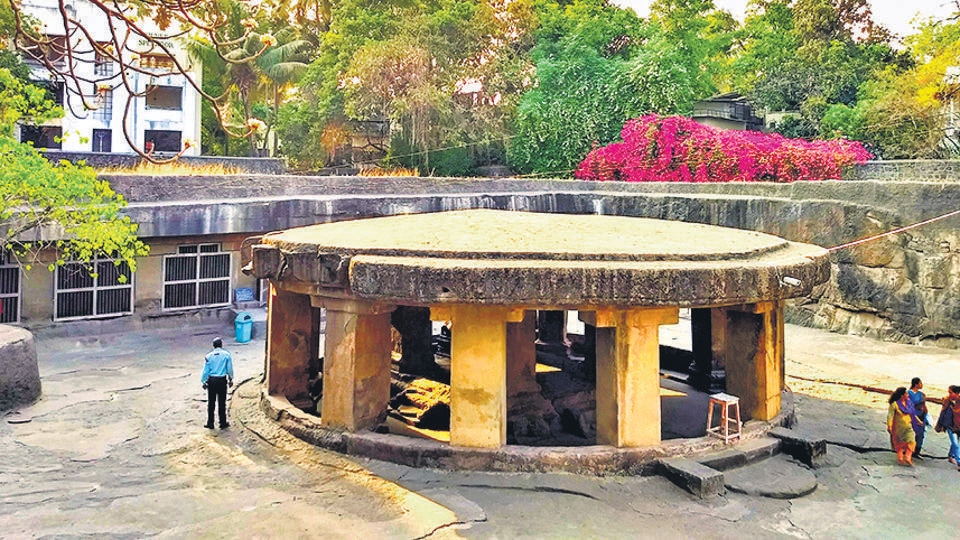
The Pataleshwar caves can be accessed by a flight of stairs, which takes us to an open square-shaped courtyard with a central rock-cut monolithic mandapa. This free standing mandapa is the highlight of the entire cave.
This vahana manadpa is built to house the mount of the central deity, in this case Nandi, the mount of Shiva.
The current Nandi installed is much smaller in size and might be a later addition.
At the entrance of this mandapa is Chandra-shila or a moon-shaped stone.
This free standing mandapa and a similar one at Ambejogai, are precursors to the elaborately carved monolithic Kailasa rock temple at Ellora (Unesco world heritage site) under the Rashtrakuta dynasty.
The courtyard once had a stepped well to provide for water, but was buried due to frequent water contamination and lack of upkeep.
The horizontal and vertical rows of rectangular pillars occupy a major portion of the east-facing hall to leave space for three connected shrines facing the entrance.
Each shrine has a chandrashila flanked by auspicious symbols.
The doorways of the three shrines are decorated and the lintel has miniature shikharas carved in relief.
A circum-ambulation path is carved around the three shrines. As you circum-ambulate the shrines you notice a big chunk of uncut rock left at one of the corners. This feature, combined with roughly chiselled surfaces, is tell-tale sign that the cave has been left incomplete.
Flanked by pillars, wall niches on all sides show some signs of carving, while others are plain.
Thus, based on comparison with Ambejogai cave, Rameshwar cave at Ellora and Elephanta caves, we can identify some episodes with sufficient certainty.
There also exists an inscription at the entrance in Nagari script, but it is quite illegible except for a few alphabets.
Thus, the enigma about the creator of Pataleshwar still remains firmly buried.
The central shrines, today, house Shivlinga and modern idols. However, based on the analysis of architecture and symbols, Dr Manjiri Bhalerao proposed that the three shrines might have been dedicated to a trinity.
We do not know exactly, when the Pataleshwar or Panchaleshwar name stuck to this cave temple. But, the medieval archives inform us that in 1810, Bajirao II offered a dakshina to all the temples in, Pune including donation of 1 rupee to “Bhuyaratil Mahadev”, which has to be Pataleshwar.
James Wales, the artist under the patronage of Sir Charles Malet at the Peshwa court in the 1790s was fascinated by the rock-cut caves around Pune and has drawn a picture of “Pandoo’s cave”, aka Panchaleshwara.
James Wales in September 1792 had sent his assistant Robert Mabon to make a drawing of “Pandoo’s cave”, and he almost certainly visited it himself later.
When James Douglas visited the temple in 1882, the temple was occupied by small group of fakirs. They prohibited him from entering, fearing he would make them leave.
The occupation of Jangli Maharaj (1806–1890) brought a new identity to the place and subsequently, the expansion of Pune city, the building of the road in 1952 (named Jangli Maharaj road), made it a part of the core city.
Excavated 1,300 years ago (eighth century CE), the Rashtrakuta period’s Pataleshwar cave temple stands as a testament to Pune’s first religious expression in timeless rock-cut form.
It is our collective misfortune that insensitive modern infrastructural development in the form of roads, flyovers and underpasses, threatens the existence of Pune’s first monument.


