


 Live Score
 Teams
 Players
Kagiso Rabada strikes every 34.6 balls in fourth innings: How the South African pacer compares with his contemporaries
Kagiso Rabada has the best fourth-innings strike rate among leading Test fast bowlers since his 2015 debut, taking 71 wickets from 2,455 deliveries.

 Prefer HTon Google


The fifth day of the Newlands Test was set for a thriller. Australia needed 288 runs to win the game and seal the series. After their first-innings effort with the bat, the visitors were considered the favourites.
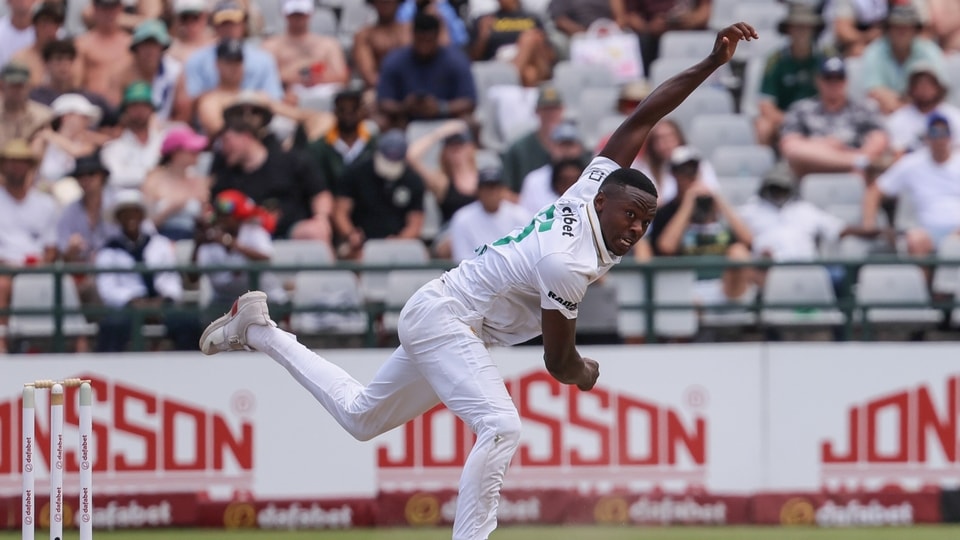
However, Kagiso Rabada turned up with the new ball and dismissed Matt Renshaw and Marnus Labuschagne in the first over. He followed it up with the wicket of Travis Head and had the visitors reeling at 22/3. This was the beginning of a collapse that eventually led to Australia being dismissed for 111, suffering a 176-run defeat. It helped South Africa reclaim the No.1 spot in the ICC Test rankings.
Rabada's performance reveals an impressive pattern in his career. The fourth innings of a Test appears to bring out the best in the South Africa fast bowler. Since Test debut in November 2015, Rabada has the best strike rate among leading fast bowlers in our comparison who have bowled at least 1,000 deliveries in the final innings of a Test.
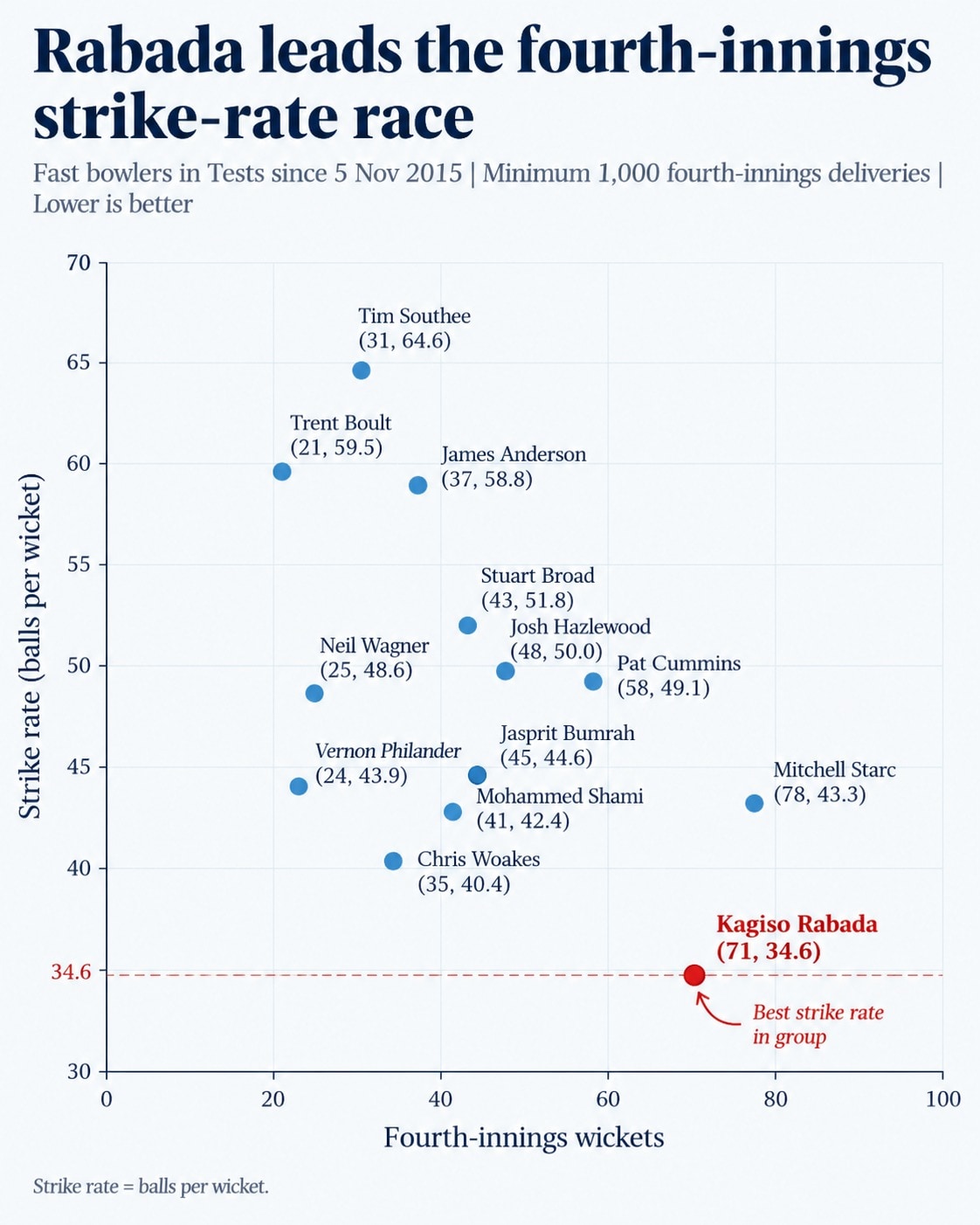
How Rabada compares with the leading fast bowlers of his era
Rabada has bowled 2,455 balls in the fourth innings and claimed 71 wickets. He takes a wicket nearly every 35 deliveries while conceding around 20 runs per dismissal. When compared with some of the dominant pacers of the same period, the closest to him is Chris Woakes. The English pacer has taken a wicket nearly every 40 deliveries in the fourth innings.
| Rank | Bowler | Wickets | Balls | Average | Strike Rate |
|---|---|---|---|---|---|
| 1 | Kagiso Rabada | 71 | 2,455 | 19.72 | 34.6 |
| 2 | Chris Woakes | 35 | 1,416 | 20.08 | 40.4 |
| 3 | Mohammed Shami | 41 | 1,739 | 22.65 | 42.4 |
| 4 | Mitchell Starc | 78 | 3,384 | 24.56 | 43.3 |
| 5 | Vernon Philander | 24 | 1,054 | 18.33 | 43.9 |
| 6 | Jasprit Bumrah | 45 | 2,008 | 21.15 | 44.6 |
| 7 | Neil Wagner | 25 | 1,215 | 20.48 | 48.6 |
| 8 | Pat Cummins | 58 | 2,850 | 22.87 | 49.1 |
| 9 | Josh Hazlewood | 48 | 2,402 | 22.08 | 50.0 |
Among Indian pacers, Mohammed Shami has the best strike rate in the period. He has picked a wicket nearly every 42 balls. One name has been the poster boy of Indian fast bowling during this era: Jasprit Bumrah. He has claimed a wicket every 45 balls.
One criticism often levelled at exceptional strike rates is that they come from relatively small samples. That is not the case with Rabada. He has bowled 2,455 deliveries, while Mitchell Starc has delivered 3,384 balls in the fourth innings in the same period. That translates to approximately 409 overs for Rabada, compared with 564 overs for the Aussie great. The comparison is not merely to establish that Starc has bowled more, but to demonstrate how Rabada has maintained his remarkable efficiency across a substantial workload.
Also Read: Kagiso Rabada fastest to 350 Test wickets, overtakes Dale Steyn as Australia crumble in decider
Rabada's history of dismantling opposition in the fourth innings
This ability of Rabada to dismantle opposition batting line-ups in the final innings was evident long before Cape Town. In 2016, against England in Centurion, he claimed 6/32. His devastating spell helped the Proteas dismiss England for 101, South Africa winning the match by 280 runs. This was far from an isolated instance.
In 2017, Rabada demonstrated his prowess again in Cape Town. Sri Lanka were chasing a mammoth target of 507 runs. Rabada picked up 6/55 and removed key batters like Dinesh Chandimal and Angelo Mathews. He orchestrated Sri Lanka's rout for 224 and his team's 282-run victory. While the targets were huge in both cases, Rabada has also delivered when the opposition faced a much smaller chase.
In 2023, West Indies were chasing 247. Rabada stepped up with a spell of 6/50 and the visitors were bundled out for 159, the Proteas securing an 87-run victory. These performances underline how Rabada has repeatedly emerged a match-winner for South Africa, claiming crucial wickets at the decisive stage of the contest.
His latest performance reinforces that pattern. In Cape Town, Australia were seen holding an edge at the start of the final day. Rabada's incisive opening burst though triggered a collapse that allowed off-spinner Simon Harmer to showcase his brilliance. Harmer claimed six wickets and sealed the match after Rabada had ripped the heart out of Australia's top order. With this performance, he has further strengthened a legacy that could eventually rank among the greatest in Test cricket history.


