
 E-Paper





Roshan Kishore is the Data and Political Economy Editor at Hindustan Times. He heads the newsroom's data journalism team, which produces Number Theory, a daily data-driven feature for the print edition and the HT app. Number Theory uses data analysis and story-telling based on it to add value to the newsroom’s daily coverage by putting stories in a larger context on a range of issues, including politics, macroeconomy, markets, global affairs and climate. Under his leadership HT’s data journalism work has established itself as a niche product in Indian journalism and pushed the boundaries of marrying academic rigour with news sense and speed. Along with writing and editing data stories, he has also been writing a weekly political economy column called Terms of Trade for HT Premium. A trained economist with an MPhil degree from Jawaharlal Nehru University, Kishore has also been a visiting fellow at the Centre for Advanced Studies of India (CASI) at the University of Pennsylvania. Along with his journalistic work, his writings have also appeared in journals such as the Economic and Political Weekly and working papers for CASI and UNESCAP.
INDIA has a problem in Uttar Pradesh | Number Theory
The alliance formation problem, to be fair to both the SP and the Congress, is not easy to solve. Here is why


Samajwadi Party (SP) leader Akhilesh Yadav, while speaking at the Hindustan Times Leadership Summit on November 14, said that the Congress had asked for 181 out of the 403 assembly constituencies (ACs) to be part of the SP alliance. Earlier this week, the SP stunned the Congress by offering it just 26 ACs instead. Yadav, in a public outreach via a post on X, suggested that while the alliance math was still in the works, the Congress needed to lower its expectations in the interest of winnability. The alliance formation problem, to be fair to both the SP and the Congress, is not easy to solve. Here is why.

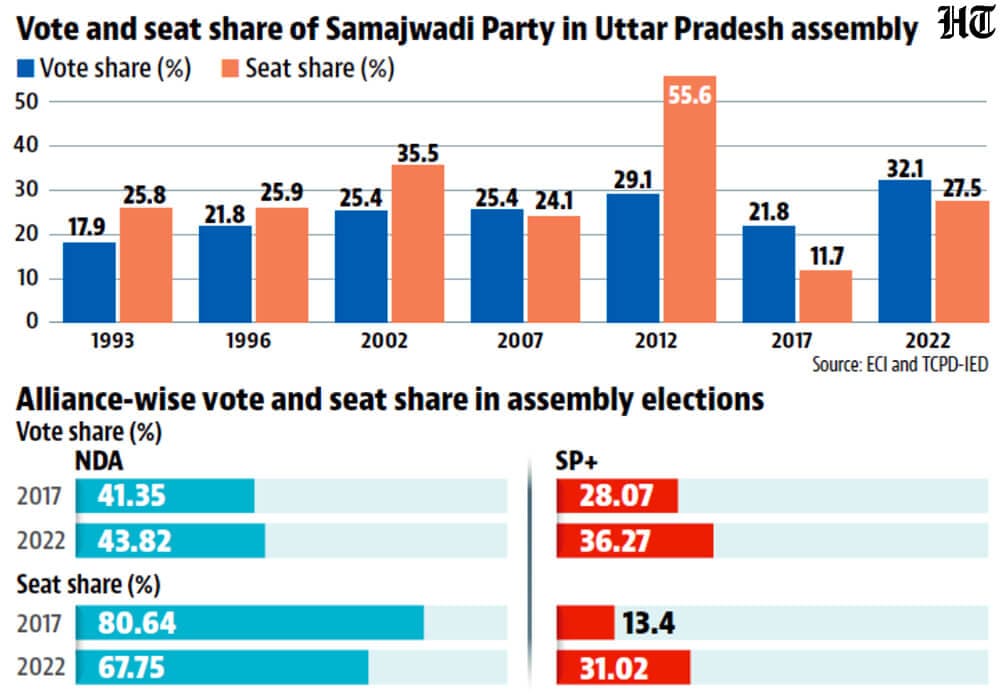
 SP’s gap vis-à-vis the BJP is too big to go alone in the electionsAfter allying with each other in 2017 elections, the SP and the Congress fought separately in the 2022 elections. While the results were an absolute disaster for the Congress – it won just two ACs out of the 399 it contested – the SP faced a bittersweet situation. Its popular vote share reached 32.1%, its best ever in the state, but it could only win 111 ACs, 144 behind what the BJP won. The reason was a wide vote-share gap between the BJP- and SP-led alliances. Now that two of SP’s 2022 partners – Rashtriya Lok Sabha (RLD) and Suheldeo Bharatiya Samaj Party (SBSP) – are in the BJP camp, it really needs a boost in popular support from an alliance partner.
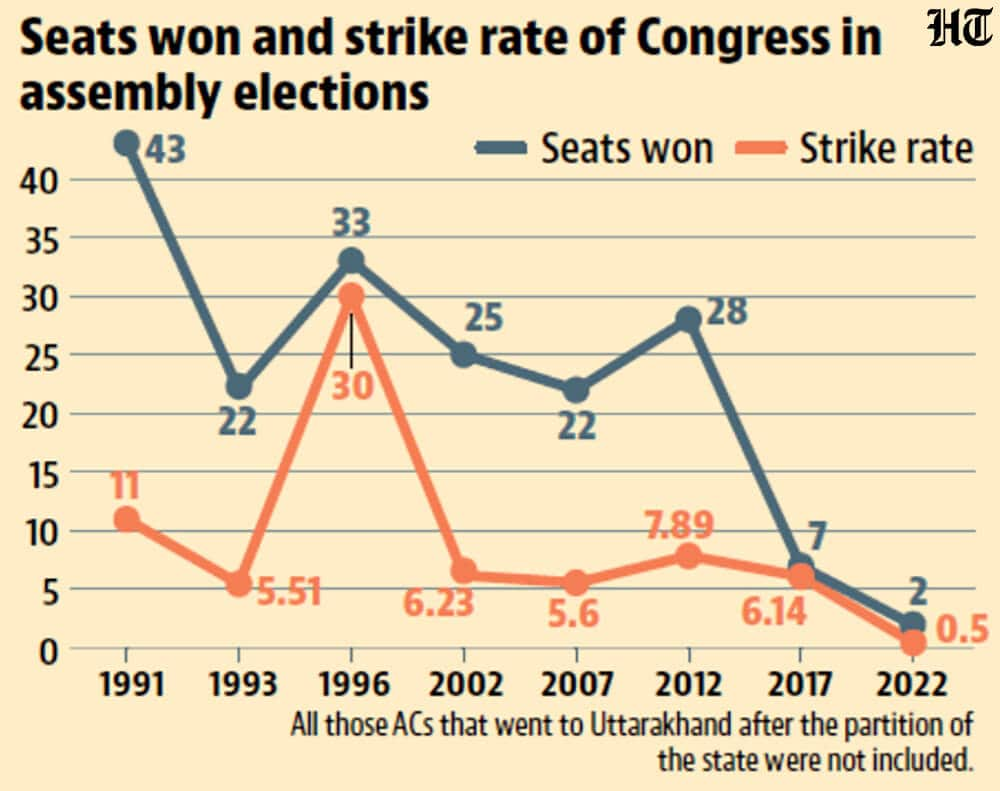
- But Congress has had a very poor track record in Uttar Pradesh since the 1990sIf there is one number that makes the Congress’s ask for 181 ACs in Uttar Pradesh look absurd, it is this. It has won a total of 182 ACs in all eight assembly elections in the state since 1991. Congress’s strike rate – seats won as a share of seats contested – has been in single digits in 2002, 2007, 2012 and 2017 elections. It was just 0.5% in 2022. Given this track record, it is difficult to make sense of the Congress’s demand for a larger number of seats in the alliance.
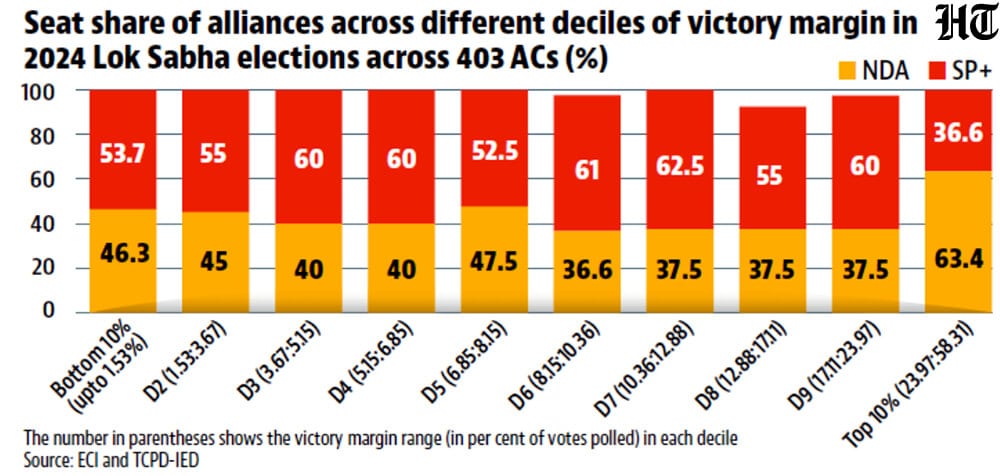
- SP’s real challenge is to preserve 2024’s gainsIf there is one state where the 2024 Lok Sabha election results were an absolute shocker for the BJP, it is Uttar Pradesh. The BJP-led alliance’s seat count went from 64 in 2019 to just 36 in 2024, while the SP-Congress alliance won 43 Lok Sabha constituencies. When broken down at the AC-level, the BJP- and SP-led alliances won 174 and 224 ACs each. What made the results even more interesting was the fact that the vote share difference between the BJP- and SP-led alliances was very small -- 43.69% and 43.53% respectively. A granular analysis of the results shows how tightly contested the elections were. 10% of the 403 ACs were decided by a margin of up to just 1.5% of the votes polled, which would have been enough to flip the majority mark in the assembly between the two elections. Another 10% of the ACs were decided by 1.5% to 3.7% of the votes polled. Given the neck and neck nature of the contest in as many as 80 ACs, it is no wonder that every constituency will witness a hard bargain between the allies and a bitter contest between the two alliances. Alliance formation in 2024 would have been easier for the Congress and SP because the alliance was a distant second on the basis of past results. Not anymore. The 2024 results, ironical as it sounds, might have become the biggest problem for the INDIA alliance in the state.
ABOUT THE AUTHOR
Nishant Ranjan has been working as a data journalist with Hindustan Times since 2023. In this short period, he has established a niche for creating original datasets and utilising them to produce journalistic work that pushes the boundaries of journalism. The list of datasets and stories done by him include the following: a dataset of all 717 chief ministers India has had since 1952, a dataset of all 3,350 members of India’s council of ministers, a dataset of all 190 deputy chief ministers in India and a dataset of all 279 Supreme Court judges in India (1950-2025). He has also profiled each elected Muslim MLA/MP since 1952. He is a mining engineer by training who decided to pursue a Master's in Development Studies from TISS after working in a coal mine for 10 months. He also worked as a research associate at the Centre for Policy Research, researching local governance in India. He also has a keen interest in analyzing electoral politics and political executives in India.


