E-Paper



Over 10 lakh students skip UP board exams in four days
Close to 15% of registered examinees did not turn up for tests, which experts say may be result of strict anti-cheating measures and could lead to a dip in pass percentage.

 Prefer HTon Google


Over 10 lakh students have skipped the Uttar Pradesh board examinations in the last four days till Friday, which is likely to cause a dip in the state’s high school and intermediate exams.
It is for the first time in over nine decade history of the Board that such a large number of examinees have quit examinations, which experts said could largely be a result of strict
anti-cheating measures implemented by the board in accordance with the state government’s directives.
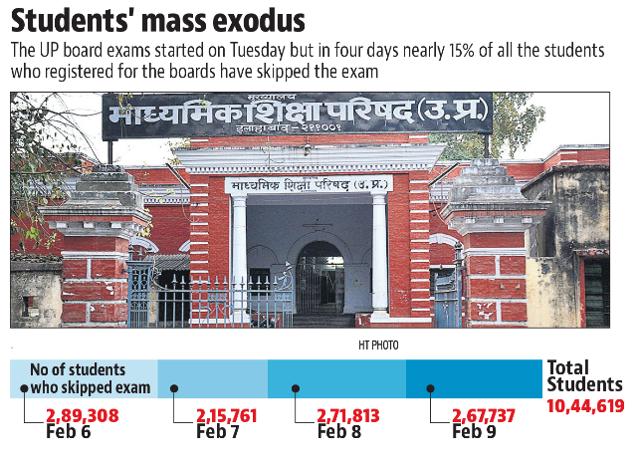
Till the fourth day of the ongoing UP Board’s High School and Intermediate examinations, 10,44,619 lakh students — nearly 15% of all those who had registered.
Board records revealed the total count of examines having left exams include 6,24,473 of High School and 4,20,146 of Intermediate. In 2016, the total count of examinees who had left examinations midway was 6,45,024.
When the past one decade of UP Board records were assessed, a significant fluctuation in overall pass percentage in both high school and intermediate examinations was evident, a likely outcome of the anti-copying measures strictly implemented from time to time.
In the higher school examination lowest pass percentage of 40.07% was registered in 2008 while highest percentage of 87.66 % was recorded in 2016. Similarly in Intermediate examination of the Board lowest overall pass percentage of 65.05% was recorded in 2008 while highest pass percentage of 92.68% was registered in 2013 in past one decade.
According to Lal Mani Diwedi, state general secretary of Uttar Pradesh Madhyamik Shikshak Sangh (UPMSS), varying political will to check copying under different regimes played a major role in the pass percentage fluctuating.
“In 1992. during the Bharatiya Janata Party rule with Kalyan Singh as chief minister, the overall pass percentage in high school examinations had come down around 14 percent% . However, it again started to rise with Samajwadi Party at the helm,” he said.
Diwedi added that during the tenure of the Bahujan Samaj Party (BSP) government with Mayawati as chief minister pass percentage again dropped but “during SP rule between 2012 and 2017 the overall pass percentage for High School remained above 80%”.
As per Diwedi, with such strict measures in place overall all pass percentage in High School and intermediate examination of UP Board could drop to around 50 percent this year.
UP Board secretary Neena Srivastava said this year the authorities had adopted strict measures to ensure that the examinees do not use any unfair means while writing the exams.
Giving details of the measures taken, she said they had ensure d online allotment of exam centres, installation of CCTV cameras across all exam halls, deployment of armed police as well as UP STF personnel to crackdown on the copying mafia besides a strict vigil being kept by administrative machinery of the state to ensure a smooth and copying free exams