
 E-Paper



CJP's Abhijeet Dipke, 2 others detained on Air India plane: What we know of aviation and security rules
Delhi Police detained three CJP leaders in their seats on an Air India flight on Saturday. Aviation security rules may explain part of what happened.

 Prefer HTon Google


Delhi Police officers boarded an Air India flight at the capital's airport on Saturday morning and detained three leaders of the Cockroach Janta Party (CJP) from their seats, shortly after the flight from Mumbai touched down ahead of their planned protest against Chief Election Commissioner (CEC) Gyanesh Kumar.
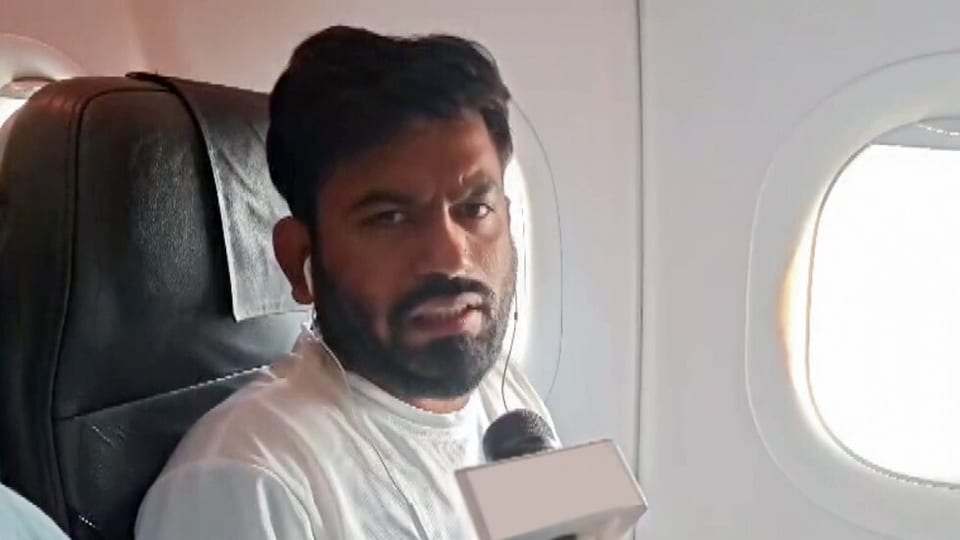
The CJP called it a “pre-planned interception”, and its founder, Abhijeet Dipke, said in a video shared by the CJP that the police could have detained them outside the plane.
The episode raises the question of who may step on board an aircraft once it has parked, and on whose authority. The published aviation security rules answer part of it.
Dipke and co-convenors Saurav Das and Ashutosh Ranka had flown in for a protest at Jantar Mantar demanding the resignation of the CEC over alleged irregularities in the Special Intensive Revision (SIR) of electoral rolls.
The three were released on Sunday.
On board AI 2428
The flight touched down at 10.18am and was moved to remote bay R12 after the airport's Airside Operations Control Centre asked air traffic control to park it there, people aware of the matter told HT. Airport officials said the bay was changed at the last moment, with police and Central Industrial Security Force (CISF) personnel already waiting there.
Officers, including women personnel, detained the three in seats 7A, 7B and 7C after a woman sub-inspector told Dipke the CJP's permission to protest had been denied. "We are here to be arrested, come and arrest us," Dipke can be heard telling them in the video.
The three were the first off the aircraft and were escorted out through cargo gate number 6. "This was done to ensure the safety of the three leaders and prevent inconvenience to other passengers," an airport official said, asking not to be named.
Also read: Farmers stopped at Noida-Delhi border amid CJP protest
Who runs security at an airport
The Aircraft (Security) Rules, 2023, notified by the civil aviation ministry on August 9, 2023 under the Aircraft Act, 1934, and carried over under its successor, the Bharatiya Vayuyan Adhiniyam, 2024, divide the work among several bodies.
The Bureau of Civil Aviation Security (BCAS) is the regulator, and its director general is responsible for "regulatory and oversight functions" in civil aviation security and may coordinate between government agencies, airports and airlines.
On the ground, the CISF handles security at the Delhi airport. The force's chief aerodrome security officer's duties include enforcing access control to the airport's restricted area, supervising the movement of people and vehicles in security-restricted areas, and liaising with local police and intelligence agencies.
Airports and airlines each operate under their own security programme, approved by the BCAS director general.
Getting police airside
Rule 22 of the Aircraft (Security) Rules bars anyone from entering an aerodrome unless they are "a bona-fide passenger", hold a valid aerodrome entry permit or visitor admission ticket, or have written permission from the BCAS director general or the central government. The rules exempt police personnel on duty from the ban on carrying weapons into an aerodrome or an aircraft.
Special passes were issued to the police officers for access to the airport premises, an officer, who asked not to be named, told HT.
Inside the aircraft
Rule 36 puts access to the aircraft in the airline’s hands. "The aircraft operator shall control access to aircraft and maintain surveillance from the security search or check till the departure of the aircraft," the rule states.
The provision runs from the security check to the aircraft's departure. It does not explicitly specify a procedure for police to board an aircraft after it has parked at the end of a flight.
The pilot-in-command's defined role is tied to the cockpit, with airlines required to "assign responsibility of access control of cockpit to pilot-in-command".
Rule 8, which deals with removing a passenger, begins with the pilot. Under it, the CISF's chief aerodrome security officer, or an officer of the Aviation Security Group he authorises, shall “on a written request of the pilot-in-command, assist him in disembarking any person from the aircraft on grounds of risk to safety and security of the aircraft, passengers and the crew”.
A 2024 amendment gives the regulator a separate power. Under Rule 29A, the BCAS director general may, “in the interest of security”, issue written directions to “require any person or group of persons to leave the aircraft”.
It isn't clear whether such a direction was issued on Saturday.
Also read: After CJP, Opposition calls for protest, march to Supreme Court to demand action against SIR
What officials say
Former police and CISF officers told HT that police can legally board a parked aircraft after coordinating with the pilot-in-command, and a former CISF officer said police must inform the airline, which tells the captain. “It is the pilot who opens the door from inside and allows them to enter,” the officer said.
“An aircraft is considered in flight from the time doors are closed before take off to doors are opened after being parked, during which the PIC (pilot-in-command) is the ultimate power,” an airline official said, adding that once the doors are open, any security agency can enter for serious issues.
The 2023 rules don't define “in flight”.
What we don’t know
The rules require airports, airlines and other entities to ensure that their security programmes and “other sensitive aviation security information” are “protected against unauthorised access, amendment and disclosure”.


