E-Paper



India clarifies on mural in Parliament building that offended Nepal politicians
Arindam Bagchi said the mural depicts the spread of the Ashokan empire and the idea of responsible and people-oriented governance

 Prefer HTon Google


NEW DELHI: India on Friday sought to play down the issue of a mural in the new Parliament building that has stoked controversy in neighbouring Nepal and Pakistan, with the external affairs ministry saying the artwork only depicts the spread of the prehistoric Ashokan empire.
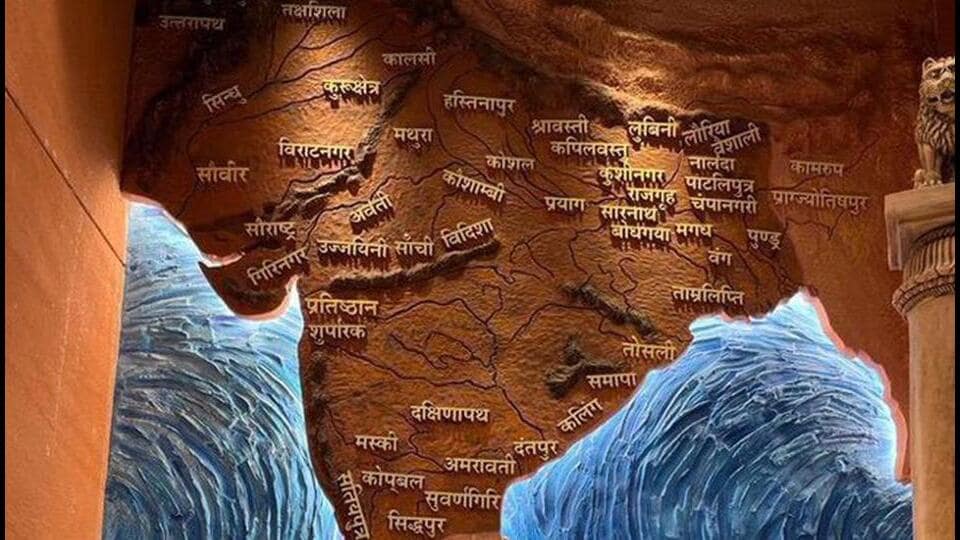
The mural, which officials have said is a depiction of the influence of ancient Indian thought, has been referred to by some BJP leaders as a representation of “Akhand Bharat” or unified India that includes parts of several neighbouring countries. For instance, the mural has been referred to as a depiction of Akhand Bharat in tweets posted by parliamentary affairs minister Pralhad Joshi and Lok Sabha member Manoj Kotak.
The references to Akhand Bharat did not go down well with political leaders in Nepal and Pakistan.
External affairs ministry spokesperson Arindam Bagchi told a news briefing that the mural was not raised by visiting Nepal Prime Minister Pushpa Kamal Dahal during a meeting with his Indian counterpart Narendra Modi on Thursday. Bagchi said he didn’t know if protests were going on in Nepal over the matter and that he hadn’t seen any official protest from Pakistan.
“The mural in question depicts the spread of the Ashokan empire and the idea of responsible and people-oriented governance that [Emperor Ashoka] adopted and propagated,” Bagchi said.
“That’s what the mural and the plaque in front of the mural says. I really don’t have anything further to add to that. I’m certainly not going to comment on statements that other political leaders might have made,” he added.
The mural depicts ancient sites such as Lumbini and Kapilvastu in Nepal and other historic locations in present-day Pakistan.
Ahead of Dahal’s arrival in India on Wednesday, Nepal’s political leaders urged him to raise the matter with Indian interlocutors and to seek the removal of the mural. Former Nepal prime minister KP Sharma Oli was among the leaders who raised the issue.
“If a country like India that sees itself as an ancient and strong country and as a model of democracy puts Nepali territories in its map and hangs the map in Parliament, it cannot be called fair,” Oli said.
Lumbini, the birthplace of Lord Buddha, is among the most important pilgrimage sites for Buddhists. Kapilvastu, an ancient city that was the capital of the Shakya rulers, was the childhood home of the Buddha.