E-Paper



Janakpuri tragedy: Order issued by Delhi Jal Board after Noida techie death ignored
After Noida techie's death by falling in an excavation pit on January 17, the Delhi Jal Board (DJB) had issued a stringent order on January 24.

 Prefer HTon Google


The death of 25-year-old Kamal Dhyani, who plunged into an open sewer excavation pit in Janakpuri, has exposed a fatal disconnect between official safety mandates and their implementation on the ground, revealing how repeated warnings issued after a similar recent tragedy in Noida were systematically ignored.
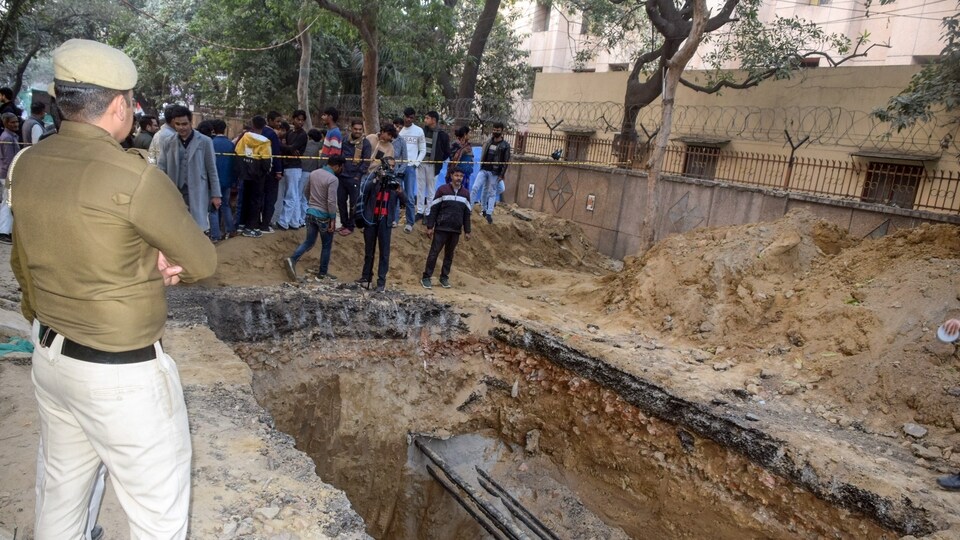
Dhyani’s body was discovered around 8am on Friday by morning walkers.
The incident is starkly similar to one in Noida on January 17, where a 27-year-old software engineer died after his car fell into a water-filled excavation pit. That death had led to nationwide outrage and, in Delhi, it had prompted a flurry of safety directives from multiple civic agencies in the city. But Friday’s accident appears to show that the warnings may have been mere paperwork.
In a direct response to the Noida accident, the Delhi Jal Board (DJB) – the utility overseeing the Janakpuri sewer work – issued a stringent order on January 24. The directive, reviewed by HT, explicitly commanded engineers and contractors to “ensure adequate safety arrangements at all construction and excavation sites.”
It mandated barricading, reflector tapes, green nets, signboards, lane markers, and strict adherence to all public safety protocols.
The order warned that site engineers would be “immediately held responsible” for any lapses and threatened disciplinary action against both officials and contractors. It further required surprise inspections and photographic proof of compliance. Similar guidelines were re-circulated by the Delhi government’s Public Works Department (PWD) and the irrigation and flood control department.
Despite these unequivocal instructions, the Janakpuri site where Dhyani died appeared to be catastrophically unsecured.
On Friday morning, eyewitnesses said multiple people jumped into the nearly 15-20-foot-deep pit to remove the motorcycle that lay on top of the victim. “I saw a crowd gathering when I reached the spot. I could see that the victim was lying inside the pit with his motorcycle on top of him. People then jumped inside and removed the bike, only to discover that he had no pulse,” said a local Rajneesh Sharma, 48, who was among the first on the scene.
Locals alleged that while one end of the road had partial barricading, the other side had none at all. The immediate vicinity of the fresh pit – which residents said was dug only 48 hours prior – lacked adequate warning signs, lighting, or secure fencing.
“This pit is also new, but it is unclear whether he drove through the barricaded side or the other end which had no barricading at all,” Sharma noted.
Yogesh Wadhwa, who works at a shop 20 metres from the site, stated that some of the barricading appeared only after the fatal incident.
“There is minimal protection in the form of barricading. The pit outside my shop was also properly secured only this morning. Earlier, we only had tarpaulin sheets guarding the site,” said Wadhwa, adding while physical barricades existed on one side of the road – from where the victim likely entered – the other side had no barricades.
“People on two-wheelers would often ride on the footpath or ride through the gap between the barricades. Ahead, there was practically no barricading or protection and, in this instance, the fresh pit may have taken him by surprise,” Wadhwa added.
Contributing to the hazard was a chronic lack of lighting. “There are absolutely no lights at night. While streetlights exist, most are non-functional,” said 23-year-old resident Ganesh Chaudhary.
Local RWA president Vikram Diwan cited decades of neglect in sewer maintenance and road subsidence. “That fact that there is plenty of negligence – with the road being not properly barricaded and the pit left open – is quite apparent,” he said.