
 E-Paper



Sowing picks pace as monsoon revives
Sowing of key summer crops accelerated after a long pause following a revival of the monsoon, which has narrowed rainfall deficiency from 33% a week ago to 23% as on date, an official tracking crops said on Tuesday.

 Prefer HTon Google


Sowing of key summer crops accelerated after a long pause following a revival of the monsoon, which has narrowed rainfall deficiency from 33% a week ago to 23% as on date, an official tracking crops said on Tuesday.
The monsoon, critical to the economy, waters nearly half of the country’s farmland and is vital for drinking, power generation and irrigation. It is on track to cover the entire country within the next three to four days, according to the official of the agri-met division, who declined being named.
Only a few parts of Rajasthan, western Punjab and Jammu and Kashmir remain to be covered by the southwest monsoon, which was held up by the formation of Cyclone Biparjoy in the Arabian Sea.
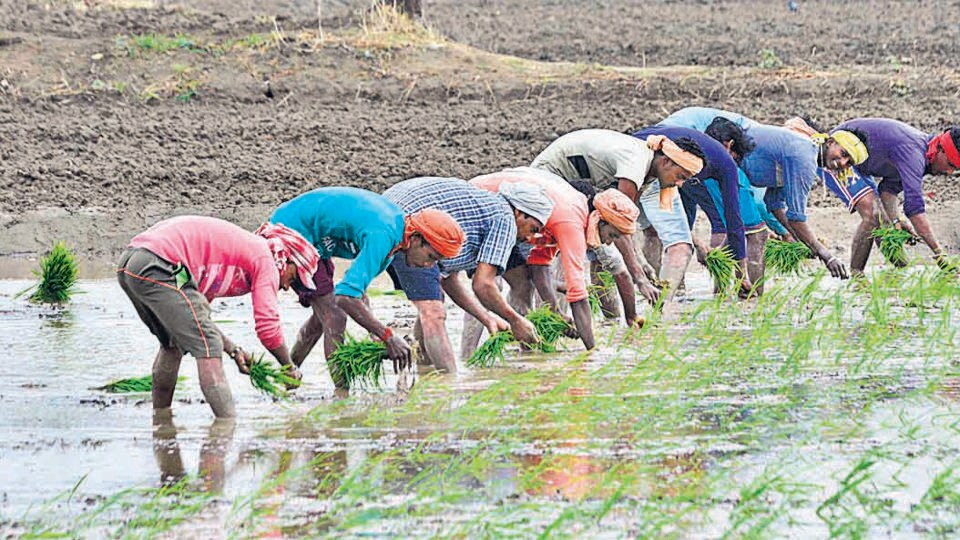
The monsoon’s expansion has allowed farmers in Uttar Pradesh, Haryana, Rajasthan and Madhya Pradesh to sow paddy, the main staple, and other crops, a second official said, seeking anonymity.
The pickup in rainfall will be especially beneficial for cultivators of pulses, which are mostly grown in rain-fed areas with little or no irrigation.
Plentiful harvests help to kip a lid on inflation and boost rural spending, which spurs demand in Asia’s third-largest economy. For instance, rural buyers account for half of all motorcycles sold annually, according to market data.
Analysts have cited concerns over a prevailing El Nino weather pattern, which results in hot and dry summers, and potentially drought. To be sure, the India Meteorological Department has forecast a normal monsoon for 2023.
On June 25, Reserve Bank governor Shaktikanta Das said the central bank would strive to get consumer inflation to a targeted 4% but cited El Nino as a challenge. “Sowing is expected to rapidly expand now and it has started in places where it had been delayed,” the first official said.
Millions of farmers depend on the monsoon to grow summer crops, such as rice, maize, coarse cereals such as pearl millet, lentils such as urad (black gram) and arhar (pigeon peas), apart from sunflower, groundnut and soyabean, crops that yield edible oils.
As on June 23, farmers had planted 1.07 million hectares under rice, which is 34.57% less than that sown in the corresponding period a year ago, according to official data. At 0.92 million hectares, the acreage under pulses was up 3.85%, but the area under key lentil varieties such as pigeon pea was down 65% for this time of the year.
“By the weekend, sowing of rice would have picked up by 3-4%,” said Abhishek Agrawal of Comtrade, a private commodities trader.


