
 E-Paper



What's in ‘H Files’, Rahul's latest ‘vote chori’ charge at EC, BJP? ‘Congress would have swept polls if…' | Watch
Gandhi claims there were 25 lakh “fake” voters in Haryana, including example of woman who is Brazilian model but her pic is used to register at multiple booths

 Prefer HTon Google


Alleging “duplicate, fake and bulk” voting in the Haryana assembly election of 2024 that the BJP won, Leader of Opposition Rahul Gandhi shared on November 5 what he claimed to be the next big set of proofs — dubbed “The H Files" — that the Election Commission is “working at the behest of the ruling BJP to steal votes”.
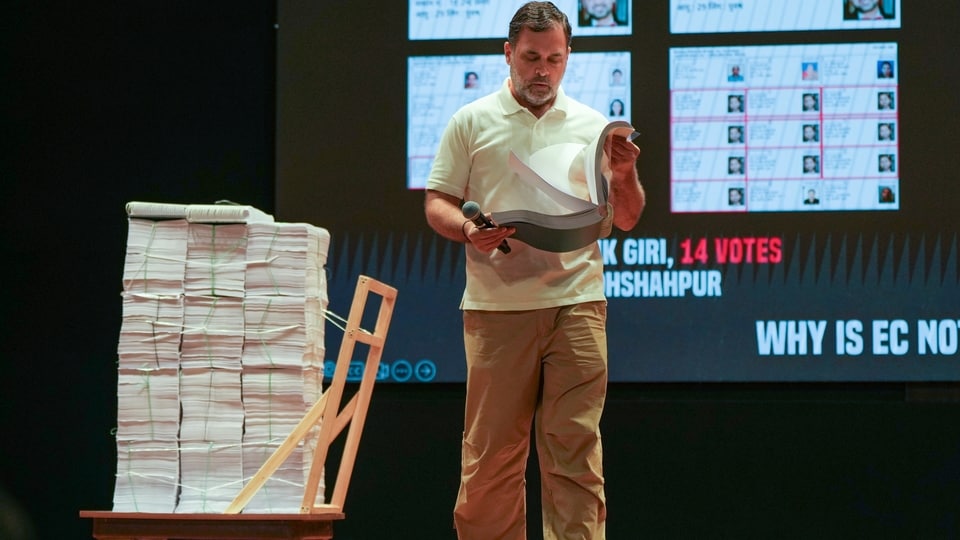
“I want Gen Z to take this seriously, because your future is being taken away from you,” he said at the press conference at the Congress party headquarters in New Delhi on Wednesday, barely two days before voting begins in the Bihar election.
Rahul's big claim on Haryana assembly polls 2024
- The Congress leader claimed there were 25 lakh “fake” voters in Haryana — including an example of a woman he said is a Brazilian model but her photo is used to register as voter across multiple booths.
- The state has around 2 crore total voters, and the key margin of victory for the BJP in eight segments in the 2024 Haryana assembly polls was slightly less than 23,000, he said. This “crucial” number was derived from the eight constituencies considered the lowest-margin seats, including Uchana Kalan, Dadri, and Rai.
- Why eight segments? Haryana has 90 seats, of which the BJP won 48 to make history and form the government for a third consecutive term. The Congress fell short of the midway mark of 45 by eight seats, getting 37, even when exit polls had said it had a significant edge.
- “One in eight voters in Haryana are fake, that is 12.5%,” he said. “This tells you that when the margin was only around 22,000, 25 lakh was just this!” These included 5 lakh he said were duplicate voters, 19 lakh as bulk voters, and over 93,000 with invalid addresses.
- Rahul also showed the same photo being used for over 200 voters in one instance, and claimed another individual voted 22 times across 10 booths in the Haryana assembly election. He said he only used the EC's own data for this.
Also read | 'Kabhi seema, kabhi sweety': Rahul Gandhi says Brazil model appeared 22 times in Haryana electoral list
Watch below: Rahul Gandhi's ‘The H Files’ presentation as webcast live
How EC responded to presser
EC officials responded as the press conference was underway, saying there have been zero appeals against electoral rolls in Haryana. “What were the agents of Congress doing at the polling stations? They are supposed to object if the elector has already voted or if there's doubt about the identity of the elector," said an EC official familiar with the matter.
The EC also asked Gandhi to, thus, clarify his stand on the Special Electoral Revision (SIR) of voter rolls, which he has been opposing with the claim that the EC is being selective in removing voters. “Is Rahul Gandhi now supporting the SIR which removes duplicate, dead and shifted voters along with verification of citizenship, or he is opposing?” said an official.
Rahul's direct charge at EC
Meanwhile, Rahul Gandhi, at his press meet, questioned why the EC has been deleting CCTV footage of polling booths, and alleged that that the EC is not using software capable of removing duplicates. He also said many voters were registered in both Uttar Pradesh and Haryana, some of them notable local BJP leaders.
He characterised 19 lakh “bulk” voters in Haryana as those where 20 or more voters shared a single address. The 93,174 with allegedly invalid addresses are listed with ‘House No. 0’, which CEC Gyanesh Kumar has said is used for the homeless. Rahul Gandhi said the CEC is “lying” on this too.
To questions about why no objections were raised during the SIR in Bihar, for instance, he said parties cannot fix flawed voter lists without access to the complete database, “which the EC does not provide”.
“It is the EC who has to guarantee voter list integrity,” he said, “What the EC does is: it tries to put the onus on the parties who solve the problems. We cannot solve the problems. If you want us to solve the problem, give us the entire database and we will solve it.”
Latest in series of ‘vote chori’ charges
Rahul Gandhi earlier held two press conferences on these lines — the first one in August that spoke about voter additions in some Lok Sabha and assembly segments, for instance in Bengaluru in Karnataka, and the second one about a month later that alleged a “massive voter deletion scam”. He had promised more proof, calling it the impending “hydrogen bomb”.
In his September presentation , he stopped short of dropping the promised “hydrogen bomb” of evidence on “vote chori”, saying preparations were underway for that.
Rahul Gandhi also gave a one-week deadline to chief election commissioner Gyanesh Kumar to respond to his allegations, but the EC has since rejected his assertions. Earlier, the EC had challenged Gandhi to submit his claims with evidence as a sworn affidavit, to which he had retorted that he had only used EC's own data and already taken an oath to the Constitution.
Gandhi, along with RJD's Tejashwi Yadav and other INDIA bloc members, also carried out a 'Voter Adhikar Yatra' in Bihar, during which he made barbed attacks on the BJP, castigating the BJP and its parent body RSS, and saying that “forces who murdered Mahatma Gandhi are now trying to destroy the Constitution of India”.
The 16-day “rights march” protested alleged irregularities in the Special Intensive Revision (SIR) of the electoral rolls in Bihar in particular. Since then, the EC has started SIR in 12 more states and UTs.
Gandhi termed “vote chori” also a “theft of rights, reservation, employment, education, democracy” by extension.


