
Sign in

Time for Gen Next in Himachal: Election sets stage for ‘son rise’ in BJP, Cong

Experts say the election is all about who will pick up the party mantle next as Congress’ Virbhadra Singh is in his 80s while BJP’s Prem Kumar Dhumal is in his 70s.

Updated on: Oct 12, 2017, 19:57:52 IST
Hindustan Times, New Delhi | By
Share
Share via
  • facebook
  • twitter
  • linkedin
Copy link
  • copy link

The election to the 68-member Himachal Pradesh assembly will be a keenly fought contest between the ruling Congress and the Opposition BJP but it will be watched closely for another reason: The emergence of the next generation of leaders on both sides of the political divide.
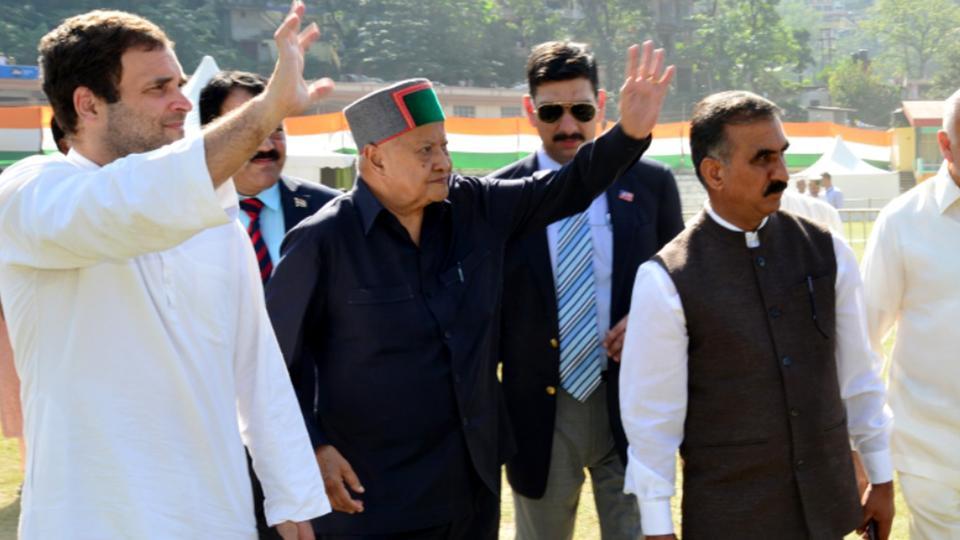
Congress national vice president Rahul Gandhi with chief minister Virbhadra Singh and state congress president Sukhvinder Singh Sukhu at a party rally in Mandi on October 7, 2017. (HT Photo)

Chief minister Virbhadra Singh, who is 83, and the 73-year-old leader of the Opposition, BJP’s Prem Kumar Dhumal, are will eventually make way for the younger leaders and this election will show the way to the generational shift.

“Obviously, the election here is all about next generation,” said RS Chauhan, a professor in Himachal Pradesh University. “But, the real contest will be between Virbhadra and Modi as BJP has not declared its chief ministerial candidate”.

Singh has virtually anointed his 28-year-old son Vikramaditya Singh, who has sought a ticket from his father’s Shimla (rural) constituency, his political heir.

In the last five years, Vikramaditya has been active in the youth wing of the Congress and also has had a say in key decisions of the government.

The seven-time chief minister is working overtime to project his son as the future leader of the Congress in the hill state and is believed to be backing aspirants who are close to his son in their bid to secure party tickets.

Over the last five years he has ruthlessly crushed any possible challenge to his son, leading to infighting in the state unit, sources said.

Himachal is one of the only five states that the Congress rules, as the party has been hit by a string of poll defeats in the last three years.

This time, the state’s poll history favours the BJP. In the last two decades, the Congress and the BJP have alternatively ruled the state with a population of around seven million.

Other than anti-incumbency, Singh is battling corruption cases and the mood in the Congress camp is far from upbeat. The rape and murder of a 16-year-old schoolgirl in July added to his troubles.

In the BJP, Dhumal’s son Anurag Thakur represents Hamirpur in the Lok Sabha but he has lately showing interest in the state politics as well.

Unlike Singh, Dhumal has resisted projecting his 42-year-old son, who was India’s top cricket official till he and another Board of Control for Cricket India official were sacked by the Supreme Court earlier this year, as his political heir.

But BJP leaders close to Dhumal have been pushing for Thakur and are also aligned against Union health minister JP Nadda, his rival in the state.

Many in the BJP know that Dhumal is unlikely to be the chief minister if the party wins, as he is two years away from Prime Minister Narendra Modi’s unwritten 75-year age bar for chief ministers and ministers.

So, Thakur and Nadda would be BJP’s campaign faces in an election that would be fought in the name of Modi and his development agenda.

Party insiders, however, have not ruled out a dark horse – like ML Khattar in neighbouring Haryana -- as the next CM if the BJP wins.

  • Chetan Chauhan
    ABOUT THE AUTHOR
    Chetan Chauhan

    Chetan Chauhan is the National Affairs Editor looking into all aspects of news and features from across India. A Chevening scholar with over three decades of experience in reporting and news management, Chetan has extensively covered all important aspects of the social sector, political economy, environment and climate change nationally and internationally. He did a journalism course at the Reuters Institute of Journalism in Oxford and Digital Media training at Nanyang Technological University in Singapore. He started as a reporter with The Statesman in 1996 and joined the Hindustan Times in 2000 in the metro bureau covering environment, crime and Delhi politics. He covered hot local news, from the Jessica Lal murder case to the rebellion of Delhi Congress MLAs against then Chief Minister Sheila Dikshit, to the replacement of toxic vehicle fuel with cleaner compressed natural gas (CNG) in the national capital. Some of his stories on air pollution became part of the Supreme Court’s landmark MC Mehta versus Government of India case in the National Capital Region (NCR), forcing the government to take corrective measures. As part of the national political bureau since 2004, he covered important central sectors such as environment, education, social justice, labour, rural development, water resources, renewable energy, agriculture, broadcasting and the Planning Commission for more than a decade producing several exclusive and investigative breaking stories. His specialisation is the environment, having covered at least a dozen United Nations global conferences on climate change, biodiversity and wildlife including climate summits in Paris, Copenhagen and Bali. He also covered India’s two five-year plans ---11th and 12th and reported on drafting and execution of right based laws such as Right to Education, Right to Information and rural job guarantee law, MG-NREGA, now being introduced in new format as VG-RAM-G Act. He has in-depth knowledge of social sector issues. He was one of the first to report on tigers vanishing from Sariska and Panna wildlife reserves in 2004 and 2008, respectively, leading to the setting up of the National Tiger Conservation Authority (NTCA) and the introduction of stringent penal provisions for poaching. He has written extensively on the rising human-animal conflict in India and the degradation of India’s biodiversity hotspots because of mining and other activities. Since 2004, Chetan has covered Parliament comprehensively and participated in training on the nuanced coverage of Parliament proceedings. He has travelled extensively across India to cover national and provincial elections since 1998, especially in the Hindi heartland states, considered India’s road to power. He writes a regular column for Hindustan Times, Ecostani, on important national politics, economy, Himalayan ecology and environmental issues. His other responsibilities include providing inputs for edits and edit page articles for the publication, apart from managing news flow from across India.Read More