E-Paper


Enchantment: Watch a play in Delhi about the life and inner turmoil of sitar maestro Pt Ravi Shankar

 Prefer HTon Google


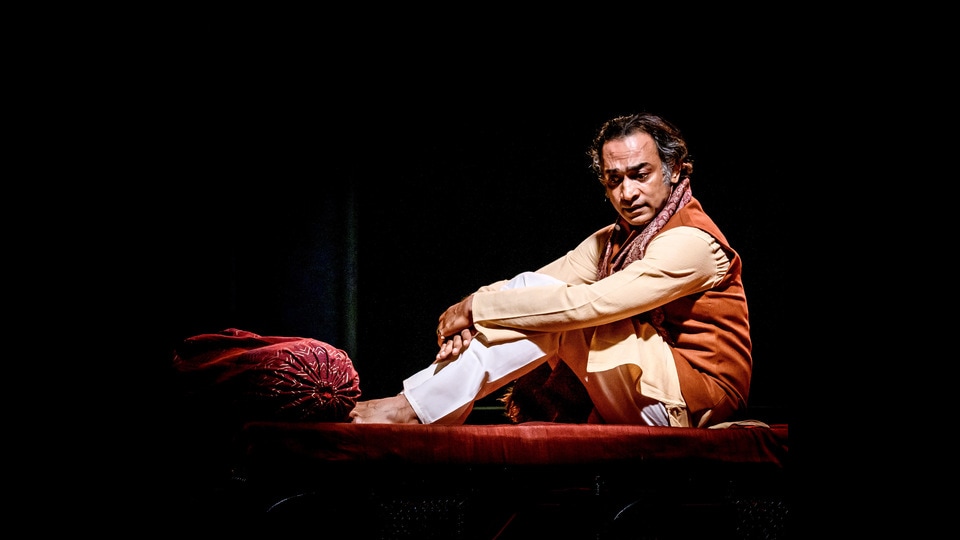
Gowri Ramnarayan, grand-niece of MS Subbulakshmi, has written and directed the unusual look at the struggles of a musical genius.
How does one make a maestro and globally renowned musical genius relatable?
If you’re Gowri Ramnarayan, you write a play about key moments of internal struggle, because “it is the man behind the myth” who grips our interest.
“We empathise with struggles more than with success,” says the Chennai-based playwright. “Everybody faces apprehensions, vulnerabilities and ambivalences. I think that is how the audience can identify with the hero, even a superhero.”
The play in question is Enchantment, based on the life of sitarist Pandit Ravi Shankar (1920-2012). Written by Ramnarayan to commemorate the maestro’s centenary year, it began its theatrical run in September 2025 and has been performed 20 times so far, across India and the US, directed by Ramnarayan’s and staged by her theatre group, JustUs Repertory.
Songs composed by Shankar for Hindi films are woven into the play, sung by Bombay Jayashri, Aditya Prakash and Vignesh Ishwar. Enchantment will make its Delhi debut on November 21.
RHYTHM AND BLUES

As the granddaughter of Ponniyin Selvan writer Kalki Krishnamurthy and grand-niece and vocal accompanist to MS Subbulakshmi (1916-2004), Ramnarayan grew up among artists.
In addition to this play, she is the author of a Subbulakshmi biography (MS and Radha; 2009), and has translated a biography of her grandfather from Tamil to English.
She based her script for Enchantment on interviews conducted during her years as a journalist, and on conversations with Shankar and then partner Kamala Chakravarty, a musician, both of whom she also knew personally.
The play is neither a chronological narration nor a hagiography.
It explores Shankar’s state of mind in four key phases of his life: the point at 18 when he quit a career as a celebrated dancer in elder brother Uday Shankar’s ballet troupe; his move to remote Maihar, to study the sitar under Ustad Allauddin Khan (whose daughter, the legendary surbahar player Annapurna Devi, he married during this time); his struggle to establish himself, despite seven years of rigorous training under his guru; and the success and fame he finally achieved.
“Before he turned 18, he was an internationally known dancer who had travelled to Paris, London and New York, and lived a life of glamour and luxury,” Ramnarayan says. “One day, he just gave up everything and moved to this mosquito-infested town, to study under an ustad known for his temper. There, Pt Shankar lived in a 10-by-12 room for seven years. All this time, he was troubled by the fact that he might have made the wrong choice for his life. He also had doubts and fears about the future.”
She found this tantalising, the playwright says.
His influence on world music, meanwhile, points to a level of intrepidity rarely seen among traditional musicians at the time.
“Pt Shankar was passionate about music, and divisions of country, race, culture and so on did not carry any import. He had an oversized influence on jazz, rock, pop and what they called raga rock. Everybody knows that George Harrison (of The Beatles) became his disciple, but few remember that (Brian Jones of) the Rolling Stones played the sitar too, influenced by him,” Ramnarayan says. “The legendary saxophonist John Coltrane even named his son Ravi after Pt Shankar.”
STRINGS ATTACHED
This influence came at a cost.
Purists at home criticised his cross-genre collaborations (which included a 1967 album with violinist Yehudi Menuhin, West Meets East, that won him the first of his five Grammy awards) and criticised his work with the Hindi film industry (in the 1960s and ’70s, he composed music for films such as Hrishikesh Mukherjee’s Anuradha and Gulzar’s Meera).
Shankar’s personal life was riven with controversy too. Annapurna Devi gave up performing in public after their separation. Shankar went on to have a long-term relationship with Chakravarty, and subsequently married musician Sukanya Shankar, with whom he had his second child, daughter Anoushka Shankar. (His first was a son named Shubhendra, with Annapurna Devi; he died aged 50, in 1992.) He had a third child, Norah Jones, with American production designer Sue Jones.
“I look at the fact that he had these consensual relationships on both sides of the Atlantic, and show how he looked at it, and how the women looked at it,” Ramnarayan says. “I think you have to see the whole life, as it was lived, and how it influenced him.”