
 E-Paper



Endeavours: Rasika Khanna reviews the new memoir by economist NK Singh

 Prefer HTon Google


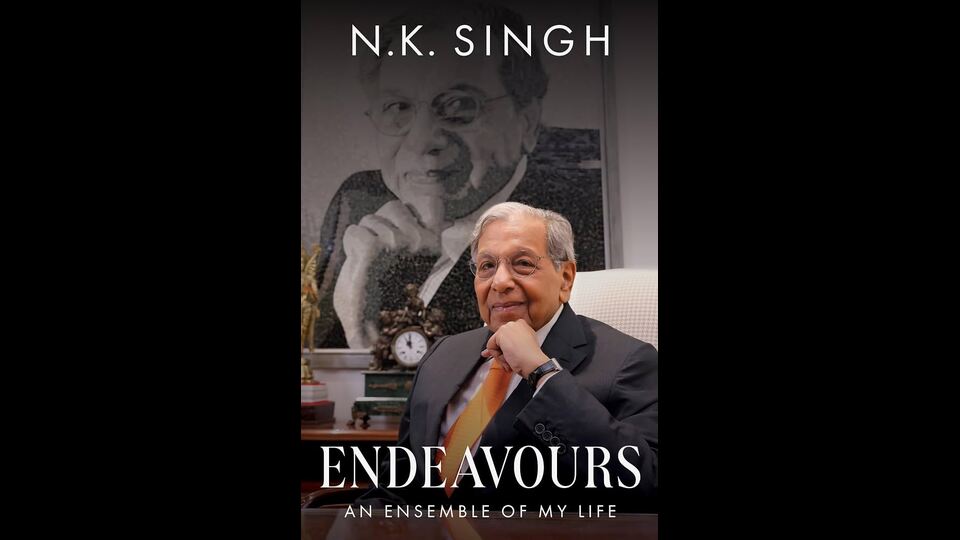
His deep, informed interest in Hindustani classical music, rose cultivation and photography make this a riveting journey, says the Bharatanatyam exponent.
Memoirs written by policymakers, economists, diplomats and politicians are usually not my cup of tea, but here is one with a difference.
First, NK Singh is all of these rolled into one. What is exceptional about this book is that it is not about any of these roles. Instead, we see NK as a photographer, music connoisseur, garden- and rose-lover, and aficionado of Japan. One is left to wonder, how many NKs are there?
Endeavours: An Ensemble of My Life is a fascinating read.
As a Bharatanatyam artiste, what stands out for me is his devotion to Hindustani classical music. Chapter 4, Om: The Eternal Sound, captures his journey from being an inquisitive listener to a connoisseur and patron of this art form.
Being exposed in his childhood to the sounds of classical music, as a clandestine listener, while his three young sisters were being trained at home, led to a kind of unconscious love for it. This was nurtured as he attended performances with his parents in the vibrant cultural milieu of Patna in the late-1950s.
What is remarkable is his detailed recollection of the artistes he heard as a teenager, both in Patna, particularly during the annual Dussehra festivities, and during winter vacations at his grandparents’ home in Purnea.
He describes the Patna of the time as “an important cultural centre rooted in past traditions”, and Bihar as “a vibrant hub of classical and folk music”. He continued this interest as a young man, concert-hopping with friends, trying to catch the best performances available in a single evening.
In describing the “soundscape of Bihar”, he recalls the contributions of figures such as Babu Chandipat Sahay, a zamindar and politician who played a pivotal role in promoting Hindustani classical music in the 1930s. Esteemed vocalists such as Pandit Vishnu Digambar Paluskar and tabla nawaaz Ahmed Jan Thirakwa, whom he describes as one of the greatest tabla maestros, graced his home with their performances.
NK recalls that Paluskar helped lay the foundation for institutional music education in India.
He notes that folk music thrives equally in Bihar, offering songs for every occasion. Bhikhari Thakur commented on contemporary social issues. Modern Bhojpuri lyricism was shaped by Radhamohan Chaubey. Purbi Geet was enriched by Mahender Misir. Pandit Dhareekshan Mishra illuminated Maithili traditions.
Together, these stalwarts created a parallel soundscape that coexisted with classical music of the time. Documenting these contributions should be seen as an important feature of NK’s remarkable book.
All these experiences added up. Music is literally food for the soul. His love for this genre brought him close to the most celebrated musicians of the day, whom he had the privilege of hosting at different family occasions at his home. Association with them enabled him to understand and honour the structures of Ragas, and their emotional content. Understanding the stylistic differences in how different gharanas treated the same raga sharpened the author’s listening skills.
These are lifelong lessons.
***
The book features a beautiful photograph of legendary Hindustani vocalist Kishori Amonkar with her granddaughter, Tejashree Amonkar, playing the tanpura alongside her singing. He narrates a poignant incident in which Kishori Amonkar, offended by a woman in the audience sipping wine while listening to her perform, stopped and wanted to leave. Music is sacred and requires discipline on the part of the artist and the audience. This real-life incident brings home this point.
The incident reminded me of one in my own life.
Performing Bharatanatyam in Switzerland, I peered into the audience through the harsh stage lights. To my horror, I realised they were seated around dining tables, in circles, poised to eat and drink. My first reaction too was to leave, to disappear from backstage.
Better sense prevailed, however. I sent a stiff note to the organisers, forbidding them from serving food or drink before the end of the recital. Questions flooded my mind: Could opera or ballet ever be showcased in such a setting? Then why Bharatanatyam?
Artists are not merely performers. They are the custodians of our cultural heritage. Recognition of this endeared the author to several musicians, who performed regularly for his family functions.
***
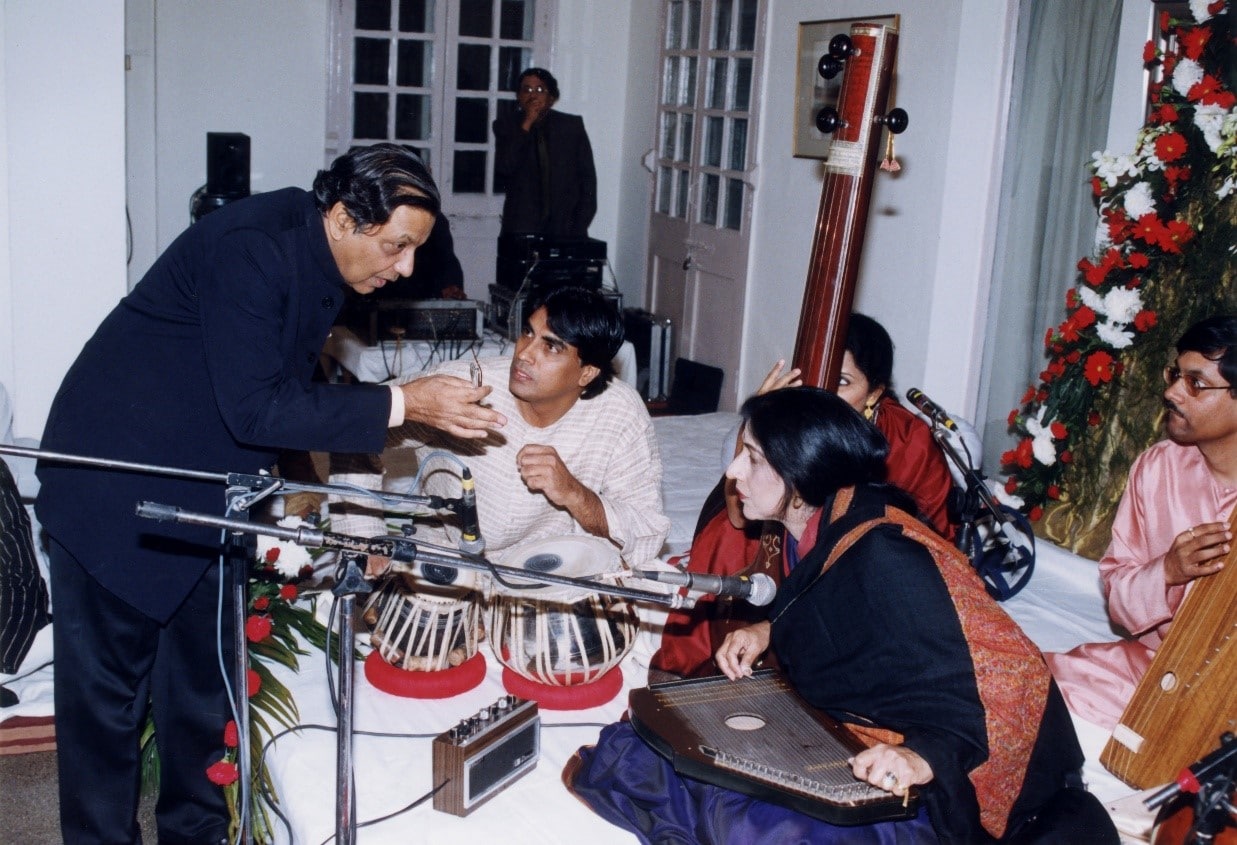
Among other notable incidents, Inward Strings offers an account of NK’s meeting with sitar maestro Nikhil Banerji, who subsequently performed at the ceremony of his engagement with Prem Kumari.
This luminous disciple of the Maihar Gharana, “a handsome personality, dressed in Kolkata’s best tradition of dhoti and kurta”, played Bageshwari and Jaijaiwanti, evoking a sense of romance and passion. NK remembers well the concluding piece in Maand, one of Rajasthan’s most popular folk tunes. After all, Prem Kumari, the young bride-to-be came from a noted family of Rajasthan.
At a private concert in his home, Pandit Jasraj sang the rare Raga Dhulia Malhar, which he described as the harbinger of rain. The word dhulia refers to the swirling dust that precedes a thunderstorm. As if to affirm this, a sudden gust of wind gave way to a storm followed at last by rain, just as the event ended.
Inviting Ustad Bismillah Khan to perform is honouring the Ganga-Jamuna culture of India.
A devout Muslim, the shehnai maestro played daily at the Kashi Vishwanath temple on the banks of the Ganga in Varanasi. He gave shehnai its rightful place as a concert instrument. His knowledge of the intricacies of Hindustani music with its use of “meends” and “gamakas” brought the shehnai very close to the human voice.
The unique QR codes in the book enable the reader to become part of the musical performances described. In this way, by sharing his musical experiences, the author becomes the custodian of the music, rather than a collector or archivist.
Association with musical giants such as Pandit Bhimsen Joshi, Ustad Alla Rakha Khan and Siddeshwari Devi seems to have left an indelible impact on him.
***
Interest in rose cultivation and subsequently rose photography arose from the author’s ancestral rose garden in Patna, which he wanted to rejuvenate. Redesigning the rose garden on different levels allowed the flowers to be seen in tiers, adding more depth and movement.
Roses are Forever opens the world of rosarians, nurseries and gardeners to the reader. Rose photography taught the author the importance of the right moment. A slight breeze or harsh sunlight could ruin a photograph.
The author’s progression from an Asahi Pentax to a Leica R4, and further to a Hasselblad, mark the seriousness with which he approached this art form. NK brings out poignantly how photography built outdoor companionship with his wife, Prem Kumari, who encouraged him in its pursuit.
The word Endeavours suggests this book is part of a process, not a completion. I look forward to NK Singh continuing his explorations of a joyful life, and sharing them with us again.
(The author is a noted Bharatanatyam exponent)


