The recently concluded World Athletics Championships in Budapest were historic for India because of a man who now turns up at events pretty much to create history. Neeraj Chopra is no longer a revelation. He is the preeminent thrower of his time. He is the World, Olympic and Asian champion.
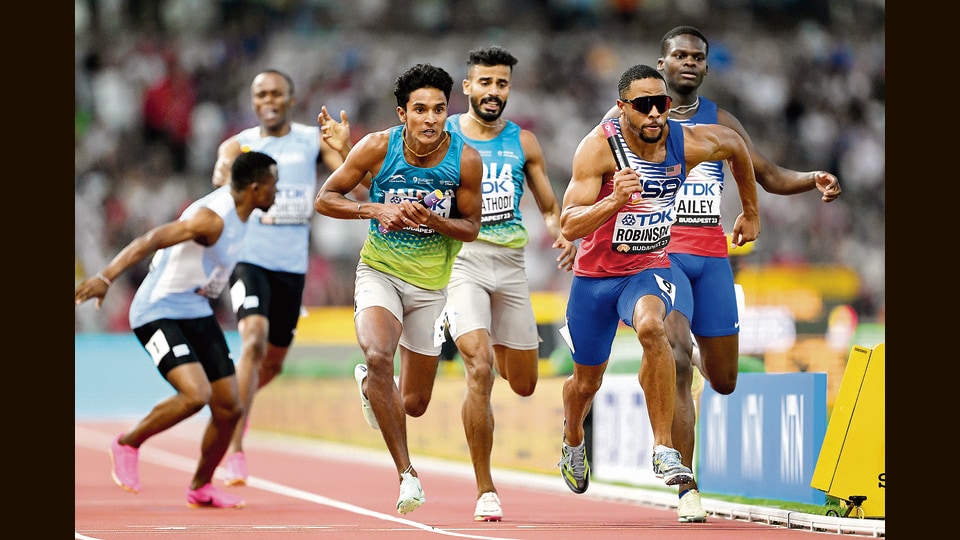
But there was an unexpectedly thrilling moment for India at the Worlds too, as Rajesh Ramesh, 24, almost overtook American runner Justin Robinson, one of the best 400m runners in the world, in the qualification race for the men’s 4X400m final.
Robinson had to shift to top gear — he admitted later that he had not expected to be pushed so hard in a qualifying round — and Ramesh’s breathtaking run resulted in the Indian men’s team (Muhammed Anas Yahiya, Amoj Jacob, Muhammed Ajmal Variyathodi and Ramesh), setting a new Asian record.
The final was won by the US, clocking one of the top-25 times in the history of the race (2:57.31). India finished in fifth place, with their second sub-three-minute time in two consecutive days.
For some perspective, it helps to remember that the US team changed two of their runners from the qualifying round. India, which has little to no back-up when it comes to elite runners, had to field the same team, despite the fact that Ramesh left the venue in a wheelchair the day before the final, due to severe cramps.
That perhaps explains why the relay team’s performance was so unexpected. Until recently, we held the Asian record anyway. We have, occasionally, shown an affinity for the 400m and 400m relay. Why has success been so sporadic?
Unlike Chopra, whose elite-level performance remains on a stable, steady pitch, India’s track and field record has been marked by long periods of disheartening struggle, punctuated by unlikely glimmers of progress.
The Indian men’s relay team lost the Asian record to Japan at the Tokyo Olympics. Recorded the second worst timing in qualification at last year’s Worlds. Finished in seventh place at the 2022 Commonwealth Games (CWG).
Up one day, down the next.
The Indian athletics system as a whole continues to struggle in pretty much the same way it always has. The Athletics Federation of India ties itself up in knots just trying to get the basics right; a well-organised series of domestic competitions remains beyond its expertise. A proper scouting and talent development system still eludes it.
Neeraj Chopra’s talent was spotted on the junior circuit, and he was helped by a series of non-government organisations, which went all-out to figure out the best possible developmental scenario for him. This involved finding him one of the world’s best coaches and then maintaining that path of progress (best possible coach, best possible training environment, best possible injury-recovery protocols) through his career.
For its part, the Indian sporting system stayed out of the way, and offered monetary support. Think of any of Indian athletes who have done well in the recent past, and you will see that this has been the pattern.
Still, India has shown a knack for the 400m and the 400m relay. And even when it has won, the teams have been treated with indifference. The women’s team, led by PT Usha, qualified for the 1984 Olympic final. Then nothing, for decades. The next time the women’s team qualified for an Olympic final was in 2004.
That turned out to be a decade of great achievements by women in the field. These included five consecutive gold medals at the Asian Games, starting in 2002, and gold at the 2010 CWG, won in front of an ecstatic crowd in Delhi.
The following year, seven Indian 400m women runners, including two who were on the CWG team, tested positive for steroids. As is the custom here, the athletes were immediately thrown under the bus. The Ukrainian coach, Yuri Ogorodnik, was sacked too.
India’s 400m women runners, who came so close to being among the best in the world, were forgotten. The legacy was left to rot.
“We were treated like…you know the way people throw stones or kick helpless animals… we were treated like that,” Ashwini Akkunji, one of the members of the 2010 CWG relay team, once said to me. “I love animals, so I would always wonder why people did that. Now I felt what it was like to be on the receiving end. After that, a whole generation of 400m runners were simply left to fend for themselves, as if in revenge.”

 E-Paper