
 E-Paper



U-turn: Mridula Ramesh writes on the high cost of cheap urea

 Prefer HTon Google


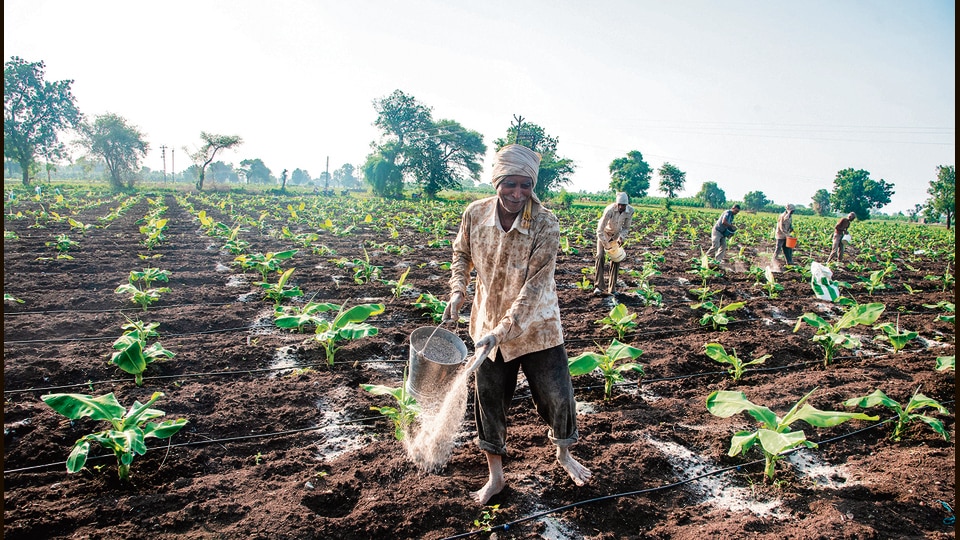
Synthetic urea promised abundance. How did it reshape India’s farms and affect pulse production? Check out Part 2 of 3 on pulses.
From the comfort of a full stomach, it seems churlish to complain about urea. So, let me acknowledge that without Messrs Haber and Bosch’s gift of synthetic urea half of humanity would likely have starved.
Synthetic urea was not just vital, it was seductive.
Now, it was not necessary to gather and manage food waste, urine and faeces to turn them into manure. Or plant nitrogen-fixers such as pulses, clover or dhaincha, wait for them to grow and mulch them back into the field. Synthetic urea compressed all that labour and waiting into the time, effort and cost of buying and spreading a few bags. It’s hard to resist this convenience.
Then came India’s Green Revolution. Stung by being held “ship to mouth” by the US in the 1960s, India’s leaders set about making the country food secure. Giving more fertiliser or water to the old hardy crop varieties did not coax more grain out of them. But the new cultivars from Mexico lapped up both and delivered in spades. Urea, with its comrade, the borewell, made each acre and each hour of a farmer’s time far more productive.
Grain production shot up.
Synthetic urea created new vulnerabilities. Just as this new habit was taking hold, global oil and gas prices surged. The government wanted farmers to keep using fertilisers, but also wanted domestic fertiliser manufacturers to keep making it. So, it capped fertiliser prices and subsidised producers. A later scheme effectively guaranteed factories a meaningful return regardless of their productivity.
In the following years, a slew of farmer protests ensured, among other things, that urea prices remained sticky. Accommodation during a crisis has a funny way of turning permanent, especially when a powerful interest group benefits.
Pincered by the forces of populism and crony capitalism, fertiliser prices remained unchanged while the subsidy ballooned.
Something had to give. When India faced a balance-of-payments crisis in 1991, fertiliser subsidies came on the chopping block. But an effort to raise urea prices met with fierce opposition. The government compromised by decontrolling phosphorus and potassium while keeping urea protected. As prices of phosphorus and potassium rose, farmers responded rationally by using more cheap nitrogen. India’s NPK ratio, the ratio of fertiliser supply nitrogen, phosphorus and potassium, rose from 6:2.4:1 in 1990-91 to 10:2.9:1 in 1996-97.
Was this a problem?
While there is no single ideal NPK ratio (different crops need different ratios of these nutrients on different soils during different stages of their lives), by any measure, 10:2.9:1 was too skewed. Agricultural economists like Ashok Gulati have spent decades railing against this skew and the subsidy, saying a large part of the subsidy is captured by the industry, while keeping public agricultural investment subdued.
But decontrolling urea is so potent a political landmine, that few dare tread upon it.
Political wisdom has it that attempts to reform subsidies was one reason why the NDA government lost the 2004 general election, in part because it was perceived to be “anti-farmer”.
And so, reforms stalled, even as the cost of making urea kept rising.
In 2010, the government embarked upon a nutrient-based subsidy scheme to try to tame the subsidy. But because it left urea out, Indian prices of phosphorus and potassium moved closer to international levels while urea remained far cheaper.
A decade or so later, the Russia-Ukraine war made the distortion stark. Indian farmers paid only about a tenth of the American retail price for urea, compared to nearly a third for phosphate fertiliser and about 60% of what American farmers paid for potash. Unsurprisingly, they used comparatively far more urea. India’s average NPK ratio reached 10.9:4.4:1; in Punjab, it was an extraordinary 50:2:1.
BEYOND THE BOUNTY
Naturally, there were consequences.
First, feeding a crop nitrogen without enough of the other things it needs is the plant equivalent of eating mostly protein shakes. That’s not the path to optimum health or yield.
Second, pulses lost their old allure. Why grow a crop that performs the expensive trick of fixing its own nitrogen when that nitrogen now comes in a cheap bag? Between 1960-1961 and 2000-2001, India’s pulse production fell even as the country’s rice production rose two-and-a-half times and wheat rose sixfold.
Pulses have recovered in the past decade, helped by higher support prices and procurement, but India remains partly dependent on imports for its dal.
Third, climate was impacted. A global cradle-to-grave analysis estimated that making, transporting and using synthetic nitrogen fertiliser emitted about 1.13 billion tonnes of CO2-eq. in 2018. About 2% of global greenhouse gas emissions. Just a touch less than the total emissions from India’s electricity and heat sectors.
More than half of these emissions occur on the field, where unused nitrogen can turn into nitrous oxide, a greenhouse gas 273 times as powerful as CO2. Excess urea can seep underground, polluting aquifers, which hurts the communities who depend on those aquifers for their drinking water. Search for “Blue Baby Syndrome”.
Unused urea is also washed into a nearby lake or river where algae, delighted by this free nitrogen, bloom. Their subsequent decay fouls the water, killing fish. This is a tragic farce – fertiliser meant to nourish one ecosystem suffocating another.
Then there is the bill to the exchequer. The Union Budget for 2026-27 earmarked an estimated ₹1.71 lakh crore to the Department of Fertilizers. Some of that money subsidises fertilisers that plants never use, which end up polluting air and water.
Finally, consider the blow to geostrategic autonomy. Atmanirbharta measured simply by domestic grain availability conceals the fact that urea is, in essence, natural gas made solid. And, between April 2025 and January 2026, about 85% of the gas used by India’s fertiliser sector was imported. The Ukraine and the Hormuz crisis exposed that vulnerability. When LNG (liquified natural gas) imports were hit, India’s urea production fell from 24.7 lakh tonnes in March 2025 to 17.5 lakh tonnes in March 2026, recovering only after alternative supplies were secured.
Six decades and trillions of rupees after India fought to prise another country’s hand from its mouth, we have discovered a different hand on the gas tap. We may have more food, but we are not secure: with a billion more mouths to feed, the vulnerability remains.
WHAT CAN BE DONE?
We can use less and differently. In 1971 the EU used roughly six times as much nitrogen fertiliser per hectare as India; by 2001 the two were about level, and by 2021 the EU was using around 40% less per hectare. China uses far more fertiliser per hectare than India, but has been bringing it down from its 2011 peak. It can happen, but not with prices the way they are.
But reform needs political capital — and a better story. In a 2024 paper, Ashok Gulati and fellow researcher Ritika Juneja argue for replacing part of the fertiliser subsidy with direct cash transfers to farmers, while allowing fertiliser prices to better reflect their true cost. The aim is to protect farm incomes while encouraging a more balanced use of nutrients.
Their case is strengthened by an uncomfortable finding from Soil Health Card data: much of India’s cropland is in poor health, with around 70% of samples deficient even in nitrogen. A possible explanation, they suggest, is that much of the subsidised granular urea never becomes available to the plant. Convincing farmers that cheaper urea is not necessarily better urea will not be easy. But a crisis that exposes the cost of the current system may also create the political space to change it.
We should also redirect part of the subsidy to pulses. Pulses are domestic nitrogen producers – why are they being left out in all this subsidising? A 2025 paper analysing 3,160 observations from 35 countries found that legume cover crops raised yield by 16.0% especially in soils poor in organic carbon.
There is one more intimate blow to consider. By making nitrogen cheap, we changed what India grew and what we eat. And that created a very personal vulnerability — one we turn to next time.
(Mridula Ramesh is a climate-tech investor and author.She can be reached on tradeoffs@climaction.net.The views expressed are personal)


