
 E-Paper



South Africa’s ‘cradle of humankind’ caves reopen to public, reveals ancient human artifacts

 Prefer HTon Google


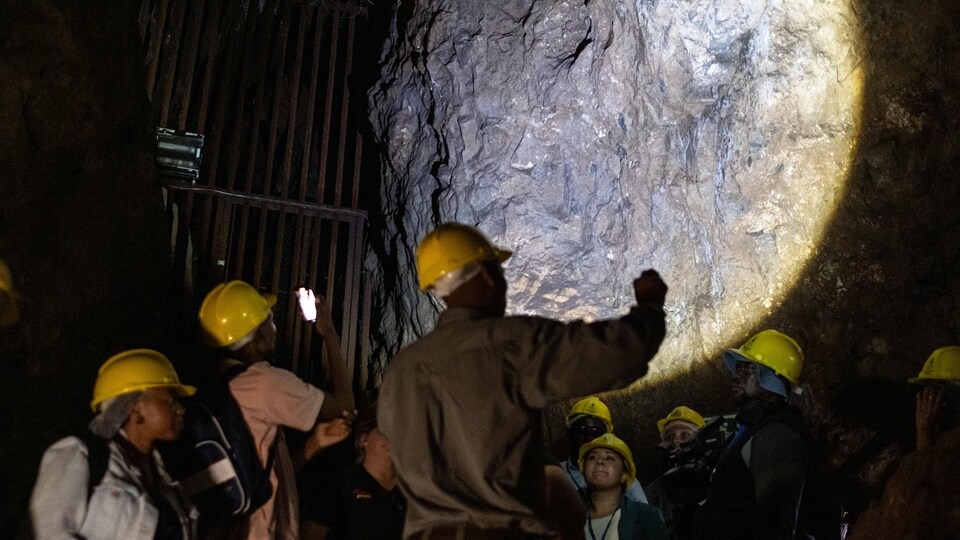
South Africa's Sterkfontein caves, home to early human fossils, reopened after three years, offering tourists a chance to engage with live scientific research.
Seated on sandbags in a knee-deep grid dug in South Africa's Sterkfontein caves, where one of our earliest ancestors was found, Itumeleng Molefe swept ancient soil into a blue dustpan, each brushstroke hunting for hidden clues. Nearby, visitors marvelled at the weathered limestone rocks hanging from the ceiling of the caves, millions of years old.
Located 50 kilometres (30 miles) northwest of Johannesburg, the caves closed nearly three years ago due to flooding and reopened Tuesday with a new experience bringing tourists closer to the scientific action. The complex is housed within the Cradle of Humankind World Heritage Site, a rich source of artefacts for palaeontologists since it was first discovered.
"My aim is to find important bones here," said the 40-year-old Molefe. His most prized find since joining the excavation team in 2013 was an early human hand bone. His father was part of the team that uncovered South Africa's most famous find, a skeleton dubbed "Little Foot", in the caves.
Deriving its name from the size of the bones first discovered in the 1990s, it is the most complete specimen of a human ancestor yet discovered, estimated to be between 1.5 and 3.7 million years old.
Little Foot is from a branch of the human family tree called Australopithecus, latin for "southern ape" -- considered the ancestors of modern humans, with a mixture of ape-like and human characteristics.
"This reopening represents a significant evolution in how we share the story of human origins," said Nithaya Chetty, dean of the University of the Witwatersrand faculty of science, which manages the caves and the nearby museum. "Visitors now have unique opportunities to engage with active live science and research, all happening in real time," said the professor.
‘Missing something’
At their peak before the Covid-19 pandemic, the caves received up to a 100,000 tourists a year. The closure had left a lingering feeling of sadness, said Witwatersrand archaeology professor Dominic Stratford, recalling busloads of schoolchildren and inquisitive visitors.
"Everyone felt like we were missing something," he told AFP. A temporary exhibit of the fossils has been set up at the museum, where visitors will also get a chance to see "Mrs Ples", the most complete skull of an Australopithecus africanus, found in South Africa in 1947.
Guiding helmet-clad visitors through the 2.5 kilometres of caves bathed in soft blue LED lights, Trevor Butelezi gestures toward a shadowy passage that leads to an underground lake. "It's actually a beautiful cavity," said the 34-year-old tourism graduate, his voice echoing gently off the walls.
"Africa gave rise to humanity and it's not a small thing," he said, paraphrasing a quote from the South African palaeontologist Phillip Tobias. For now, those hoping to glimpse the original Little Foot will have to wait for heritage month in September. The skeleton, which took two decades to excavate and assemble, is only displayed on special occasions.


Catch your daily dose of Fashion, Taylor Swift, Health, Festivals, Travel, Relationship, Recipe and all the other Latest Lifestyle News on Hindustan Times Website and APPs.


