
 E-Paper



A new round of political boxing in Pakistan
As a fresh political showdown unfolds, the outcome may not be as predictable as it has been previously

 Prefer HTon Google


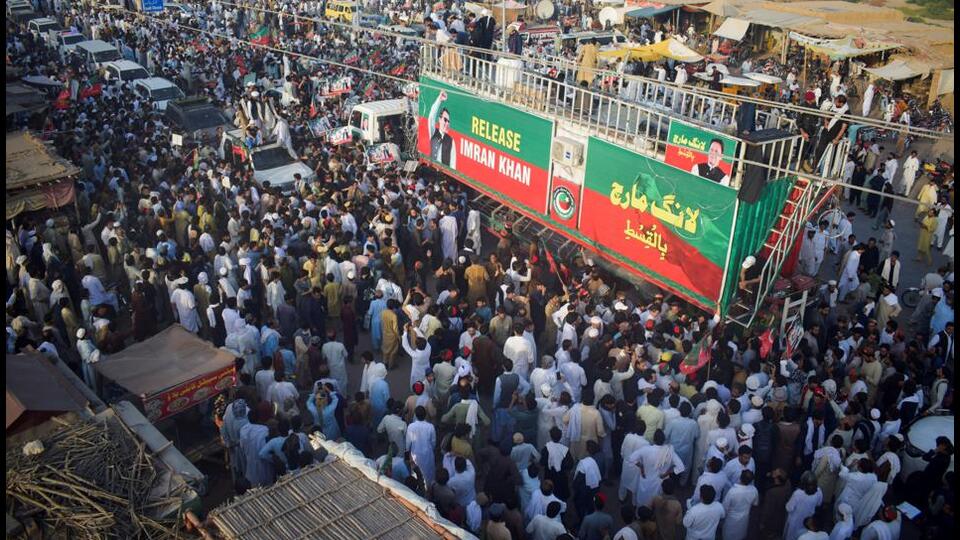
On October 11, President Asif Ali Zardari declared an emergency in Khyber Pakhtunkhwa (KP) province after suspending the government of Imran Khan’s Pakistan Tehreek-e-Insaf (PTI). The move coincided with the detention of PTI leaders as Khan’s supporters marched from KP to Islamabad demanding his release. The suspension worsened a confrontation between the military establishment and the PTI.
During his premiership, Khan remained on the “same page” with then army chief Qamar Javed Bajwa, until the latter picked General Faiz Hameed as chief of the Inter-Services Intelligence. Hameed’s appointment in 2021, despite Khan’s opposition and differences with Bajwa over it, offered the Sharifs and the Bhuttos, Pakistan’s two major political dynasties, a chance to get back to power. The Bhuttos and Sharifs brought together almost all parties to bring down Khan’s government through a no-confidence motion in 2022. Khan was imprisoned a year later on what are largely believed to be politically driven convictions.
Khan’s arrest sparked unprecedented protests and attacks on military installations. The PTI was stripped of its election symbol (cricket bat) ahead of the 2024 election. Its candidates were forced to contest as independents. Yet they emerged as the single largest bloc in Parliament and retained power in KP.
The suspension of the KP government came amid Pakistan’s de facto ruler, army chief Asim Munir’s plan to create new provinces. The plan is widely believed to be an attempt to cut the Sharifs and Bhuttos, who have strengthened their power through patronage networks in their strongholds of Punjab and Sindh, to size.
In 2010, the 18th Constitutional Amendment devolved greater powers to provinces, leaving the federal government with only 48% of the national budget. Munir is seen to have been unable to get his civilian allies on board to scrap the amendment despite returning to power with the military’s support. The allies expanded Munir’s powers through the 27th Constitutional Amendment to further marginalise Khan. The amendment granted the army chief lifelong legal immunity and limited the Supreme Court’s independence. Zardari signed it to enshrine it in the Constitution.
Zardari has been among the champions of the 18th Amendment. His Pakistan People’s Party (PPP) is its main beneficiary in Sindh, the country’s second-largest province. PPP had greater fiscal space in Sindh — its capital Karachi is Pakistan’s economic engine — over much of its 18-year rule, thanks to this amendment.
The Sharifs have invested heavily in infrastructure in Punjab, as Nawaz Sharif is preparing his daughter, Maryam, the provincial chief minister, for a bigger national role.
The military wants more budgetary allocation. The 27th Amendment undermined the Supreme Court’s remit, weakened the check on executive power, and elevated Munir to the post of chief of defence forces.
The Nawaz Sharif-led government’s inability to allocate more funds to the forces is believed to have been among the reasons for falling out with Bajwa in 2017. Bajwa spoke publicly against the 18th Amendment, as it left the federal government with fewer resources. He equated it with Sheikh Mujibur Rahman’s six points for greater autonomy before Pakistan split in 1971.
The fact is that debt service takes roughly 50% of the federal budget, leaving little room for more defence spending, which was raised by 18% this year.
The 18th Amendment curtailed the role of the federal government, effectively run by the military. In July, a protest forced the government to postpone new petrol levies amid 10.3% inflation. The same month, interior minister Mohsin Naqvi, said to be Munir’s man in Shehbaz Sharif’s government, said Pakistan’s governance system had collapsed. Naqvi called for creating new provinces. He warned the system could not cope as Pakistan faced population growth, import dependence and growing debts. Naqvi warned frustrated youth could turn everything upside down and called breaking Pakistan’s four provinces into smaller units the only solution.
Pakistan’s constitution requires the backing of two-thirds of a provincial assembly to divide a province. In September, the Sindh assembly passed a resolution rejecting the plan to divide the province. The Sharifs appear amenable to breaking up Punjab to remain in power, as they remain unpopular amid Imran Khan’s growing popularity due to continuing incarceration and refusal to give in. Munir is reportedly considering a national referendum to break up provinces to bypass the need for approval from provincial assemblies and perhaps move to a presidential system. He could also fall back upon the military’s tested musical chairs policy.
In the 2000s, the Bhuttos and the Sharifs buried the hatchet after army chief Pervez Musharraf overthrew Nawaz Sharif’s government in 1999. Sharif, who started his political career as a protege of another military ruler, Zia-ul-Haq, in the 1980s, was sentenced to life in prison before he cut a deal and went into exile like his predecessor, Benazir Bhutto. Sharif’s falling out with the country’s all-powerful military followed a pattern. In the 1970s, Zia overthrew Benazir’s father, Zulfikar Ali Bhutto. Bhutto senior was executed on trumped-up charges in 1979, years after he started his career as military ruler Ayub Khan’s handpicked foreign minister in the 1960s.
The common affliction forced the two dynasties to sign a “charter of democracy” two years before Musharraf was forced out of power in 2008 as the Bhutto’s PPP returned to power. Opponents dismissed the charter as a ruse to ensure the allegedly corrupt dynasties alternate power. Khan emerged as the most vehement voice against the dynasties taking turns in the government and their corruption. His PTI halted the power swap between the two dynasties in 2018, retained power in KP, wrested it from the Sharifs in the country’s most populous province, Punjab, and made inroads into the Bhutto stronghold of Sindh.
As a fresh political showdown unfolds, the outcome may not be as predictable as it has been previously.
The views expressed are personal


