
 E-Paper



Does the Opposition really enjoy a sweet spot at present?
An important factor to consider here is that the youth likely sees the BJP-led dispensation as the establishment.

 Prefer HTon Google


There are two parallel narratives about Rahul Gandhi’s politics at this moment — well, three, if you include those who oppose him. But, among those who think the Leader of the Opposition is enjoying a bit of a sweet spot, two varying responses are on offer.
One line of thinking is that Gandhi is the unflinching ideological counter to the BJP and the Indian Right wing, who, after a brief flirtation with soft Hindutva (remember the temple runs and the Congress’ claim of him being a janeudhari Brahmin?), has doubled down on a hard mix of secularism and social justice invocations. This school of thought casts the battle between the BJP and the Opposition as a clash of principles and assumes the floating voter has seen the light.
The other, very different argument explaining the traction Gandhi is enjoying suggests that India has entered a post-ideological political phase. Economic restlessness, a veritable jobs crisis, and an angst over administrative and governance issues figure at the top of everybody’s minds. Right-Left ideological binaries, in this scenario, are irrelevant.
As is often the case with much in Indian politics, neither theory fits neatly or exactly.
There definitely seems to be a distinct ennui with the oft-repeated tropes of religious identity politics. And that hasn’t started now. In 2024, the BJP slipped below the majority mark; the inauguration of the Ram Mandir a few months prior to the elections barely yielded any extra points.
You could argue that a host of other factors led to the knocks the BJP took in UP, including an alleged lack of perfect synchronicity between Amit Shah and Yogi Adityanath and the absence of full engagement by the Rashtriya Swayamsevak Sangh (RSS).
But I remember meeting a host of BJP supporters who dismissed the idea of the temple as any sort of voting issue. It was almost as if, with the temple built, the political power of Hindutva somewhat weakened.
Also Read | 'Nepal-style plans' vs 'mics turned off': Centre, Opposition spar over CJP protest at Jantar Mantar
For instance, while it is impossible to prove empirically, I don’t think most Indians are agitated too much about the two-stanzas-versus-full-song debate around Vande Mataram. The Congress may have bungled, with a rare dropping of guard by Sonia Gandhi who was visibly uncomfortable on camera when the full song played at the Congress headquarters on Independence Day. This happened days after Parliament passed legislation making the full version of Vande Mataram compulsory. The episode became especially embarrassing given that the full song was played at official functions in Congress-helmed states. But, despite the BJP’s “minority appeasement” charge, it is tough to believe that such rows will create a measurable electoral backlash.
Equally, I don’t think most voters see the Congress as a fount of ideological purity. The INDIA bloc was a pastiche of parties with little in common ideologically. Many of the parties that came together to take on the BJP have actively opposed each other. The unlikely coupling of the Thackerays-led-Sena and proclaimed hard-core secularists is perhaps the most obvious example of this.
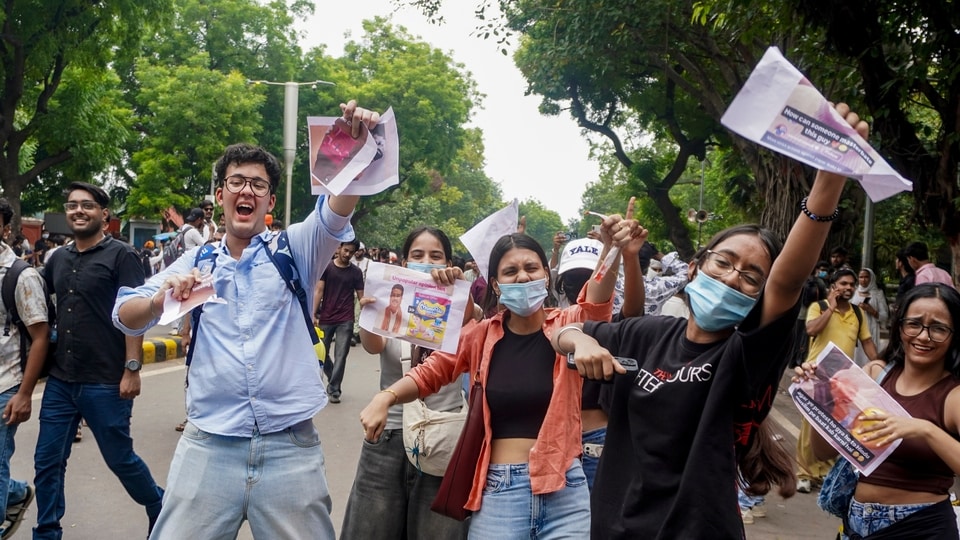
Amid the noise about whether this is an ideological fight for the idea of India, a more mundane reality is lost: The Modi government, in its 12th year of power, is experiencing old-fashioned anti-incumbency. For an entire generation of voters — many of whom would have supported the Cockroach Janta Party (CJP) protests at Jantar Mantar — the BJP has become the status quo; it is the establishment now. So, while the BJP, under Modi, still sees itself as led by a self-made outsider who took on the old, entrenched elite, for younger voters, the Sangh Parivar is the old elite.
The India Against Corruption (IAC) movement of 2011 that birthed the Aam Aadmi Party and the CJP protests of 2026 are not exactly analogous. But there is one parallel that is important to understand. Every few years, a generation of voters, quite naturally, starts seeking something new and fresh. Modi never participated in the Anna-Hazare-Kejriwal protests despite RSS supporters making up, at least in part, the crowds that defined the IAC movement. But, he did politically benefit from the anti- Congress and anti-establishment mood that the IAC protest amplified.
Similarly, the CJP, by placing protests at the heart of the citizen’s compact with the State, opened a door for the traditional Opposition. Paradoxically, the CJP’s ability to create a movement out of a meme simultaneously reflected the limitations and failures of the Opposition parties while creating a new and willing audience for the latter.
Rahul Gandhi has not openly allied with, or supported, the CJP. While other Opposition leaders spoke comfortably from the Jantar Mantar stage, it took Sonia Gandhi’s intervention for Congress leader Pawan Khera to visit the protestors at the site of their hunger strike. Gandhi pointedly held his own separate protest outside the PM’s residence while the CJP’s Abhijeet Dipke and team were at Jantar Mantar. But, even if Gandhi did not go to the CJP protests, he did have some of the youth protesters by his side in public appearances — the alleged pellet-gun victim, Sahil, and Rhiya, the young woman who stopped a police van in Mumbai being among them.
While that is strategically a smart move by him, let us give credit where it is due: It is the CJP that mainstreamed the idea of protests. And it is the CJP — not the Opposition parties — that secured the resignation of Dharmendra Pradhan as education minister.
Another factor we will miss if we look at the present situation solely through the conventional lens is how Indians, especially the younger ones, have emphasised the value of individual liberty and freedom. One of the reasons Rahul Gandhi’s all-women event at Pune was so popular is because it put a girl’s liberty at the centre of conversation. When Gen Alpha and Gen Z students come out on the streets in different parts of India, it is about the right to demand better from their administration. But, it is also about the right to speak and be heard.
The BJP is a behemoth, a clever and smart election machine led by a leader who should never be underestimated. Modi won Uttar Pradesh in the aftermath of demonetisation. So, we should be careful in drawing any hasty conclusions about electoral consequences. It will also be important to see how the BJP course- corrects. After all, just some months ago, the West Bengal win made them seem invincible. A win in Uttar Pradesh will change the political framing of today’s conversation all over again.
But, for now, there is a fascinating churn unfolding.
Barkha Dutt is an award-winning journalist and author. The views expressed are personal


