

 E-Paper



French Halloween: Horrors of a broken social contract
France’s Gen Z movement is not totally similar to the May 1968 upheaval, although it refers to it

 Prefer HTon Google


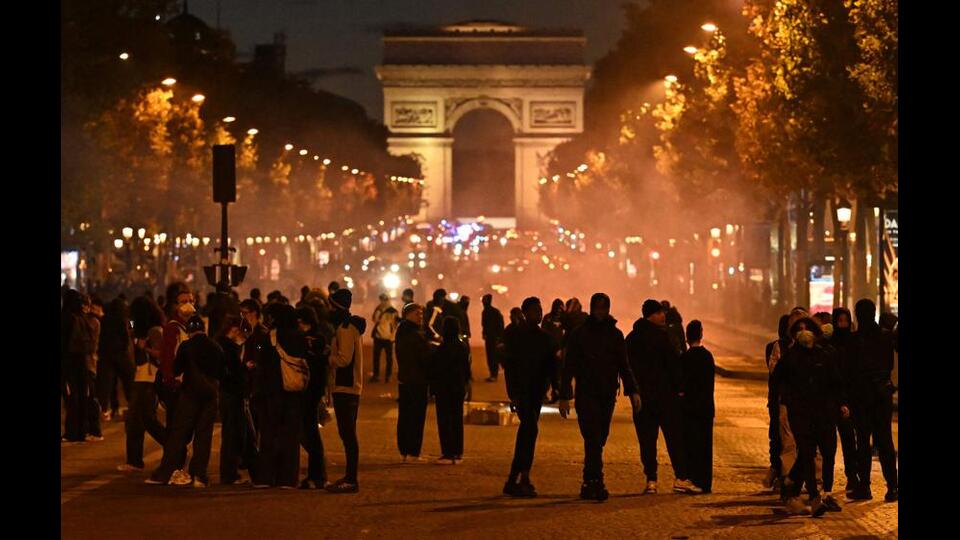
It was an unusual Halloween in Paris this year. The youth-led cost-of-living protests in France saw isolated clashes in the capital and other cities on Saturday, and have now inspired the youth in neighbouring Germany to also take to the streets over similar pains and anxieties.
This parade started on September 17, at a secondary school in Créteil, a Paris suburb, when teachers protested against the lack of resources and staff. Some students supported the movement and decided to blockade the building. One week later, on TikTok, an interview with the students highlighted their complaints. The video was viewed more than one million times, and the movement expanded in the greater Paris region, and then across the country. The protesters’ had several demands: upgrading of decrepit schools, avoiding extended time schedules with gaps between courses — the result of reforms multiplying course options — and dropping the unclear process called Parcoursup determining entry into universities or vocational institutes; the last two issues resulted from reforms implemented during President Emmanuel Macron’s first mandate (2017-2022). Sociologist François Dubet has argued that such a selection system fails to democratise access to a better life through education.
The protests soon extended, by solidarity, even to the prestigious Latin Quarter, and then to universities. In a piece published on October 17, economist Thomas Piketty underlined that during Macron’s two mandates, the nominal higher education budget rose by 17%, but the real budget per student fell by almost 20% because of inflation and rising student numbers. These trends reveal, at the very least, the power corridors’ failure to anticipate these. Some critics believe these result from a philosophy focused mostly on the future elites of the “start-up nation” dear to Macron, but leaving behind many disenchanted with the mainstream public education system.
By the end of September, the students’ movement had spread across dozens of French cities, while clashes between protesters and the police opened a new debate about the intensity of the repression that had left some young students seriously wounded. On October 2, the minister for education received secondary school student unions and opened a platform for gathering students’ views. That was not enough, and a new dynamic emerged, enlarging the protests through a call for the “convergence of struggles”: During the October 6 demonstration, students from schools and universities were joined by teachers and education staff, national trade unions, parents’ associations, and leaders of Left parties.
On October 17, at the margins of the marchers, two types of actors marked the day: First, the hardcore militants from the ultra-Left, called the black blocs because of their black attire, attacked public buildings in a number of cities. Second, young vandals, amid the chaos, loot many shops, including small businesses. The home minister, who had adopted a hard line on “maintaining order,” offered to resign; Macron refused. Overshadowing the massive and peaceful demonstrations, the images of destruction and looting went viral globally, with a number of consequences. First, since the beginning of the movement, the French government and the Right had blamed the Left party, La France insoumise (Unbowed France), for the agitation and the troubles; the party had sent some of its MPs to hear and support the students. The dubious accusations against it were amplified, despite the fact that the movement’s genesis was not party-led. Scholar Luc Rouban, sees the violence of October 17 as “without doctrine”, fed by the failure of the State and the weakened capacity of political parties and trade unions.
Second, the French far-Right, led by Marine Le Pen, was vocal about restoring “the rule of law”, and now stands to benefit the most from the chaos. Six months before the next presidential election — to be held in 2027— Le Pen was leading the opinion polls. As a bonus for her, the current government has showed the tools for containing demonstrations: detentions in large numbers, local curfews, banning some protest marches, shifting their allowed routes, among them. Moreover, a part of the Republicans, a centre-Right party, has seceded to create a new formation that is ready to cooperate with Le Pen’s National Rally. Meanwhile, a set of news TV channels owned by reactionary billionaires give hard-Right commentators significant airtime.
Third, images of the chaos in France has delighted Right-wing governments abroad: Amid growing uncertainty ahead of the US midterm polls, Donald Trump stated that France’s troubles were attributable to uncontrolled immigration. The Benjamin Netanyahu government in Israel, just days before the now-concluded general elections in the country, denounced the French demonstrators as supporters of Hamas, because some protesters had carried Palestinian flags. In India, many TV channels and social networks used the Paris troubles to try to delegitimise the Cockroach Janata Party, positting it as part of a (non-existent) “international Islamist-leftist network”. Such disparagement, however, doesn’t conceal the fact that Gen Z movements, which changed the game in Sri Lanka, Bangladesh, and Nepal, have now sprung up in many European countries, either inspired by the French protests (in Belgium and Greece), or through their own dynamics (Spain, Portugal, Italy, Albania, and Serbia, where the youth-backed Students’ Lists won a snap election held on October 25, ending the rule of the Right-wing strongman Aleksandar Vučić, after a 14-year stint in power.
Finally, after another wave of successful and peaceful demonstrations across France on October 24 despite restrictions imposed by the home ministry, the French government announced on October 27 a set of measures that roll back some of the reforms implemented during Macron’s first term. It also promised more funds for education and more teachers. The student organisations believe these announcements to be inadequate, and have stuck to the larger agenda for the next protests.
France’s Gen Z movement is not totally similar to the May 1968 upheaval, although it refers to it. In 1968, the student movement was soon accompanied by massive workers’ strikes, shaking Charles de Gaulle’s presidency before the Right marched to Paris and recovered ground, The 1968 movement left a deep impact, contributing to the liberation of a number of social norms.
The goal today is less a regime-change than offering everyone the possibility to study and enter into professional life without too many hindrances. Obviously, this call for equality is not disconnected from political aspirations for a fairer society. In this regard, a big question is: What will emerge from the presidential election next year?
Jean-Luc Racine is emeritus senior fellow, Centre for South Asian and Himalayan Studies, CNRS, and School for Advanced Studies in Social Sciences, Paris. The views expressed are personal


