
 E-Paper



Keeping up with UP: When compulsion, not compatibility drives a fragile political alliance
Cut to Uttar Pradesh (UP) where assembly elections are around the corner and likely to be held in February-March 2027

 Prefer HTon Google


Two political parties -- the Rashtriya Janata Dal (RJD) and Janata Dal (U) -- led by two unpredictable leaders Lalu Yadav and Nitish Kumar swept the Bihar assembly polls in 2015. A key factor in the victory was their public display of bonhomie, which helped bring the two backward castes, Yadavs and Kurmis, together. The rank and file, despite resentment, fell in line.
Lalu and Nitish had addressed several public rallies togther, playing their new-found bonhomie to the gallery. They united the socially and politically incompatible core social bases of the two parties and displayed the strength of Nitish Kumar’s experience and Tejashwi Yadav’s energy. With Congress also in, they managed to prevent a split of the anti-NDA votes. The alliance was officially announced in June 2015, ticket-sharing was finalised by August while voting was scheduled in October-November the same year.
Cut to Uttar Pradesh (UP) where assembly elections are around the corner and likely to be held in February-March 2027. While the NDA appears cemented in the state, the Opposition remains in disarray, even though the INDIA bloc, mainly the Samajwadi Party (SP) and the Congress, may jointly take on the BJP.
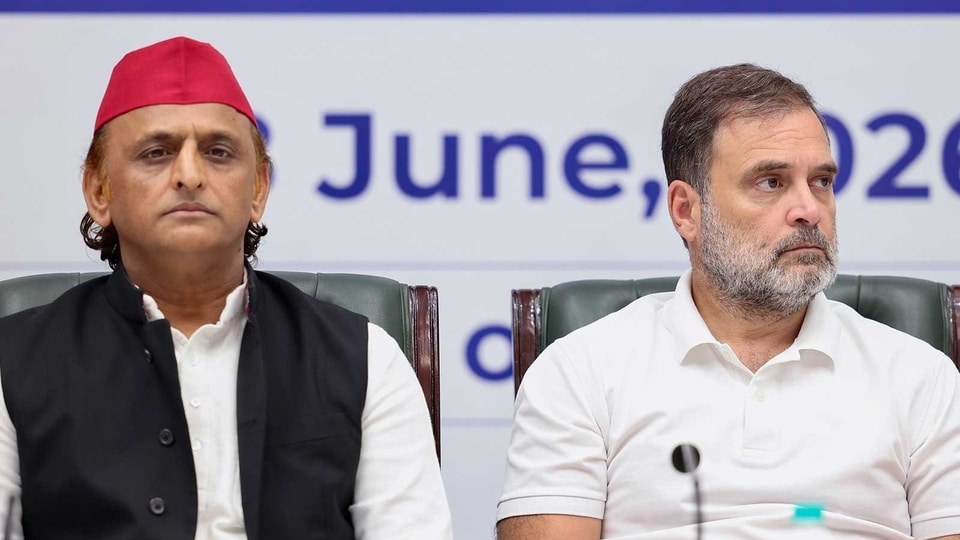
The leadership of the two parties has yet to formally announce their alliance. While Akhilesh Yadav has been open about it, the Congress is seemingly ambiguous. The chemistry or camaraderie displayed by Akhilesh and Rahul Gandhi is yet to filter down to the rank and file with the second rung leaders of both political parties playing spoilsport, adding to the confusion.
It's all about seat-sharing
The Congress high command’s decision to reconstruct its traditional Dalit-Brahmin-Muslim vote bank is reflected in the recent organisational reshuffle, which put in place the team of All India Congress Committee (AICC) general secretary Rajendra Pal Gautam (Dalit), Uttar Pradesh Congress Committee (UPCC) president Aradhana Mishra (Brahmin) and state working president Imran Masood (Muslim). They appear not to be wooing the backward castes.
Both Gautam, who shifted from the Bahujan Samaj Party (BSP) to Aam Aadmi Party (AAP) to the Congress, and Imran Masood, who holds a personal grudge against Akhilesh Yadav for denying him a ticket in the 2022 assembly polls, have been vociferously issuing statements, either to extract more seats from the SP or derail the alliance. Mishra balances this by leaving the seat-sharing decisions to the leadership without making any provocative demands or statements.
A look at the voters
The Muslim community would want the Congress and the SP to contest together. They have an option in AIMIM of Asaddudin Owaisi but his party will be a second or third preference, if he fails to find an ally.
Brahmins are looking at the Congress as an option. They are disgruntled with the BJP over various issues, including the UGC equity regulations. Can they desert the BJP, the party of their choice for many years? Well, they did in 2007 when they had supported the BSP despite its anti-upper caste slogans. The Congress will have to make an effort to reach out to the community as the BSP had done when party leader SC Mishra had visited to network in Brahmin-dominated villages.
The Congress party’s decision to go solo in the 2022 assembly elections cost them dear, leading to its worst performance in UP despite slogans like “Ladki Hoon, Lad Sakti Hoon”. The party polled 2.50% votes and won two seats. Nothing drastic has changed in the organisation despite the cadre building exercise. Moreover, the party has yet to defeat the perception that the Congress is irrelevant in the state.
The Dalit community supported the INDIA bloc in the 2024 for three reasons: Mayawati was inactive, the issue of Constitution was too emotional for them to let the BJP win the elections and the alliance provided them an option even though SP was not a party of choice of Jatavs. Another sub-caste Pasis have voted for SP in the past elections.
The scenario has changed since then. The BSP is active and so is the Azad Samaj Party (Kanshi Ram) led by Nagina MP Chandrashekhar Azad. An alliance would be an advantage for the SP, a factor the Congress is trying to exploit in its favour.
Seat-sharing
The Congress has been out of power in UP for decades but expects a turnaround in the party’s fortunes every election. Undoubtedly there has been a perceptible shift in Rahul Gandhi’s public image but the crowds have not so far converted into votes. Driven by ambition more than realism or pragmatism, Congress leaders raise their demands.
In Bihar, its strike rate was 2.47% percent in 2025. It contested 61 seats and won barely six. In UP, the second-rung leaders are demanding anything between 150-200 seats, though in the 2022 elections, the party had won 2/403 seats.
The Congress is basing its demand on two grounds—one, its performance in the 2024 general elections, when it polled 9.53% votes and won six out of 17 seats it contested. Second, their belief that the SP gained from the alliance with the Congress and won 37 seats.
On the other hand, Akhilesh Yadav has said the decision to share seats would be driven by winnability and not mere numbers. He knows the 2027 elections are crucial to sustain his party’s strength in the state. Already, the party has launched PDA Yatras in which it raises the issue of “vote chori” also to bring chief minister Yogi and his system under pressure.
Political analysts are of the view that the Opposition has a golden opportunity to upstage the BJP provided the SP-Congress stay together, dispel confusion and jointly campaign in the state.
The BJP has certain advantages. Despite internal differences, CM Yogi Adityanath will remain the face of the party and he has somehow managed to retain his popularity despite the Ram temple donation theft allegations, excessive use of bulldozers and talk of corruption and Rajput domination in the countryside. His narrative focussed on saffron and ‘sanatan’ attracts them.
Among his core voters are women, who credit him for improved law and order in the state. But the youth are influenced by Rahul’s ‘Chhatron ki Goonj’, Akhilesh’s progressive vision and the Cockroach Janta Party’s campaign.


