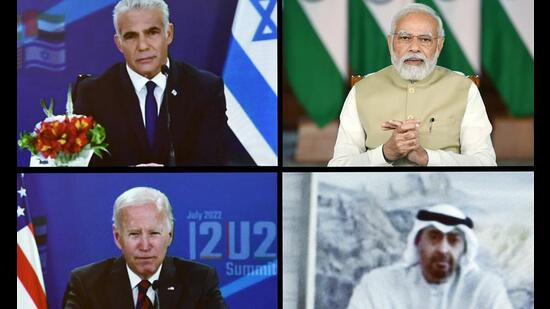
India would want cooperation and accommodation if Tehran does not breach New Delhi’s political and nuclear redlines. Until Iran crosses those red lines, the I-word will be salient yet silent for I2U2
India’s participation in I2U2 — the grouping of India, Israel, the United States (US), and United Arab Emirates (UAE) — has sparked frenzied speculation in some circles. Some insist the group is not a West Asia Quad, ruling out any security cooperation, and say India should remain careful that the shared threat perception of the remaining three partners vis-à-vis Iran does not upset New Delhi’s healthy ties with Tehran.
Some of India’s reasons to be in I2U2 are obvious. To be on the geopolitical high table of West Asia — a region where it has enormous trade, energy, and diaspora interests — is an apparent reason. China’s penetration of the region is another. Emerging maritime cooperation, including Israel’s and the UAE’s recon capabilities around the Gulf of Eden, is still another. (ANI/ PIB)
Prime Minister Narendra Modi’s remarks on a “positive agenda” with six focus areas underscores that I2U2 is not a threat-driven alliance. Nonetheless, akin to the Indo-Pacific Quad, which has one eye on non-security cooperation and the other on brewing maritime challenges, the I2U2 has one eye on the collective potential for trade and technology while the other on the altering geopolitical landscape of West Asia. Despite India’s reluctance to give any anti-Iran connotation to I2U2 for now, Tehran’s tilt toward Beijing, its nuclear programme, and practical cooperation with New Delhi will determine the extent of I2U2’s strategic orientation.
Threat-based alliances have a binding strategic glue. Even if the C-word rarely features in the official pronouncements of Quad, shared perceptions of Chinese threats bind the members. And despite the absence of the I-word, Iran very much remains the strategic glue of I2U2.
In a world where West Asia becomes a low-priority theatre for the US, two revisionist, unpredictable players harbour ambitions of disrupting the existing order: Turkey and Iran. Under President Recep Tayyip Erdogan, Turkey has made its regional ambitions evident. Nonetheless, Turkey’s dwindling economic might, Erdogan’s waning domestic popularity, and pushback from regional players have forced a recoil on his regional aspirations. The absence of a nuclear programme makes the Turkish challenge less imminent.
In Iran, one finds a fervid impulse of hegemonic ambition fuelled by sectarian ideology. With steady oil revenues to bankroll its aspirations and an unrelenting nuclear programme, Tehran is a formidable challenger. It is natural for Israel, Saudi Arabia, the UAE, Egypt, and others in West Asia, to get jittery about the possibility of a nuclear Iran. Beijing’s embrace of Tehran compounds this wariness.
Some of India’s reasons to be in I2U2 are obvious. To be on the geopolitical high table of West Asia — a region where it has enormous trade, energy, and diaspora interests — is an apparent reason. China’s penetration of the region is another. Emerging maritime cooperation, including Israel’s and the UAE’s recon capabilities around the Gulf of Eden, is still another.
Nonetheless, a strong, nuclear, and unpredictable Iran is of equal concern to New Delhi. India has witnessed its power asymmetry truncated with Pakistan due to Islamabad’s nuclear capabilities. Even if Iran is not a contiguous neighbour, with another nuke-wielding power in its extended neighbourhood upsets the current balance. Moreover, Iran’s prioritising religion in its foreign policy has created friction with India in the past.
Additionally, Tehran and New Delhi’s increasing proximity to two rivals — Beijing and Washington respectively — can potentially put them in each other’s crosshairs. In the past, Washington was able to lobby New Delhi to vote against Iran at the International Atomic Energy Agency and prevent New Delhi from buying Iranian oil. Going ahead, China can theoretically extract similar concessions from Tehran.
However, presently, I2U2 will remain silent on Iran, partly due to India’s insistence. Iran stands at a crossroads where multiple geopolitical frames overlap. Both stand to gain from cooperating for now. First, in the extended neighbourhood, New Delhi shares Tehran’s suspicion of Pakistan and the Taliban. Counterterrorism remains the key area of cooperation. Second, Russia forges convergence, even if India does not share the anti-West sentiment of the other two countries. The recent use of the north-south corridor via Iran to export Russian goods to India is an example of the current level of bonhomie.
Everyone in the region is attempting modus vivendi — the US through the Joint Comprehensive Plan of Action, and the Emiratis and Saudis through direct conversation with Iran— except Israel. India would want cooperation and accommodation if Tehran does not breach New Delhi’s political and nuclear redlines. Until Iran crosses those red lines, the I-word will be salient yet silent for I2U2.
Chirayu Thakkar is a doctoral candidate with the National University of Singapore

 E-Paper