
 E-Paper



PKL's success has not been without some major challenges
Pro Kabaddi League commissioner Anupam Goswami believes big bucks are reflective of PKL's growing currency among stakeholders

 Prefer HTon Google


About a month and a half back, when Pro Kabaddi League (PKL) player auctions threw up a bunch of crore-plus stars, it invariably turned a corner in the rustic sport. The league — the second most watched sports league in India after the Indian Premier League (IPL) — had expanded to 12 teams five years back, and the willingness of franchises to break the bank was another endorsement of its sustenance.
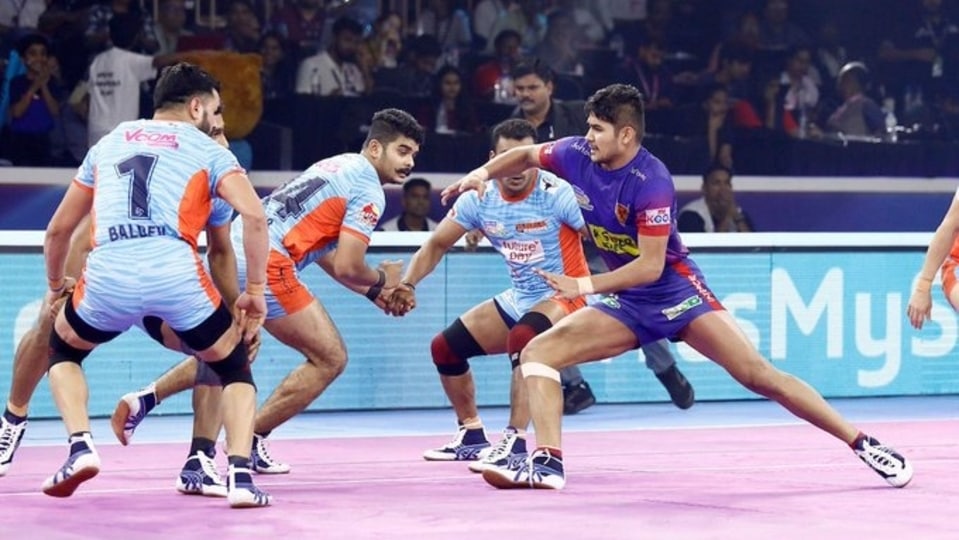
Raider Pawan Sehrawat drawing a league record ₹2.26 cr may be a pittance compared to the million-dollar IPL signings, but considering the most expensive player in the league's inaugural edition (2014) had gone for ₹12.80 lakh, Sehrawat's contract is a quantum leap for PKL.
League commissioner Anupam Goswami believes big bucks are reflective of PKL's growing currency among stakeholders. "It is an index of good governance. It tells us that the league is working well for players, and is building aspirations and careers. For any sport to grow, the compensation to the player has to grow," Goswami, who is also the CEO of Mashal Sports that owns the league, said.
Still, the player purse is only the veritable end of the winding process that builds a sporting enterprise. Barring IPL, only PKL and Indian Super League (ISL) look primed for a tenth season. Leagues in tennis, wrestling, hockey, and boxing have faded away, but that has been of presumably little deterrence. Just last month, the indigenous sport of Kho Kho got its own league, the planning of which was in the works for at least two years.
While most such initiatives begin with a bang, they struggle for longevity. Goswami calls the critical five-year mark an "inflection point" that every league goes through. For PKL, it arrived in 2016 when its expansion was finalised.
"It was a tough call. It had its own challenges, but we went ahead and became a 12-team league from an eight-team league. For an Indian league to have expanded so quickly and get the kind of investors we did shows the value of the proposition,” he said.
Another contributing factor has been PKL’s investment in youth. League’s own talent hunt scheme – New Young Players Programme – that began in 2017, has started to show results. In the last two seasons, league’s MVPs had come through this talent hunt.
“It has been a big boost in terms of talent availability, finding the second generation of talent, and controlling costs. Such a programme is a first for a federation-run sport outside cricket or football,” Goswami explained.
“We audition around 4000 players and after skill upgradation and conditioning, about 60-70 are inducted into the league. It has infused great confidence in franchises to start their own academy programmes. Puneri Paltans have a whole new generation of youngsters who have either come through this or from their own academy structure. UP Yoddha also have a very strong academy programme,” added Goswami, who foresees at least two more franchises coming up with their academies this season.
The challenge for the league going into the ninth season is to maintain engagement, a tall order considering how little the national team plays internationally. Rarer still are its appearance on television.
“For sports leagues to grow in India, the respective sports must do well internationally,” Goswami opined. “Despite our loss in the last Asian Games, we are a very strong kabaddi nation, but people don’t get to watch the players.
“The best way to tackle this challenge is product differentiation and renewing fan engagement. There are two very strong pillars on which a league rests — it has to offer the best competition in this globalised sports world, and the league’s governance must be on point.”
While PKL takes pride in comparing itself to the IPL, the national federation is nowhere as organised as BCCI that conducts over 1000 domestic matches each calendar year. By contrast, kabaddi nationals are an exercise in obscurity.
Goswami believes there’s a definite scope for bilateral and trilateral events, besides starting a few more national-level tournaments to unlock fresh talent.
“Before Covid came into play, there was a mushrooming of a lot of regional kabaddi. East African Kabaddi Championships were conducted in 2017 and 2019. The East Asian Kabaddi Championships were held in Taipei in 2019. Kabaddi was being taken to some East Asian martial arts or contact sports championships. There was a regular Asian Kabaddi Championships for senior men and women and boys and girls. So, some kind of momentum was building. As things stand now, there has to be some reconstruction,” he said.
The ninth season of PKL, beginning October 7, will be played across Bengaluru, Pune, and Hyderabad.


