
Sign in

Archeologists in Peru find remains of 227 sacrificed children

Archeologists have been digging since last year at the huge sacrificial site in Huanchaco, a beachside tourist town north of the capital Lima.

Updated on: Aug 28, 2019, 12:56:22 IST
Lima | By
Share
Share via
  • facebook
  • twitter
  • linkedin
Copy link
  • copy link

Archeologists in Peru say the 227 bodies they have unearthed from a site used by the pre-Columbian Chimu culture is the biggest-ever discovery of sacrificed children.
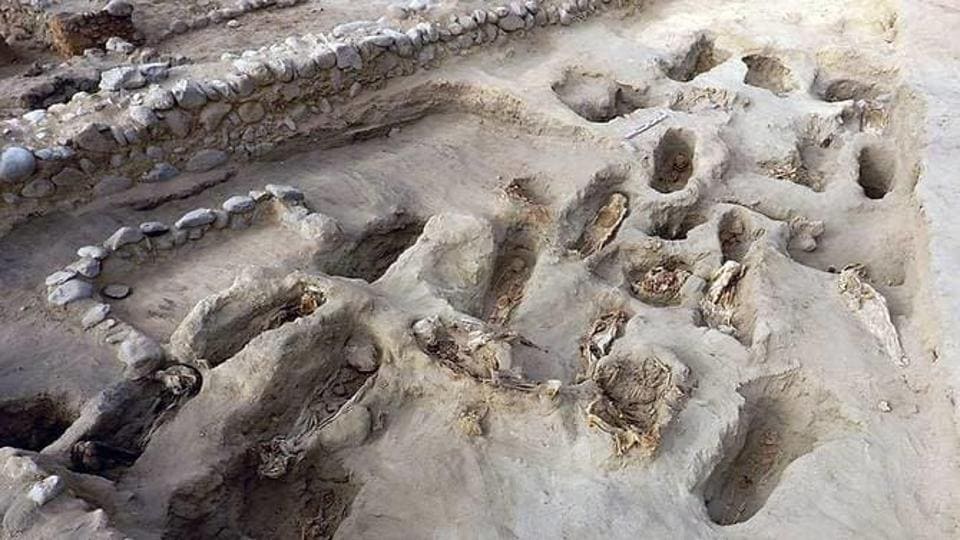
The children who were aged between four and 14, were sacrificed in a ritual to honor the Chimu culture’s gods. (Kashf Rana Twitter)

Archeologists have been digging since last year at the huge sacrificial site in Huanchaco, a beachside tourist town north of the capital Lima.

“This is the biggest site where the remains of sacrificed children have been found,” chief archeologist Feren Castillo told AFP on Tuesday.

Castillo said the children, who were aged between four and 14, were sacrificed in a ritual to honor the Chimu culture’s gods.

“They were sacrificed to appease the El Nino phenomenon,” and show signs of being killed during wet weather, he said.

He added that there may still be more to be found.

“It’s uncontrollable, this thing with the children. Wherever you dig, there’s another one,” Castillo said.

The children’s remains were found in a position facing the sea. Some still had skin and hair.

Huanchaco was a site where many child sacrifices took place during the time of the Chimu culture, whose apogee was between 1200 and 1400.

Archeologists first found children’s bodies at the dig site in the town’s Pampa la Cruz neighbourhood in June 2018, unearthing 56 skeletons.

Pampa la Cruz is a short distance from Huanchaquito, where the remains of 140 sacrificed children and 200 llamas were found in April 2018.

The Chimu civilization extended along the Peruvian coast to Ecuador but disappeared in 1475 after it was conquered by the Inca empire.

(The story has been published from a wire feed without any modifications to the text, only the headline has been changed.)

  • HT News Desk
    ABOUT THE AUTHOR
    HT News Desk

    Follow the latest breaking news, major developments and agenda-setting stories from India and around the world with the newsdesk at Hindustan Times. Operating round the clock, the desk brings together experienced editors, reporters and correspondents to deliver fast, accurate and contextual reporting across subjects that influence public policy, governance, business, society and international affairs. The HT News Desk covers politics, elections, government policies, the economy, business and markets, science and technology, the environment, law and order, infrastructure, education, climate issues and geopolitics, while closely tracking developments across states, institutions and global capitals. The team also leads coverage of major breaking news events, policy announcements, court proceedings, natural disasters, public emergencies and significant international developments. Reports published by the newsdesk are based on information gathered from reporters on the ground, official statements, government agencies, court records, regulatory filings, recognised institutions and other authoritative sources. Stories undergo editorial scrutiny and verification processes to ensure accuracy, fairness and relevance, and are updated as events evolve and additional information becomes available. Whether covering a key political decision in New Delhi, an economic policy shift affecting millions, a landmark court ruling or a major global event, the HT News Desk aims to provide readers with reliable, fact-based journalism that delivers not only the latest developments but also the context and analysis needed to understand their wider implications.Read More